Category: Employee Experience

  • Top 3 Skills For Finance Leaders In A Post Pandemic World

    Top 3 Skills For Finance Leaders In A Post Pandemic World

    The COVID-19 pandemic has set in motion numerous new changes and challenges in how businesses and organizations operate. This includes an increase in flexible and remote work arrangement for workers, a higher emphasis on employee well-being, and greater importance on technology and data to name a few. Finance leaders today will need to navigate and overcome a new set of challenges in a “post-pandemic” world.

    Adriell Ong, our recruitment expert in Accounting & Finance Sector at Cornerstone Global Partners Singapore, shares the top 3 skills for finance leaders required to help them and their organization succeed in a post-pandemic world.​

    Business Collaboration

    The pandemic has put an even greater emphasis on Finance Leaders to work even closer with the business stakeholders within an organization as the economic and business landscape is evolving at a faster pace with greater volatility.

    Finance Leaders will need to be more adept in stakeholder management, and to understand the greater business as finance teams will be increasingly relied on for their insights to make strategic decisions. Finance Leaders will work closer with Information Technology to drive digitalization and create a more data-driven organization, and Human Resources on employee development and retention matters.

    People Management

    With more finance teams working and communicating remotely, issues such as lack of clarity in communications, employee isolation, and diminishing work performances may occur in finance teams.

    In addition, the changing hiring landscape for finance professionals also meant that putting a lot of emphasis on talent retention. Thus, it is important that Finance Leaders recognize the issue and put in place plans to ensure higher work efficiency. Finance Leaders will need to emphasize on stronger relationships with their team, building stronger connections and making an effort to recognize their contributions.

    Browse Accounting & Finance Jobs »​

    Technological Aptitude

    In the last couple of years, there has been a major push towards digitalization within finance teams, with a greater emphasis on data analytics and automation. This process has certainly accelerated by the pandemic with more frequent strategic planning and updates in businesses due to the uncertainty. Finance Leaders today will need to possess a stronger understanding of new technologies to meet new business demands, increasing agility in forecasting and enhancing efficiencies.

    The role of a Finance Leader has changed significantly over the years from a bookkeeper to a strategic advisor. The challenges poised in a post-pandemic world will further evolve a Finance Leader’s role and increase their importance to any organization.

    If you wish to discuss more insights on Accountancy & Finance, get in touch with Adriell Ong at adriell.ong@cornerstoneglobalpartners.com

    ​ALSO READ

  • How To Conduct A Performance Review?

    How To Conduct A Performance Review?

    Employee performance is something your organisation values immensely – and befittingly so. You cannot expect productivity, profitability, and success to knock at your organisation’s door if you don’t have a superlative employee performance review strategy. However, simply caring about your employees’ performance won’t justify your efforts in running your business. This is where employee performance review enters the picture.

    While conducting employee performance reviews provides an opportunity for managers to assess an employee’s performance, identify areas for improvement, and set future goals, these reviews can be difficult to conduct effectively. Doing poorly can lead to resentment, decreased productivity, and even turnover.

    This blog entails the right ways to conduct a performance review. So stay glued to the post for everything you’ve ever wanted to learn about employee evaluation. By following the tips in this blog post, you can conduct performance reviews that help your employees reach their full potential.

    Conducting a Performance Review: How to Make it Successful?

    The Basics

    The temptation to give your employees feedback in one go or just before a review might lead you in the wrong direction. Instead, plan and identify the best time of the year to conduct performance reviews.

    Look for particular processes or schedules that your organisation needs to follow.

    Additionally, consider the budgeting process to determine the right time to hand out bonuses. Finally, make sure to have ample time to dedicate to this activity without hampering the business functions.

    Decide & unveil the employee evaluation process and communicate the same to your employees.

    Let us now proceed toward learning the aspects that can help organisations conduct good performance reviews.

    #1. Set goals & expectations

    The best way to set goals and expectations is to meet with your employees at the beginning of the year and share your vision & mission. This can be followed by meeting the employees one-to-one to set their performance goals.

    Use the SMART rule to map them out.

    S– Specific

    M– Measurable

    A– Achievable

    R– Result-oriented

    T– Time-bound

    #2. Give feedback to employees all throughout the year

    Hold touch-base meetings throughout the year so that the final review in the annual meeting does not come as a surprise to the employees. Therefore, pre-schedule these meetings and plan to conduct them on time.

    Before every meeting, prepare an agenda and discuss the expectations and questions. Post these meetings, and prepare notes for yourself that will serve as a reference for you in the future and help you prepare well for the annual meeting.

    ALSO READ: The Employee Productivity-Happiness Loop: How One Influences the Other

    #3. Ask employees to stay prepared

    Employees’ preparation must begin months before the actual reviews. Simply put, ask them to compile their annual performance results. This will give you a recap of their job responsibilities, current project work, and achievements. You can also ask them to evaluate themselves, which will give them an honest review of their performance.

    #4. Prepare yourself

    Spend at least two months before the final review compiling your notes and results for each employee. Then, collect employee performance references, such as sales reports, project deliveries, and call records. Besides, you can also gather qualitative data like client feedback. The exercise will give you an insight into the deviations between your expectations and employees’ performance, if any. Subsequently, you can move to your next plan of action.

    #5. Hold the meeting

    This is the most challenging part of the process. Ensure the meeting is a two-way conversation rather than making it seem like a lecture to your team members. Employees must stand a fair chance to share their strengths, challenges they have overcome, and areas of improvement.

    #6. Shift toward the future

    Discussing failures and areas of improvement is pertinent to conducting a successful performance review. However, once discussed in detail, you must redirect your focus to the future. Share new goals and your plan to make the employee succeed at work. This will make them feel more valued and ready to step out of their comfort zone to improve their performance.

    ALSO READ: The Connection Between Employee Recognition and Retention

    Summing Up

    Although the employee evaluation process is never fun, it is crucial for increasing employee engagement & improving performance. Great leaders know how to make performance reviews fruitful for the organisation. They know how to make their people feel valued, appreciated, and understood. They put people first and focus on improving performance to see the best employee performance review results.

    Summing up, here are some of the key elements of an effective performance review:

    • Be specific and objective. Avoid making general statements or using subjective language. Instead, focus on specific examples of the employee’s performance.

    • Be constructive and actionable. A performance review aims to help the employee improve their performance. Therefore, your feedback should be constructive and actionable.

    • Be timely. Don’t wait until the end of the year to give feedback. Provide feedback on a regular basis so that the employee has time to make improvements.

    • Be confidential. The performance review should be a confidential conversation between the manager and the employee. Avoid discussing the review with other employees or managers.

    Contact Cornerstone Global Partners (CGP) Singapore to hire stellar employees that can contribute to your company’s success. After all, your organisation deserves to have start candidates on board.

    Catch up on valuable information in case you missed it the first time. Click on the link here:

    Reduce Risk & Identify S.T.A.R Candidates Using Behavioural-Based Interview (BBI) Techniques

    FAQs

    1. How do you conduct a good performance review?

    To conduct a good performance review, there are a few tips managers must follow that are listed as follows:

    • Prepare ahead of time

    • Make the right choice of words and ask the right questions

    • Be a good listener

    • Provide concrete examples of exemplary achievements and areas of improvements

    • Evaluate your employees’ progress

    • Conclude the process with a final review and discuss everything with the employee

    • Make performance reviews a regular exercise

    2. What are the four stages involved when conducting a performance review?

    The four stages of conducting a performance review are:

    • Planning goals

    • Monitoring performance

    • Reviewing results

    • Rewarding success

    3. What are the key benefits of conducting effective performance reviews?

    Some of the common benefits for an organisation to conduct performance reviews include:

    • Improved employee performance

    • Increased employee satisfaction

    • Reduced turnover

    • Clearer communication between managers and employees

    • A more productive workplace

  • The Ultimate List Of Remote Work Tools And Resources

    The Ultimate List Of Remote Work Tools And Resources

    “People are more productive working at home than people would have expected. Some people thought that everything was just going to fall apart, and it hasn’t.”  –  Mark Zuckerberg

    While everyone might not agree with Mark Zuckerberg, he has a valid point. For years, business leaders have been doubtful about the success of remote work. However, the secret lies in effectively managing and enhancing employee productivity and experience. We aim to emphasise the availability of tools & resources for remote workers and how they help in remote team management.

    Today, there are a plethora of tools and resources available for remote workers who work in different time zones. They collaborate with colleagues from different parts of the world and need to stay connected, thus making remote work more efficient, productive, and enjoyable.

    Various communication and project management tools, as well as time-tracking and file-sharing platforms, are available to remote workers.

    This comprehensive list will cover some of the top tools and resources for remote workers, providing a one-stop-shop for anyone looking to improve their remote work experience. Whether you’re a seasoned remote worker or just starting out, this ultimate list will have something for everyone.

    #1. Trello

    Manage Team's Projects From Anywhere

    Manage Team’s Projects From Anywhere

    Trello is a collaboration tool that organizes your projects into boards. In one glance, it tells you what’s being worked on, who’s working on what, and where something is in process.

    It brings your tasks, teammates, and tools together. A project management tool loaded with powerful features, Trello is the corporate world’s favourite.

    • The ‘Views’ feature lets the users see projects from every angle with Board, Timeline, Table, Calendar, Dashboard, Map, and Workspace views.

    • The ‘Automation’ feature allows users to automate the workflow with Butler.

    • The ‘Power-Ups’ feature powers teams by linking their favourite tools with Trello plugins.

    • ‘Templates’ give a blueprint for success with easy-to-use templates.

    • ‘Integrations’ to find the apps team is already using or discover new ways to get work done.

    #2. Slack

    Bring team communication and collaboration into one place

    Slack keeps everyone connected with a user-friendly interface. Having all your people, tools, and communication in one place enables the team to work faster.

    It is the productivity platform that empowers everyone with no-code automation and AI, makes search and knowledge sharing seamless, and keeps teams connected and engaged

    • ‘Channels’ let users stay organised and focused with central spaces for communication, files, and tools.

    • ‘Slack Connect’ provides collaboration with teams at other companies.

    • ‘Messaging’ makes way for efficient and organised team chat.

    • ‘Accessibility’ boasts keyboard accessibility, animation preferences, and visual controls.

    ALSO READ: Remote Workforce Essentials: Perks and Benefits That Promote Work-Life Balance

    #3. Zoom

    Get more done in a frictionless video environment

    Zoom is a video conferencing tool with a touch of the in-person experience. Being a unified communication and collaboration platform, it allows users to hold virtual meetings and team chats.

    Among different product categories, Zoom offers unique features under them.

    • Zoom One – It brings together options for team chat, phone, whiteboard, meetings, and more into a single solution to help deliver frictionless communication and collaboration experiences.

    • Zoom Rooms – It is a software-based room system that provides an integrated experience for audio conferencing, wireless screen sharing, and video conferencing.

    • Zoom Events – It is a versatile platform that allows you to create a variety of engaging virtual experiences for attendees will love. You can manage your own branded event hub, track ticketing and registration, control user access from one dashboard, and allow networking during your Zoom Events.

    #4. Dropbox

    Backup your most essential files to the cloud

    Dropbox is a reliable and secure cloud-based file hosting service for storing and sharing the most important files. With Dropbox, you can do more than just store files.

    • ‘Backup’ automatically backs up important files on the devices and restores them.

    • ‘Dropbox Sign’ helps users prepare, send, sign, and track agreements with legally-binding eSignatures.

    • ‘DocSend’ securely sends important documents and gets real-time analytics.

    • ‘Capture’ creates screen recordings and video messages.

    • ‘Dropbox Shop’ provides advanced access to the newest product experiences.

    #5. Asana

    Enable teams to work together effortlessly

    Asana is the go-to resource for remote workers. It comes as a comprehensive toolkit with a solution for the unique needs of different organisations. The tool can be used as a lightweight CRM for project management, campaign management, creative production, request tracking, agile management, and more.

    With Asana, teams are more confident, move faster, and accomplish more with less—no matter where they’re located.

    • ‘Workflow Builder’ creates automated processes to coordinate your teams.

    • ‘Timeline’ builds a beautiful Gantt chart quickly.

    • ‘Boards’ allow users to see and track the work.

    • ‘Calendar’ allows teams to plan, manage, and visualise their work in a shared team calendar.

    • ‘Reporting’ to get real-time insight into progress on any work stream.

    • ‘Automation’ streamlines processes and reduces errors.

    • ‘Workload’ checks how much work team members have across projects.

    Trello Vs. Asana: Trello is focused on Kanban boards, whereas Asana offers multiple project views such as timelines, calendars, and workflows.​

    #6. Hubstaff

    Manage remote workforce efficiently

    Hubstaff is a time-tracking and productivity-monitoring tool that automates many aspects of running a growing business. At its core, Hubstaff helps teams track time in easy, automated ways that produce more accurate, detailed timesheets.

    In addition, it offers one-of-a-kind features under different categories that benefit employers and employees, which include:

    • Time tracking
    • Employee monitoring
    • Workforce analytics
    • Agile project management

    #7. Blueboard

    Reward your employees with fun, memorable experiences

    Blueboard is a unique employee reward and recognition platform to show employees how much they matter. Organisations can recognise and reward their employees for different moments in different forms, such as:

    • Anniversary awards

    • Sales incentives

    • Spot recognition

    • Referral incentives

    • Company values awards

    • Wellbeing gifts

    • President’s Club

    • Onboarding gifts

    Blueboard offers organisations a 360-degree view into complete rewards lifecycle – from reward delivery, to scheduling, to completion.

    RELATED READ: The Connection Between Employee Recognition and Retention

    Final Comments

    Businesses today are adopting remote trends and hiring talent across the globe. But, without any doubt, the biggest challenge is to nurture, guide, and support team members.

    Having appropriate resources for remote work is crucial to support remote employees in their day-to-day work, facilitating effective communication and collaboration, boosting productivity, and promoting overall well-being. Employers should ensure that remote workers have access to the necessary resources to perform their job effectively and thrive in a remote work environment.

    It might become a tough gig to manage remote workers, but the tools mentioned above and resources are certainly there to assist your business.

    Hire the talent that matters to you!

    Besides the remote team management tools and resources, hiring the right talent impacts the results. Therefore, ensure to hire the top talent for your organisation by partnering with the most reliable team of recruitment experts. Want to know about the sectors we serve? Visit us here:

    Our Expertise

    Cornerstone Global Partners (CGP) Singapore provides the best recruitment solutions. Access a rich network of contacts and expert information on Singapore and Southeast Asian job markets.

    FAQs

    1. What resources are needed to work remotely?

    Remote work is a hot issue, and many companies have wholly adopted remote work. To make remote work easy, the team can use a few resources.

    Resources like Zoom and MS Teams are ideal for video conferencing. Chat applications such as Slack, Google Hangouts, and Workplace by Facebook have eased communication.

    Google Drive, Dropbox, Microsoft OneDrive, and Media Fire are highly suitable for file storage.

    2. Why do you need resources for remote Work?

    Resources for remote work are essential for several reasons:

    • Access to information and tools – allowing remote workers to effectively carry out their tasks and stay connected with their team.

    • Productivity and efficiency – Having the right resources can enhance productivity and efficiency in remote work environments.

    • Communication and collaboration – Helping to maintain effective teamwork and achieve project goals.

    • Training and development – Providing remote employees with opportunities for learning and development, which can contribute to their career advancement and success in remote work roles.

    • Well-being and work-life balance – Helping remote workers maintain their physical and mental well-being, manage stress, and achieve a healthy work-life balance.

  • The Employee Productivity-Happiness Loop: How One Influences The Other

    The Employee Productivity-Happiness Loop: How One Influences The Other

    ​Employee happiness has increasingly become an imperative in business. Forbes published certain statistics that revealed happy employees are as much as 20% more productive in the workplace than unhappy employees.

    Indeed, employees’ happiness is the key to unlocking productivity and letting it spread across the organisation. Promoting workplace happiness benefits organisations in several ways, including:

    • Higher creativity levels

    • More energetic individuals

    • Better output

    • Reduced burnout

    • Increased employee retention rates

    The happy attitude of the employees can turn your average profit-making organisation into a highly profitable venture. The reason is the link between employee happiness and productivity, which translates into better work and customer service.

    No magic trick is involved; let’s explore how employee productivity is directly proportional to the employees’ happiness level.​

    How does employee happiness impact productivity?

    Employee happiness brings significant transformation in the organisational setup and boosts productivity levels. Here is how happy employees are more productive and the benefits they bring to the company.

    #1. Happy employees foster meaningful relationships

    Meaningful relationships boost employee engagement by over 50%. When employees are happy, they are generally more engaged and motivated in their work, which can lead to improved performance and productivity. Additionally, when employees have positive relationships with their colleagues, they are more likely to feel supported and valued in their work, which can help to create a more positive and collaborative work environment. Therefore, organisations see higher productivity levels among their employees.

    Building meaningful relationships in the workplace can also help to foster a sense of community and belonging, which can be particularly important for remote or distributed teams who may not have the opportunity to interact in person on a regular basis. By creating opportunities for employees to connect with one another and form meaningful relationships, organizations can help to promote a more positive and supportive workplace culture.​

    #2. Happy employees are quite creative

    Certainly, No modern business can run smoothly without creative people!

    A clearer headspace lets employees generate innovative ideas and utilise them for organisational benefits. Research has shown that happy employees are more likely to engage in creative problem-solving and innovative thinking. For example, a study published in the Journal of Organizational Behavior found that employees who reported higher levels of happiness and well-being were more likely to engage in creative problem-solving at work.

    Additionally, they can confidently share their point of view and bring their best version to the workplace. And when their creativity is at its best, employee productivity will never cease to grow.

    Overall, employee happiness fosters a positive work environment that supports employee happiness and well-being. By doing so, organizations can help to promote greater creativity and innovation, which can be critical for success in today’s rapidly changing and competitive business landscape.​

    #3. Happy employees attract new talent

    Happy employees can be a valuable asset for organizations looking to attract new talent in several ways:

    • Positive Word-of-Mouth: When employees are happy and satisfied with their work, they are more likely to speak positively about their experiences to others, including potential new hires.
    • Referrals: Happy employees may be more likely to refer friends, family, or colleagues to open positions within the organization. Referrals can be a highly effective way to find new talent, as candidates who are referred by current employees are often more likely to be a good fit for the organization’s culture and values.
    • Employer Branding: Happy employees can also be an important part of an organization’s employer branding efforts. By highlighting the positive experiences of current employees through social media, marketing campaigns, and other channels, organizations can help to create a strong and attractive employer brand that can help to attract top talent.
    • Reduced Turnover: When employees are happy and satisfied with their work, they are less likely to leave the organization. This can help to reduce turnover and the associated costs of recruiting and training new employees, which can be attractive to potential new hires who are looking for a stable and supportive work environment.

    By investing in employee happiness, organizations can build a strong employer brand and reputation that can help to attract new talent and support long-term success.​

    #4. Happy employees are more engaged

    Engagement and happiness go hand in hand. Simply put, happier employees are more engaged and passionate toward their work. They strive to excel at everything they do, which converts into higher ownership of their growth. As a result, employers drive benefits from engaged employees who bring energy to their jobs.

    Research has shown that happy employees are more likely to be engaged in their work. For example, a study published in the Harvard Business Review found that employees who reported higher levels of happiness were more likely to be engaged in their jobs, as well as more likely to be productive and satisfied with their work.

    There are several reasons why happy employees may be more engaged. They are:

    • Generally more motivated and enthusiastic about their work.
    • More likely to feel a sense of connection and purpose in their work.
    • Likely to be highly engaged and productive, which can contribute to greater job satisfaction and overall well-being.

    #5. Happy employees possess more vital interpersonal skills

    Employers, co-workers, and customers find interaction with happy employees pleasant. Moreover, interpersonal skills help to facilitate effective communication and collaboration in the workplace where happy employees are:

    • More likely to be empathetic towards their colleagues and coworkers
    • Likely to be effective communicators
    • Better able to manage their own emotions and reactions
    • Efficient at resolving conflicts

    By investing in employee happiness and well-being, organizations can help to build a strong and cohesive team that is better able to achieve its goals and succeed over the long term. Motivated employees fuel the employers’ vested interest in the organisation’s financial growth with their productive work.​

    #6. Happy employees are healthier

    An employee’s physical health impacts organisational success. Visibly, happier employees bask in the glory of good health and deliver their best. They have positive attitudes and a sense of purpose in their work, which can contribute to greater overall life satisfaction and well-being. This, in turn, can have a positive impact on physical health.

    The motive behind present-day organisations prioritising their workforce’s mental and physical health is to increase productivity. Ultimately, with increasing productivity come better results for the company.​

    Tips for Building Happiness Among Your Team

    Building happiness among your team can be a challenging task, but it is also an essential one if you want to create a positive and productive work environment. Here are some key tips for building happiness among your team:

    1. Promote work-life balance – Employees deserve the opportunity to spend quality time with their family & friends. This will reduce burnout and absenteeism from work for general well-being reasons.

    2. Invest in employees’ professional growth – A company that invests in its employees’ professional growth is more likely to retain workers. You can offer them online courses to help them upgrade their skills and grow within the company.

    3. Develop an inclusive workplace – Work toward DEI (diversity, equality, and inclusion) goals by employing people from different cultures, creeds, and religions. On top of that, it must also include the prevention of discrimination based on physical abilities.

    4. Offer remote and hybrid working – A remote or hybrid working arrangement creates a better work-life balance. If you can offer your employees the freedom to work remotely and come to the office on pre-determined days, they will stick longer. But plan before you choose the suitable model.

    5. Recognise & celebrate their success – You must recognise and celebrate your team’s efforts instantly and without delay till the annual event. For instance, managers can thank their team members by gifting them goodies or taking them for a team lunch.

    6. Provide non-monetary benefits – Consider providing non-monetary benefits such as one-on-one lunch with team members or extra leave. While you can offer numerous non-monetary rewards to your employees, choose them wisely to suit your corporate setup.

    In summary

    Are your employees happy? Are you satisfied with the way your organisation is progressing toward its goals?

    Consider the options and implement the righteous strategies to infuse more happiness into your organisation. The current trends reveal workers turning down higher-paying jobs for more fulfilling ones. And this is what every company needs to identify and address wisely.

    Considering the path to employee happiness to be a straight line can downturn your functions. However, creating a unique employee happiness and wellness plan can make a difference. As the word spreads, more people will want to work with you.

    FAQs

    1. Why is employee happiness important?

    Happy employees always bring better output because of increased productivity. In other words, employee productivity is directly proportional to how happy the employees are in the organisation. A company that values its employees’ happiness gets employee loyalty in return and, thus, better customer service. A happy workforce exhibits:

    • Higher productivity levels

    • Reduced burnout

    • Less absenteeism

    • Enhanced creativity levels

    2. What factors contribute to employee happiness in the workplace?

    Factors that contribute to employee happiness in the workplace are:

    • Meaningful work

    • Employee empowerment

    • Feedback, recognition, and growth

    • Coworker relationships

    • Organisational trust

    • Work-life balance

  • Why Employee Upskilling Is Essential During Economic Uncertainty?

    Why Employee Upskilling Is Essential During Economic Uncertainty?

    The year 2023 started with economic uncertainty looming worldwide and is gradually becoming a real problem for organisations. Consequently, businesses may consider cost-cutting and slashing their workforce. There’s a lot of uncertainty, but organisations can pull down storm shutters to combat the unpredictable times ahead.

    Now, the question is how?

    LinkedIn Global Talent Trends, October 2022, reveals the importance of opportunities for upskilling and career development and how people place them on their top priorities.

    Additionally,  the World Economic Forum’s Future of Jobs Reports states that because of the growing uptake of technology and automation, half of the workforce will need reskilling by 2025.

    In this blog, we will help you understand how employee upskilling focusing on relevant knowledge and skillsets to reduce the skill gap can help you improve work efficiency and innovation rate, thus nullifying the effects of current market uncertainty.

    Reasons to Upskill Employees

    #1. Boosts Motivation & Morale

    Imagine having two different teams. While team A comprises continuous learners, team B has people who don’t learn much and perform only what’s required.

    Which team would be motivated and committed to producing the best output? Without any doubt, it would be team A.

    Unarguably, if your employees come across a lack of learning opportunities, their work will start becoming burdensome. But, on the flip side, employee upskilling always brings job satisfaction among employees. Sending your team for upskilling courses shows your commitment to their professional development, increasing motivation at work, increasing productivity, reducing attrition rates, and improving job satisfaction. As a result, there arises no point in disagreeing on the benefits of having an invested and engaged team to fight economic instability.​

    #2. Saves on Recruitment Costs

    Organisations that train existing employees are said to have better talent retention rates and save the cost of replacement hiring. Of course, every time an employee leaves, it brings a financial burden, and things worsen during economically uncertain times. Nonetheless, upskilling your existing employees is a much more cost-effective way to hire and train replacements, especially when the economy is unsettled.

    Employee upskilling makes the organisation more agile and responsive to changing times without disrupting the organisation’s social capital.​

    #3. Prepares a Well-prepared Team for the Future 

    Employee upskilling helps team members develop varied skills and abilities. On top of that, it makes them prepared for the changes that lie ahead in the market. Once you identify the benefits of skill programs, there will be no looking back. Your employees will get proof that their career development matters to you.

    When the economy suffers turbulence, your organisation can fill in the gaps without new hires. In other words, upskilling your team will help you have your existing team drive toward goals by playing more than one organisational role. Thus, saving the company from the odds of economic uncertainty.​

    #4. Helps Workers See the Bigger Picture

    In the wake of economic uncertainty, millions of organisations like yours have understood the importance of upskilling. Straight from the shoulder, employee upskilling not only focuses on a promotion or a salary increase but also embraces other crucial factors. While an efficient upskilling program can boost employees’ confidence at work, it also improves their quality of life.

    Career advancement leads to better work-life balance and instills a sense of purpose while making work more interesting. Moreover, modern-day organisations also could nurture better employee experience and create a healthy workplace. Therefore, you can always maintain the best levels of talent retention even during uncertain times by making them reflect on what they might gain.​

    #5. Perseveres Relationships and Teamwork

    Upskilling your employees help improve collaboration and productivity. And when we mention improved teamwork and productivity, we indicate its benefits for your organisation during economically uncertain times. The fact that only some new hires can fit into the role as per your expectations, employee upskilling will keep you afloat without fail. Additionally, you can maintain the best composition of your company’s social capital.

    At this point, you have learned the benefits of employee upskilling, but we haven’t concluded. It would be considered incomplete if we didn’t discuss how to level up the benefits of upskilling. So let’s have a look.

    Get an up-to-date view of ever-changing employment landscape in Southeast Asia to optimise your recruitment strategies to retain top talent.

    Download 2023 Salary Trends Report​

    Getting Through the Uncertainty Ahead

    Leaders must adopt a transparent approach

    Leaders must see uncertainty in the economy as an opportunity to recap and make the necessary adjustments. An adaptive approach by leaders will provide more clarity to employees about the short-term goals and priorities of the organisation.

    Encourage Team Collaboration

    Nurture a work environment that promotes collaboration and knowledge sharing among employees. Nothing can overpower a strong connection of an employee with their colleagues and further strengthens company culture. You just need to know the ways to develop a high-performance team.

    Understand the skills gap

    Identify the difference between the skills your people have and the skills your company needs in the future. It will give you a better idea of designing and developing your skills program to fill the gap.​

    Leveling up: Where to Begin With Employee Upskilling?

    Upskilling could be in any form. From business courses to webinars, build learning paths with your employees customised to the skills they wish to acquire, and get insights into their progress to ensure they’re on the right track. Here we have collated some of the resources

    • SkillsFuture Series – which provides training courses across emerging skills in the four economic growth pillars – Digital, Green, Care, and Industry 4.0.

    • Udemy Business is another useful online learning platform that offers courses on technical and soft skills alike

    • At LinkedIn Learning with Lynda, where you can access business, technology, and creative courses taught by industry experts from various sectors and get course recommendations based on your employees’ unique skill sets.

    • Edx.org is another useful resource offering expert-led to build career-critical skills – ranging from executive education to professional certifications to build today’s in-demand skills.

    Final Words

    Upskilling provides benefits to both employees and organisations. Times have changed, and money is not the only factor that motivates the workforce. Currently, job seekers are looking for meaningful jobs aligned with their professional goals. In that case, organisations can offer upskilling opportunities to their people and make their job roles more purposeful.

    Our exceptional recruitment consultants at CGP Singapore’s team can help you spot suitable candidates and fill the vacant positions within your organisation.

    We pride ourselves on our personalized approach to matching top talent with the perfect job opportunity. Our team of experienced positive recruiters uses the latest technology and modern techniques to ensure a seamless and successful hiring process.

    Get in Touch

    FAQs

    How can employee upskilling help during economic uncertainty?

    Upskilling helps employees prepare for the future of work and boosts their competitiveness. Employers offering skills programs to their employees will help future-proof their organisation and sail through uncertain times due to economic reasons. Moreover, employers that invest in their people always gain their employees’ trust and loyalty.

    How can employee upskilling help with career development?

    Skill development happens over time and is a natural process. However, people who choose to upskill themselves in a planned way can get more benefits, such as

    • Fosters continuous self-improvement

    • Increases competitiveness in the market

    • Helps secure better jobs

    • Qualifies an employee for promotion

    • Assists in progressing toward goals

  • The Importance Of Continuous Learning And Professional Development

    The Importance Of Continuous Learning And Professional Development

    “Anyone who stops learning is old, whether at twenty or eighty. Anyone who keeps learning stays young.”

    The saying by Henry Ford indicates the importance of continuous learning for human existence. On top of that, it hints at the many benefits of being a life-long learner. Investing in skills and knowledge can help job seekers to stand out to potential employers and increase their chances of landing their dream jobs.

    At the same time, employers investing in continuous learning opportunities enrich their employee skills throughout their work life to keep up with the ever-changing corporate work. Therefore, whether you are an employer or job seeker, continuous learning and development are essential to:

    • Remain competitive in the market,
    • Enhance career prospects,
    • Achieve growth & business success, and
    • Advance innovation.

    Thus, it is important to prioritize learning and development throughout one’s career to ensure ongoing success and fulfillment. Let’s delve deeper into this topic.

    What is Continuous Learning?

    Continuous learning refers to undeterred and self-motivated persistence to acquire knowledge and skills. The driving force behind the term is the development of future opportunities and the expansion of skill sets. A continuous learner builds a defense against stagnation and strives to reach their full potential.

    Continuous learning can also help you stay competitive in your industry. By staying on top of industry trends and emerging technologies, you can position yourself as an expert in your field and increase your value to potential employers.

    • 50% of all employees will need reskilling by 2025, as the adoption of technology increases, according to the World Economic Forum’s Future of Jobs Report.

    • Critical thinking and problem-solving top the list of skills employers believe will grow in prominence in the next five years.

    What is Professional Development?

    Professional development includes numerous learning opportunities like academic degrees and non-formal learning opportunities. There are multiple ways to facilitate professional development, including sessions, communities of practice, technical assistance & supervision.

    A professional development program aims to make individuals more effective and efficient at their jobs, and to provide them with the skills necessary to handle new responsibilities and challenges. In an ever-changing job market, it is a lifelong process that helps individuals adapt and stay relevant.​

    Continuous Learning in the Workplace

    For Employers:

    #1. Prepare Employees for Promotions

    Continuous learning and development of an individual professionally allow employees to expand their knowledge base. As a positive outcome, they consider taking on senior positions in the organisation, which implies preventing incurring costs for new hires.

    Besides, the organisation will always have employees that help drive success by stepping up and using what they’ve learned.

    #2. Improves Employee Retention

    The corporate landscape is highly competitive, and various employee skills stay in high demand. However, finding suitable candidates at the right time isn’t as easy as it seems. An organisation that fosters go-getters and offers a good learning & development program never ceases to succeed.

    #3.Achieve Organisational Goals

    Helping your employees reach higher levels of knowledge can generate new ideas and perspectives, boost morale, and raise overall employee performance. This, in turn, make employees feel valued thus, they aim to contribute better to organisation’s goals and foster a forward-thinking innovation culture in the workplace.​

    For Employees:

    #1. Boosts Profile and Experience

    Employees that are constantly learning never face hurdles in their professional life. Additionally, they start adding skills to their profiles, which makes them irreplaceable in the organisation. And in case there arises a need to switch jobs, continuous learning allows them to adapt to the competitive market.

    #2. Uplifts Confidence

    A feeling of accomplishment is the immediate outcome of continuous learning. Employees experience a rise in confidence and self-sustenance. Also, employees feel more prepared to take on new challenges and explore new opportunities.

    #3. Prepared for the Unexpected

    Lifelong learning lets employees adapt to unexpected situations. For instance, if one is laid off from their current job, they will be ready to step out of their comfort zone and find new opportunities with new skills.

    #4. Changes Attitude

    Unceasing determination to learn and develop opens minds and changes attitudes. Universally, continuous learning is the minimum requirement to succeed in any field. The business environment is quickly changing, and only a lifelong student can manage to understand & grasp the leading practices and emerging tools.

    #5. Promotes mental flexibility

    The ability to adapt to change becomes quicker due to continuous learning. In a way, lifelong learning and professional development promote lateral thinking and mental flexibility. Lateral thinking is the ability to think more creatively and expansively. Because learning continuously builds knowledge, it allows employees to spot future opportunities.

    Did you read? Best Practices for Positive Employee Experience and Retention Rate​

    What Does a Continuous Learner Look Like?

    A continuous learner will:

    • Always be curious to learn something new

    • Learn a wide variety of things

    • Look out for new ways of doing things

    • Keep abreast of current and future trends & technologies

    • Exhibit flexibility and adaptability to change

    • Be active on social media to track the latest developments

    Tips Supporting Continuous Learning & Professional Development

    There are several ways to pick up new continuous learning activities. Based on the industry and skill type, supporting sources to continue learning could include:

    • Register for online skill programs & courses

    • Subscribe to publications as per your area of interest

    • Connect with a global network of people

    • Listen to podcasts

    • Read online articles

    Conclusion

    People who develop the ability to acquire and apply new knowledge to their work and life will be mountain movers in society for years to come.

    Do you know the most fantastic thing about the lifelong journey of learning? You might head the wrong way down or make a U-turn and still reach your destination if you remain determined and curious to learn.

    Cornerstone Global Partners (CGP) Singapore considers its people the most significant asset. Therefore, we are always looking for enthusiastic, determined, motivated & hardworking professionals who are also active learners.

    If you are skillful and an ardent learner and wish to join our team, click here.

    If you are looking for a job in other sectors, register here.

    If you are an employer and looking for suitable candidates, contact us.

    FAQs

    1. How can continuous learning and professional development benefit an organization?

    Continuous learning in the workplace:

    • Expands employee skill sets

    • Increases skills & knowledge

    • Generates new ideas and perspectives

    • Boosts morale

    • Enhances employees’ overall performance.

     As a result, continuous learning and professional development enable organisations to fill new and internal promotion positions and save the cost of new hires.

    2. How do continuous learning and professional development help employees advance their careers?

    Continuous learning and professional development help employees develop critical skills. As a result, employees grow professionally and personally while achieving their full potential.

  • Skills To Master Before Your Next Job Search

    Skills To Master Before Your Next Job Search

    Technology is booming. While it is constantly changing and upgrading the workplace, at the same time, employers’ requirements and expectations are evolving for the workforce. The skills that employers looked for a few months ago need to be updated. Concurrently, job seekers are also striving to demonstrate their capacity for growth. As a result, no matter how experienced and qualified they may be, it sometimes becomes challenging to learn how to find a job these days.

    So, what skills are in high demand that job seekers can master when looking for their next job? We have listed down the skills you need to get a hold of and be rewarded with job opportunities.

    But before your read further, note that, hiring Managers know that technical skills can be taught, but you must embed some skills in your personality. The reason is while some skills can earn you success overnight, there are a few skills that can ensure your success in the long run.

    RELATED READ: Top 9 Candidate Screening Questions Recruiters Ask

    So, if you are looking for a new line of work, acquire the skills mentioned here.

    1. Critical Thinking

    ​

    What is critical thinking? It is the ability to analyse evidence, question assumptions, test hypotheses, and observe & draw conclusions from data.

    What is critical thinking? It is the ability to analyse evidence, question assumptions, test hypotheses, and observe & draw conclusions from data.

    Businesses will continue to face challenges or need to evolve with time, requiring them to have problem-solvers teams and communicate well. However, as a professional, you must think rationally and clearly about what and what not to believe.​

    2. Continuous Learning

    The ability to learn continuously attracts recruiters the most. Beyond a doubt, the world is changing rapidly. And job seekers need help learning new skills to adapt to ever-evolving workplaces. Agile learners thrive when they are given room to learn and grow.​

    3. Digital Literacy

    Most businesses rely on the latest technology. So make yourself marketable by staying up to date on the newest iterations at the core of your present organisation.

    This will assist you in adapting to the technology driving the modern world.​

    4. Resilience

    A study reveals that 57% of employers see resilience as a critical skill for candidates.

    Resilience refers to the ability to deal with setbacks and grit to overcome them and win. In other words, you must be capable of dealing with change that will make you less susceptible to burnout. The key aspects of resilience can usually be boiled down to five pillars— emotional well-being, inner drive, future focus, relationships, and physical health.​

    5. Flexibility

    ‘It is not the strongest of the species that survives, not the most intelligent. It is the one that is the most adaptable to change.”- Charles Darwin.

    Flexibility will remain the key to successful years for years to come. The world is all on a new journey where employers seek candidates that have comfort with change & ambiguity. Flexibility makes working with everyone easier and adds to your desirability.​

    6. Emotional Intelligence

    Emotional intelligence is counted among the most predictable skill sets to help candidates gain a competitive advantage.

    As per CareerBuilder study: Out of 2,600 hiring managers and HR professionals, over two-thirds—71%—value EI more than IQ in employees.

    To secure a high-paying and stable job, you must acquire self and social awareness, assertiveness, social responsibility, and empathy.

    ​View All Jobs

    7. Networking

    Stand apart from the crowd by acquiring the ability to work with and through others. Professionals tend to undervalue this skill, but you’ll need to learn how to network sooner or later. Make networking a regular practice and incorporate it into your professional life.

    There’s no denying that meeting new people can make you uncomfortable sometimes. Nevertheless, you’ll profit from your connections with people within your professional circle.​

    8. Creative Thinking

    Do you fall in the category of people who associate creativity with arts? If yes, then it’s time to pull yourself out. Creative thinkers possess the ability to bring their imagination into action.

    Be open to new ideas from experts and team members, and show willingness to learn, plan, and communicate properly. In simple words, be an out-of-the-box thinker.​

    9. Self-management

    Self-management skills refer to the ones that allow you to manage your time and take your productivity levels to their pinnacle. If you hone the skill, you can expect yourself to start prioritising tasks, focus on professional growth, and contribute to your organisation.

    Self-management skills worth acquiring are time management, organisation, and self-motivation. And then you won’t require to ask others about how to find a job because you have found the answer, which is self-management.​

    10. Organisational skills

    Organisational skills are essential to productivity, time management, and goal achievement. Skills such as planning, critical thinking, and conflict management can help you meet the goals you are striving for.

    Make time for what’s important to you

    After you have learned the skills you must master before your next job search, it’s time to follow through. Employers look for an applicant’s skills in various places, such as resumes, cover letters, and interviews. Therefore, ensure you are prepared for the upcoming opportunities by incorporating these skills throughout your journey to land the right job.​

    Get the Right Assistance from CGP Singapore

    CGP Singapore’s Talent Search assists suitable candidates in getting placed with the right organisations.

    So now you have discovered how to find a job & have started working on your skills, you can land your dream job. Connect with us and allow our expert consultants to help you take one step closer to your next job.

    READ MORE:

    FAQs

    1. What three skills would you bring to your next job?

    In this competitive world, one can only secure a good job if there is a skill set that the candidate possesses. The top three skills that should be taken to the next job are:

    1. Critical thinking

    2. Continuous learning

    3. Digital literacy

    These skills would place you above other candidates and help you secure a better job.

    2. What are the best skills employers want?

    Nowadays, employers think ahead of time and seek candidates with exceptional skills. Employers mostly look for skills such as critical thinking, continuous learning, resilience, flexibility, emotional intelligence, networking, creative thinking, self-management, and organisational skills.


  • 7 Common Onboarding Mistakes Companies Make And How To Avoid Them

    7 Common Onboarding Mistakes Companies Make And How To Avoid Them

    Onboarding a new employee can be a make-and-break experience for both the employee and the employer. Good onboarding experience can make your employees your future brand advocates, but at the same time, a poor experience can lead to lower confidence, lower engagement, and even a risk of quitting the job.  Did you know?

    • According to research, 28% of hired employees will quit their new job within three months of joining. This fact has a lot to do with the onboarding process.

    • Another study reveals that 88% of new hires think their employer did a poor job of onboarding them.

    Don’t forget that hiring and retaining talent is costly, and no employer would want to see their team among this 28% or 88%. Would you?

    Notably, to many employers, onboarding means the candidate entering the doors of their workplace and signing the contract. But do you feel onboarding is restricted, as defined here?

    Well! It is not, indeed. Factually, employers often fail to understand the essence of the onboarding process. It is crucial to employee engagement from day 1 of their joining. This article will help you identify common onboarding mistakes and how to avoid them.

    ​

    “Onboarding is the magic moment when new employees decide to stay engaged or become disengaged.”

    Upcoming Webinar:

    Join our free webinar on March 29th at 11 am SGT to hear from a panel of recruitment experts on how you can deliver a positive experience throughout the candidate-employee journey and minimize the onboarding gaps to minimize talent impact. Register Now!

    Upcoming Webinar - Beyond Hiring: Onboarding Strategies for Candidate Engagement & Retention

    Common Employee Onboarding Mistakes 

    #1 Delaying the onboarding process

    Employers do not start pre-boarding by supplying the necessary paperwork ahead of time. Consequently, employees feel adrift and ignored, as the company doesn’t prioritise its onboarding process. A bigger threat is that until the employee joins your organisation, your new hire might still communicate with other employers and get tempted to accept their offer.

    How to avoid it?

    • Begin your process, and don’t wait until the employee starts working officially for the organisation.

    • Provide them with the essential documents before they join so they have ample time to read, digest, and develop a connection.

    • Take care of the administrative work in advance and chart out their first day.

    • Incorporate modern onboarding tools to let new hires access their intro dashboard, and upload documents at their convenience.

    Related Read: How to Keep Candidates Engaged – Pre- and Post-Offer Management

    #2 Overwhelming your new hires

    Overloading your team’s newest members is detrimental to the onboarding process. Adding to the employee’s woes, providing them with all the information in one go can make them anxious and encourages procrastination. Besides, if you leave your employee alone to figure out things from there, they might feel excluded and burdened.

    How to avoid it?

    • Streamline the process with a slow & focused onboarding strategy.

    • Consider having an internal document that answers the questions pertinent to policies & procedures.

    • Ensure regular check-ins with your new hire with a more consistent and structured approach.

    • Extend some processes like peer and management introductions over a week or more.

    #3. Setting unclear goals & expectations

    Setting clear goals and expectations is synonymous with employee engagement. However, employers that set unclear or unrealistic goals make way for the disorganisation of their workforce.

    ​

    It has been witnessed that employees with goals are 3.6 times more likely to be committed to their organisation.

    How to avoid it?

    • On average, it takes six months for an employee to feel entirely prepared. Therefore, you must use that time to check their progress and seek feedback.

    • Be transparent & upfront with every new hire.

    • Build a central place that displays company goals and team initiatives.

    • Let top leaders on company goals educate managers to educate further and guide the team.

    #4. Ignoring generational gaps

    Having unbiased onboarding practices isn’t wrong. But a general onboarding process may leave certain employees in a state of uncertainty regarding their roles. Additionally, sticking to the stereotypical onboarding process won’t let the new hires feel included. And expecting a baby boomer to require the same onboarding as provided to Gen Zer lands employers in chaos.

    How to avoid it?

    • Have a flexible onboarding process to suit new hires of all ages.

    • Ask hires what onboarding method they would prefer.

    • Keep in mind the person’s age before proceeding.

    • Give them time to experiment with all the available options.

    #5. Considering onboarding as just completing paperwork

    Looking at onboarding as an administrative task limits the process’s potential. In other words, most employers don’t recognise it as integrating the person into the organisation, its culture & environment.

    How to avoid it?

    • Connect new hires to someone inside the organisation to serve as an ambassador.

    • Shoot an email to the new member before their first day about what to wear, where to park the vehicle, and more.

    • Ask the new hires to complete a questionnaire about their favourite food & drinks to treat them upon joining.

    • Make them feel valued & welcomed rather than just getting the paperwork done.

    Related Read: Best Practices for Positive Employee Experience and Retention Rate

    #6. Failing to provide management support

    When organisations don’t consider employee onboarding a part of routine responsibilities, it doesn’t seem very easy. As a result, they fail to devote time to the onboarding process as they see it outside their job role.

    How to avoid it?

    • Organise and schedule the onboarding process well in advance.

    • Provide ample time for supervisors to conduct one-to-one meetings with the new hires.

    • Educate personnel from the management on the importance of avoiding onboarding mistakes.

    • Provide leaders with tools & resources to provide their input.

    #7. Negative feedback loop

    ​

    75% of employees who do receive feedback feel that it is incredibly important to their work.

    Things become challenging for the employees when employers feel tempted to move to the next task without assessing their performance. Furthermore, employees also start to feel disinterested if they aren’t provided with timely feedback or asked for one.

    How to avoid it?

    • Provide feedback to the new hires and ask them to identify loopholes in the process.

    • Gather & analyse feedback received from the new hires.

    • Ensure continuous conversation.

    Conclusion

    The corporate world is going through the “Quiet Quitting” phase that has brought a downfall in the current scenario. Upon identifying the reasons, it has been observed that inappropriate onboarding processes have led the market here.

    Related Read: Quiet Quitting, what is it and how can you combat it?

    As Amy Hirsh Robinson, Principal of Interchange Group, a mobile application consulting firm in Los Angeles, stated: “Onboarding is the magic moment when new employees decide to stay engaged or become disengaged.”

    Aim to live and let new hires live the magic moment while setting clear expectations and following the correct procedures. If people enjoy their work, they will be more engaged and productive.

    At CGP Singapore, we promote a healthy onboarding process for new hires to assist them in adapting to the work environment. By doing so, we see ourselves setting an example in the market for other employers to follow.

    We hope to have covered all the common onboarding mistakes and ways to tackle them in advance.

    Need a recruitment agency? Work with CGP today!

    Let CGP Singapore help you find suitable candidates for your growing organisation. We can be your recruitment partner of choice to guide you through the complete hiring journey so you can offer an exceptional experience to your potential candidate.

    ​

    FAQs

    1. What are the 5C’s of onboarding?

    The 5C’s of onboarding make the employees feel valued & admired and are as follows:

    1. Compliance with organisational rules & standards – HR Managers must begin the onboarding process by informing the new hires about your company’s rules and policies. This is done to make them aware of the necessity to comply with them.

    2. Clarification of organisation responsibilities & expectations – This component deals with informing new hires about their duties and expectations of the organisation from them.

    3. Cultural introduction to attract & retain required talent – HR Managers must give a fascinating introduction to the new hires about the organisation’s culture to earn their loyalty.

    4. Connections building for optimal outcomes – An HR Manager’s role is to ensure an engaging connection with the newly hired team and assist them with their role.

    5. Check back during the transition period  – Recruiting Manager must properly check new employees, especially during transition, to ensure employee satisfaction.

    2. What are the three phases of employee onboarding?

    • Hype phase: This phase is the pre-induction and starts before the employee enters the premises. Companies can send animations explaining the company’s vision and mission and what is expected from them on the first day.

    • Immersion phase: The phase begins on day one and signals the employee’s growth. This intends to let the employees immerse themselves in the business.

    • Cultivate phase: This phase is about the employee’s learning and growth within the business and reassures the employee’s decision to join the company.

    3. What is an onboarding checklist?

    An onboarding checklist is a way for hiring managers to organise the steps to guide new hires through their initial days at the company. In addition, it provides a starting point for procedures that the recruiting managers must follow.

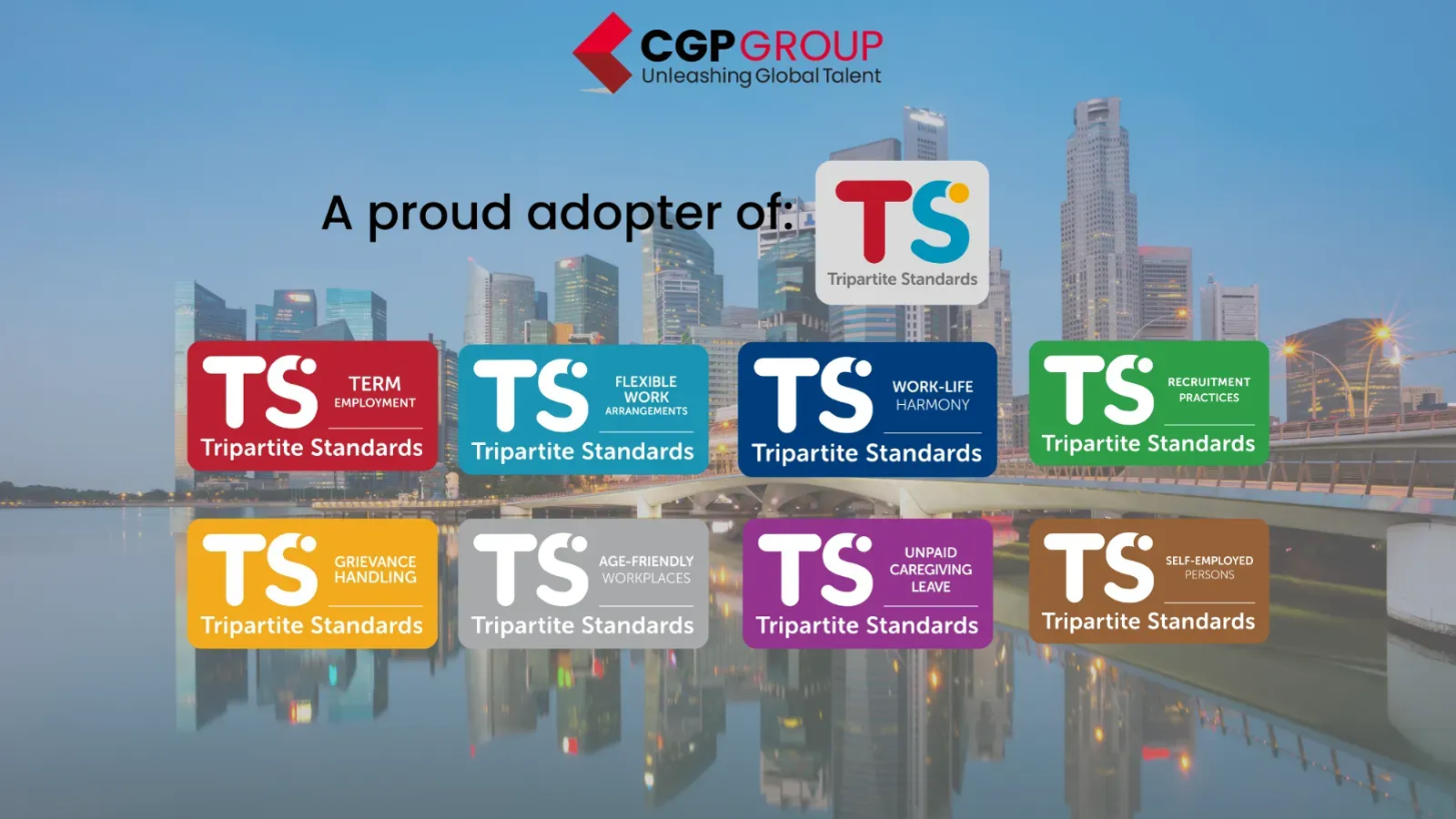
  • Cornerstone Global Partners Singapore Adopts 8 Tripartite Standards

    Cornerstone Global Partners Singapore Adopts 8 Tripartite Standards

    Enhancing Company Ability and Potential to Pool and Retain Talent

    ​CGP Singapore (hereafter, “CGP” or “The Company”) is proud adopter of the Tripartite Standards on the following 8 standards:

    • Recruitment Practices
    • Age-Friendly Workplace Practices
    • Unpaid Leave for Unexpected Care Needs
    • Employment of Term-Contract Employees
    • Flexible Work Arrangements
    • Grievance Handling
    • Contracting with Self-employed persons
    • Work-life Harmony

    The achievement in the adoption of these Tripartite Standards benchmarked our strong commitment to foster a conducive, progressive and healthy workplace for our staff, in addition to our high standards of staff training and development.

    What do these standards mean?

    The Tripartite Standards is a new initiative that was jointly developed by the Ministry of Manpower, National Trades Union Congress and the Singapore National Employers Federation that identifies and recognises employers who have implemented fair and progressive employment practices.

    Each Tripartite Standard comprises a set of verifiable, actionable employment practices in a specific area of employment which employers can publicly commit to adopt and implement at their workplaces.

    These standards help us showcase our strengths and establish our presence to:

    • Be recognised as an employer of choice.
    • Be recognised for your progressive employment practices.
    • Motivate your employees.
    • Enhance our ability and potential to pool and retain talent

    Building a better workplace for you

    By adopting the Tripartite Standards, we are committed towards building a better workplace and work environment for our staff, thus helping our employees to achieve good work-life balance and a fulfilling career. We will continue to ensure that our staff is treated fairly and with respect, and we will do our best to support them to achieve their full potential.

    Tripartite Standard on Recruitment Practices (RP)

    We assess and select job applicants through merit-based and inclusive hiring practices. This is especially important in a global and diverse workforce environment.

    Tripartite Standard on Flexible Work Arrangements

    We help employees better manage work and personal needs by offering Flexible Work Arrangements.

    Tripartite Standard on Age-Friendly Workplace Practices

    We value our older employees and support them with training and workplace health programmes.

    Tripartite Standard on Unpaid Leave for Unexpected Care Needs

    We help our employees to manage unexpected situations with leave for caregiving needs.

    Tripartite Standard on Employment of Term-Contract Employees

    We offer term contract employees the same benefits (leave entitlements, notice period, and training) as our full-time employees.

    Tripartite Standard on Grievance Handling

    We foster a more harmonious workplace with proper procedures to manage grievances.

    Tripartite Standard on Contracting with Self-Employed Persons

    We foster a stronger working relationships with self-employed persons by promoting progressive employment practices for service contracts

    Tripartite Standard on Work-Life Harmony

    We establish a work-life strategy to include flexible work arrangements, leave schemes, and employee support schemes to support our employees to effectively manage responsibilities and aspirations in the spheres of work and personal life.

    ​The Tripartite Standards initiative has reshaped the employment landscape in Singapore where it constitutes a positive step forward to develop a holistic framework for employment practices in Singapore. To ensure, CGP upholds its promise to promote inclusivity, agility, sustainability, and fairness in the workplace so our employees can realize their full potential, we are constantly reviewing our existing practices to check if we meet the specifications of the Tripartite Standards.

    Visit tafep.sg to learn more about the Tripartite Standards.

  • Best Practices For Positive Employee Experience And Retention Rate

    Best Practices For Positive Employee Experience And Retention Rate

    Employee retention has become a pertinent problem for many companies in the Asia Pacific. According to a survey finding from PwC Global, only 57% of employees in APAC are satisfied with their jobs and at least one in five desires to switch to a new employer.

    Changes in workplace expectations and possible manpower restructures are escalating due to imminent global inflation. Coupled with uncertainties and disruptions of the pandemic over the past 2 years, many people are spurred to reflect on how they are treated at work, re-evaluate their priorities, and eventually quit their jobs in pursuit of a better quality of life.

    Ongoing trends of the Great Resignation and Quiet Quitting are already in full swing and have become obvious manifestations of global workforce discontent.

    These trends raise an essential question – How can employers then ensure employee happiness, prevent further disengagement, and foster positive employee experience and retention rate?

    But, before that first understand what is employee experience and why it is important.​

    What is Employee Experience?

    Employee Experience is a holistic combination of all the interactions an employee experiences during its journey with an organization – from recruitment to onboarding and career development, to exiting the organization. These interactions include people, systems, policies and workspaces.

    ​ Employee experience includes everything – how an employee feels, how they perceive their potential and abilities, and the effect on their well-being.

    Employee experience is a pivotal factor that significantly impacts employee satisfaction and is very crucial throughout the entire employee journey. In the wake of the COVID-19 pandemic, everything about employee experience has fundamentally changed versus earlier times. Employee expectations and so do their priorities have shifted.

    Chris Lui, Director – Corporate Services Recruitment Team at Cornerstone Global Partners Singapore, shares best practices to help you deliver a positive employee experience as well as optimize retention rate.​

    Advocate Employee Wellness and Invest in Employee Growth

    The aftermath of the pandemic has taken a significant toll on both the physical and mental well-being of the workforces, hence supporting employee well-being by talking to them and gathering feedback is the biggest way to prevent disengagement and improve the employee experience.

    Offering merely a hybrid remote work environment should not be the sole solution, but genuinely checking in on teams to gauge their overall happiness towards work and aligning their career paths go a much longer way, providing a sense of fulfilment and meaning.​

    Encourage to Have Authentic and Heart-to-Heart Engagements

    Employees need to be able to trust their managers, which also requires employer transparency. Traditional hierarchical structures and top-down, command-and-control approaches may not work anymore and may further create a transparency gap.

    Employees want to feel empowered and secure in what they do and how they are being invested in their growth within the company, hence a heart-led leader that displays traits of empathy, vulnerability, and humility demonstrates tenacity and credibility to their employees, and will stand out during turbulent times at work.​

    Offer Fair and Competitive Compensation

    …but not as the sole factor to retain talent

    Manpower restructures post-pandemic have led to increasingly heavy workloads as employees are putting in even more hours than before, inspite of remote work privileges. It is therefore important to re-assess employee wages based on industry standards to prevent them from looking at greener pastures.

    However, hasty reliance on compensation counter-offers to retain talent attempting to move on with no basis towards their work productivities is clearly unsustainable and may create a wrong signal to employees where they feel a shift of power in their favour to ask for unrealistic remuneration demands beyond their actual work capabilities.

    Hence, employees must be clear and transparent about the pay structure and employers should increase bonuses and their wages only when employees have demonstrated that their value is truly deserving of it.

    In fact, offering skill specialization through specialist training or adding motivators to existing roles through increasing autonomy and task variety are more often than not better alternatives to increase job satisfaction and retention for the employee.​

    At the end…

    Employee retention will always be a constant concern for many companies, but the main key strategy for employee retention is to always make sure that employees are heard, and feel appreciated. Whether it is financial incentives, education and skill enhancement growth opportunities, or well-being benefits, feeling valued at the workplace fosters a sense of fulfilment and resilience, despite a volatile economic landscape today.

    ​At CGP, we have a comprehensive line of HR solutions that meet the needs of companies with distributed teams, including talent search, executive search, and contracting. Learn more about how we can help you bring great talents together across Asia.

    Know More​

    ALSO READ: