
Category: Job Seeker Insights

  • CGP Singapore: Official Statement on Job Scams and How to Avoid Them

    CGP Singapore: Official Statement on Job Scams and How to Avoid Them

    CGP Singapore, part of the Cornerstone Global Partners (CGP) Group, is aware of recent incidents involving individuals claiming to be employed and/or associated with CGP and are recruiting in Singapore & Malaysia. We, at CGP, take our candidates safety seriously during the recruitment process. When in doubt, it is always best to contact the company the recruiter is claiming to be from via the official number/email.

    Scams including job scams hit all time high in Singapore, recording 45000+ cases in 2024 and in the first half of 2025, there were 2,701 reported job scam cases.  So far in 2025, job scams were the third most common scam type (2701 cases reported), after phishing and e-commerce scams, while victims reported over 9043 cases in 2024.

    In this scenario, how can you ensure a legitimate job opportunity and protect yourself from falling victim?

    Understanding Job Scams

    Job scams are fraudulent schemes where scammers pose as employers or recruiters to deceive individuals seeking employment. The primary objectives of these scams are to extract money, obtain personal information, or exploit victims for free labor. Scammers often advertise fake job openings through various channels, including online ads, social media platforms, and even reputable job search websites, sometimes mimicking legitimate companies to appear credible.

    Common Warning Signs of Job Scams

    • Unprofessional Communication:  Correspondence from recruiters or employers containing grammatical errors, generic email addresses (e.g., Gmail, Yahoo), or unprofessional language. Professional organizations maintain a standard of communication; deviations may indicate fraudulent activity.
    •  Unsolicited Job Offers: Ambiguity in job descriptions can indicate a scam. Additionally, promises of high income for minimal work, especially for entry-level positions, are often too good to be true.
    • Requests for Personal or Financial Information: Legitimate employers will not ask for sensitive details like your Social Security number or bank account information early in the recruitment process.
    • Upfront Payment Requirements: Be cautious if asked to pay for training materials, background checks, or other fees. Authentic employers typically cover these costs.
    • Vague Job Descriptions: Job postings lacking clear details about responsibilities or qualifications may indicate a scam.
    • High Earnings for Entry-Level Positions: Offers that promise substantial income with little experience required should be approached with skepticism.

    Nov 2025: Impersonation Alert: Fake Consultant Calls Reported

    We are aware of recent incidents involving individuals impersonating our consultants and contacting candidates via phone calls. These impersonators may offer fake job opportunities or inquire about employment status under false pretences.

    We take candidate safety seriously and urge everyone to remain vigilant. As part of our Protective Measures Against Unsolicited Communications, please note the following:

    • All CGP Singapore consultants will state their EA Personnel Registration number, which begins with “R”, when contacting candidates.
    • All CGP Malaysia consultants will provide their JTK license number or registration number during outreach.
    • See below to understand how to stay vigilant and verify our consultants.

    How to Protect Yourself from Job Scams

    • Research the Company: Verify the organization’s legitimacy by checking for an official website, reading reviews, and confirming contact information. At CGP, our official emails are from @cornerstoneglobalpartners.com or @cgptalent.com
    • Be Cautious with Personal Information: Share sensitive details only after confirming the employer’s authenticity and receiving a formal job offer.
    • Avoid Upfront Payments: Decline any job opportunity that requires you to pay fees before starting employment.
    • Trust Your Instincts: If something feels off about a job offer or recruitment process, it’s wise to step back and reassess.

    Protective Measures Against Unsolicited Communications

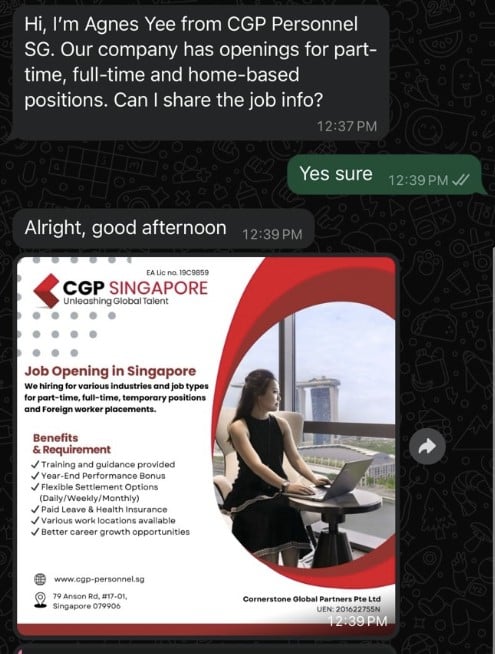
    We’ve been getting reports about unsolicited WhatsApp messages from people pretending to be from ‘CGP Personnel’ or ‘CGP Singapore.’ Sometimes, they use fake names of people who don’t even work here; other times they use the name of one of our consultants.

    Unless verified, these messages aren’t from us. Here’s what you can do:

    • DO NOT respond to text messages or calls from unknown numbers and avoid any communication with unverified individuals.
    • DO NOT click on any links within the message unless verified.
    • DO NOT share any personal information at the initial stage of the interview process.
    • DO NOT proceed with any monetary transactions as we at CGP never ask for any form of payment from candidates as part of the recruitment process.

    We are grateful that all our potential candidates exercised due diligence by verifying with us, and our CGP team responded promptly to prevent them from falling victim to these job scams.
    scam msg 1

    Stay vigilant from job scams

    We encourage all job seekers to take extra precautions, especially when receiving unsolicited messages. . If you receive an unexpected communication claiming to be from CGP, you can verify the person’s identity by using the  Ministry of Manpower EA Directory. You can also contact us directly at contact@cornerstoneglobalpartners.com before responding.

    CGP’s Official Social Accounts 

    ​CGP Group’s only official social media accounts in Singapore are on LinkedIn, Facebook, Instagram, and our WhatsApp channel: 

    For information on reporting suspected recruitment scams, please refer to the Singapore Police Force’s guide.


  • How to Work with Recruiters when Searching for a Job

    How to Work with Recruiters when Searching for a Job

    Searching for a new job can be a very, very stressful activity – whether you are looking on your own or using a Recruitment Agency to support you. Here are a few tips to manage this process a bit better:

    1. Most Recruitment Agencies provide their services to you for free.

    They are paid “recruitment fees” by their client companies when they help with successful hiring. Be wary of any agency or website that charges you a fee for career advice!

    2. Prioritize Recruitment Agencies that prioritize you!

    If you reach out to an agency via email or on their website, keep track of how long it takes before they reply to you and what type of response you receive. Are they willing to meet with you face-to-face? Have a video call? Or are they asking for a phone or email chat? Do they reply quickly and answer your questions in a timely and reasonable way? Avoid companies that send spam replies or take too long to get back to you.

    3. Consider your timing for when you want to leave.

    Agencies are generally supporting active searches – meaning that they will want to immediately introduce you and arrange interviews. Ideally, they would like to help you receive an offer within 2-4 weeks and to change jobs 2-4 weeks after that. That said, job searches do not always go so smoothly and it can take several months to find a job that fits you. Make sure to communicate with your Agent on your preferred timing and how much notice period you need once you receive an offer. Your Agent will do their best to get you an attractive job at a time that suits you.

    4. Keep track of where you have applied and ask for updates.

    Some agencies – especially the larger ones – will struggle to update you after every application or interview. If you are using multiple agencies, this problem can be compounded. Make sure to reach out to your Agents regularly for updates and feedback. If one agency is consistently struggling to update you, consider shifting your focus to another agency that is more responsive.

    5. Be transparent with your Agents.

    Let your Agents know if you have any questions or concerns about a job/company. Let them know if you have other processes ongoing. Your Agents will do their best to support you with the job that they introduced. Sharing information with them can help them negotiate for better interview schedules or better offers (titles, salaries, start dates, etc.). At the same time – do not mislead them with inflated numbers or false processes. If an Agent finds out that you have been untruthful, you can put your entire interview process at risk.

    6. Good Agents can be long-term relationships!

    Treat your Agents with respect and care – even if you choose a job through another source. You may decide to look again in the future and that Agent may be able to help you then. Keep those doors open when you can!

    This article is originally published by Cornerstone Recruitment Japan and edited by CGP Singapore. <Original article>

    Get The Right Assistance From CGP Singapore

    So now that you have discovered the value of recruitment agencies in navigating your job search, finding the right fit is key! CGP Singapore’s Talent Search assists suitable candidates in getting placed with the right organisations!

    Connect with us and allow our expert consultants to help you take one step closer to your next job.

    ALSO READ:

  • Why Do You Need To Work In The Healthcare Sector? Here Are The Top Reasons

    Why Do You Need To Work In The Healthcare Sector? Here Are The Top Reasons

    Healthcare is a staple industry all over the world and in developed nations, a core industry underlining a healthy future. In Singapore, the healthcare industry has received increasing attention from both public and private sectors especially in the last decade, resulting in the rapid development of the industry.

    Singapore’s healthcare industry is well regarded as one of the best in the world due to a combination of factors, such as:

    • Strong regulatory governance,
    • Good blend of public and private healthcare infrastructure, and
    • A comprehensive, cost-sharing medical health insurance system.

    With Healthcare being one of the major industries pulsating Singapore, what could potential job seekers expect if they choose to join this industry?​

    Stable Job & Career Growth Opportunity

    The Healthcare sector in Singapore has continued to grow from 2012 to 2022, and currently employs around 150K talents (clinical and non-clinical), of which close to 100K are working in public healthcare. What this means to potential job seekers is the availability of jobs on both sides of the fence which guarantees good career development /pathing opportunities.

    This is set to become even better moving ahead as Singapore further develops its healthcare industry – the Ministry of Health has recently announced a 10-year development plan to create a “Healthier Singapore” – and job seekers in both clinical and corporate functions can expect more robust career and growth opportunities in this sector.

    Some of the highlights include more and more opportunities for mental health and finance professionals and experts, as the Singapore government looks at developing more mental health facilities and more value-driven, cost-effective financing options for the public.

    ​ With pandemic bringing to the forefront the importance of healthcare workers, coulped with Singapore’s newest Healthier SG plans, the industry is expected to undergo drastic changes in hiring practices and offer the diversity of positions.

    ​A Plethora of Career Development Options

    As the industry continues to grow and develop, new job functions and vacancies are created every year. For healthcare talents this means no matter where they start in the field, they have a variety of options to pick from when pursuing their careers. They could even change paths a few times before charting a final career pursuit, without losing any pre-existing respect in their field.

    ​Both clinical and corporate healthcare professionals can leverage training mechanisms made available by their employer or through reskilling courses subsidised by the Singapore government when making a career transition.

    Apply for Healthcare & Clinical Jobs Here »​

    Competitive Total Rewards

    Clinical professionals in Singapore are among the best remunerated in Asia, in addition to receiving structured professional skill development training that will see them progressing steadily upwards in their careers. Mid-career switch opportunities are also readily available for clinical professionals wanting to make a transition into corporate functions. Some of these job opportunities include Quality Development, Program Management, Training & Development, etc.

    ​Corporate function professionals in healthcare (Finance, Healthcare, Information Technology, etc.) are also in demand – this is in tandem with the continued growth of the sector warranting new job creation, especially in cutting-edge technology (Analytics, Artificial Intelligence, Machine Learning) for the advancement of care provision, and corporate shared services (human resource, finance) for improved cost efficiency.

    ​In summary, jobseekers could expect a comprehensive base salary in addition to attractive fixed and performance-based bonuses and perks when joining the Healthcare industry. Click here to download full report on salary trends.​

    Value-Driven Work

    Healthcare is fundamentally about extending and saving lives – and this remains one of the most rewarding aspects of holding a job in this industry. While the industry generally offers competitive total rewards and career development plans – healthcare professionals identify most with the fact that they go to bed each day having improved a patient’s quality of life.

    For someone compassionate to help and give back to society – joining the healthcare industry means you will be doing this day in and out while making a pretty good living. Regardless of your chosen vocation – corporate or clinical – you will be helping patients all the same to get the care that they need. Very few other industries could afford the value-driven work whilst paying competitive salaries and rewards.​

    ​In-Demand Roles In The Healthcare Sector

    Currently, there are several clinical and non-clinical roles in demand in the Healthcare industry, such as:

    • Nursing & Allied Health: Nursing Manager to Directors, Nurse Clinician, Radiographer, Psychologist, Radiologist
    • Corporate Positions: Human Resources, Accounting & Finance, Information Technology, Transformation & Project Management, Quality Management, Operations

    To find out more insights into hiring trends in the Healthcare industry, get in touch with our Healthcare and Clinical recruitment team now!

    Meet the Team

    Submit a Vacancy​

    References:

    1. https://www.moh.gov.sg/news-highlights/details/promoting-overall-healthier-living-while-targeting-specific-sub-populations
    2. https://www.careersingovernment.com/tools/gov-talk/career-advice/on-the-job/7-advantages-working-healthcare-industry/
    3. https://www.skillsfuture.gov.sg/skills-framework/hc
  • How To Write A Professional CV And A CV Template

    How To Write A Professional CV And A CV Template

    One of the most vital documents in anyone’s possession is their resume or CV.

    It serves as both a record of past achievements and a marketing tool to showcase your potential. Strangely, many of us often neglect the task of updating it properly.

    Throughout the years, we’ve come across a vast number of CVs that clearly appeared to be unchanged legacy documents with new job entries tacked onto the top. Alternatively, they were freshly created files using template software

    – Abundant in graphics but lacking in substance.


    Irrespective of your background, level of seniority, or industry,
    there are certain fundamental principles to adhere to when crafting your CV:

    1. Keep your resume concise, ideally under four pages

    Without going overboard, if you are a senior finance professional with over 15 to 20 years of experience, you should aim for a 2-page CV that focuses on recent roles and provides concise summaries.

    Recruiters, HR professionals, and hiring managers are all pressed for time and often have to sift through dozens, if not hundreds, of CVs daily.

    A lengthy CV can be overwhelming and discouraging, leaving two negative initial impressions: either you couldn’t be bothered to edit your resume properly, or you lacked the awareness that such extensive documents are inappropriate.

    Read this LinkedIn article to find out more!

    2. Ensure your resume is visually clear and legible

    It’s astonishing how many resumes assault the reader with an array of typefaces, font colors, font effects (e.g., bold, underline), graphics, and more.

    A well-written document with a clean presentation is far more effective than trying to grab attention with visual elements. This doesn’t mean you can’t have some variety, but it’s essential to maintain consistency and effectiveness. From my experience, it works well to use bold for highlighting companies and dates, and italics for job titles, or vice versa.

    Bullet points can be circles, stars, numbers, or dashes, but they should remain consistent throughout your document.

    For example, seek inspiration from this resume template from Enhancv.

    Alternatively, click here to learn more resume-writing tips!

    3. Include pertinent information on your resume

    List your employment history, including company names, dates, job titles, and key responsibilities. Highlight significant achievements and quantify your results with data (e.g., staff managed, sales generated).

    Consider including relevant internships, volunteer work, or academic experiences. Related Reads!

    4. Review and Roleplay

    After creating your resume, we suggest engaging in two straightforward roleplay exercises:

    First, cover up your name on the resume and imagine it belongs to your friend Lincoln, seeking your advice. How do you feel about the resume’s appearance? Does it convey essential information clearly? Would you recommend it?

    Next, cover your name again and envision you are in the position to hire for your team, with the resume being an applicant’s. Would you hire this individual based on the resume? Does it highlight the skills and experiences you’d expect from a potential interviewee?

    Creating a resume often induces stress, mainly due to the discomfort of self-promotion. It’s remarkable how clarity emerges when you pretend the document isn’t about you. Watch these videos to learn how to properly role-play interviews!

    hq720
    hq720 (1)

    We Can Help You!

    In conclusion, creating a strong CV is essential to your job search.

    By following these guidelines and utilizing the provided template, you can craft a professional and impactful document that showcases your skills and experiences.

    Enjoyed this read? Check out more articles here!

    Our FAQs

    While the terms are often used interchangeably, there are subtle differences. A CV (Curriculum Vitae) is a more detailed document that provides a comprehensive overview of your academic and professional history. It’s commonly used in academic and research fields. A resume, on the other hand, is a concise summary of your relevant skills and experiences, tailored to specific job applications.

    If you have gaps in your employment history, it’s important to address them honestly and positively. You can explain the reasons for the gaps, such as pursuing further education, caring for family members, or taking time off for personal reasons. Highlight any volunteer work, freelance projects, or online courses you completed during these periods.


  • Top 3 Skills For Finance Leaders In A Post Pandemic World

    Top 3 Skills For Finance Leaders In A Post Pandemic World

    The COVID-19 pandemic has set in motion numerous new changes and challenges in how businesses and organizations operate. This includes an increase in flexible and remote work arrangement for workers, a higher emphasis on employee well-being, and greater importance on technology and data to name a few. Finance leaders today will need to navigate and overcome a new set of challenges in a “post-pandemic” world.

    Adriell Ong, our recruitment expert in Accounting & Finance Sector at Cornerstone Global Partners Singapore, shares the top 3 skills for finance leaders required to help them and their organization succeed in a post-pandemic world.​

    Business Collaboration

    The pandemic has put an even greater emphasis on Finance Leaders to work even closer with the business stakeholders within an organization as the economic and business landscape is evolving at a faster pace with greater volatility.

    Finance Leaders will need to be more adept in stakeholder management, and to understand the greater business as finance teams will be increasingly relied on for their insights to make strategic decisions. Finance Leaders will work closer with Information Technology to drive digitalization and create a more data-driven organization, and Human Resources on employee development and retention matters.

    People Management

    With more finance teams working and communicating remotely, issues such as lack of clarity in communications, employee isolation, and diminishing work performances may occur in finance teams.

    In addition, the changing hiring landscape for finance professionals also meant that putting a lot of emphasis on talent retention. Thus, it is important that Finance Leaders recognize the issue and put in place plans to ensure higher work efficiency. Finance Leaders will need to emphasize on stronger relationships with their team, building stronger connections and making an effort to recognize their contributions.

    Browse Accounting & Finance Jobs »​

    Technological Aptitude

    In the last couple of years, there has been a major push towards digitalization within finance teams, with a greater emphasis on data analytics and automation. This process has certainly accelerated by the pandemic with more frequent strategic planning and updates in businesses due to the uncertainty. Finance Leaders today will need to possess a stronger understanding of new technologies to meet new business demands, increasing agility in forecasting and enhancing efficiencies.

    The role of a Finance Leader has changed significantly over the years from a bookkeeper to a strategic advisor. The challenges poised in a post-pandemic world will further evolve a Finance Leader’s role and increase their importance to any organization.

    If you wish to discuss more insights on Accountancy & Finance, get in touch with Adriell Ong at adriell.ong@cornerstoneglobalpartners.com

    ​ALSO READ

  • Logistics Job Skills: What Employers Are Looking For

    Logistics Job Skills: What Employers Are Looking For

    The logistics industry is a complex and ever-changing field. It involves coordinating and moving resources from a location to the desired destination. Resources can be people, materials, inventory, and equipment. The sector demands detail-oriented planning and execution to meet deadlines. And to accomplish the business function, an organisation needs the right people possessing key skills for logistics.

    With the continuous evolution of this industry, organisations constantly need to adapt to new challenges, which demand professionals with unique skills to thrive in various roles within the logistics sector.

    In this blog, understand what are the top job skills for you to claim your place in the logistics industry.  Whether you are a seasoned logistics professional looking to stay ahead or an aspiring professional seeking to enter this dynamic field, this guide will provide valuable insights into the key skills that employers highly value.

    You must also read: 7 Traits Every Employer Is Looking for in a New Employee

    What are the Elemental Skills Required in Logistics?

    Various logistics job skills must synergise to make you stand out and get hired. So let us look closely at the must-have skills.

    #1. Data analysis

    Data is everything for the modern logistics industry. Data analysis lets you make informed decisions and plan the next step accordingly. Additionally, data allows teams to spot trends & patterns and forecast what the future holds.

    With top-grade data analysis skills, you can quickly ensure your company’s goods reach their destination. Along with strong mathematical skills, you must also use spreadsheets to plan and execute activities to calculate pricing & delivery times.

    #2. Versatility

    Knowing how to identify & address concerns rapidly is one of the key skills for logistics for having a progressive career in logistics. In addition, those who understand the importance of adaptability pave the way for their growth. The reason is the scale of the supply chain for large-scale organisations require flexibility to address the situation effectively.

    #3. Resource management

    Logistics workers must be able to allocate the ideal amount of staff and other resources, such as vehicles, equipment, and building space, for a smooth process. They must know the resources available at their disposal and understand the right way to utilise them.

    Besides, resource maintenance skills are crucial when shaping a logistics career. Therefore, one must hone resource management skills to build a bright career in the industry.

    #4. Planning & organisation

    Strict planning and organisation are required for working in logistics. If you aren’t good at planning and organisation, it might lead to unhappy customers who would discontinue using your firm’s services due to missed deadlines. Undoubtedly, even the employer wouldn’t consider retaining an employee who cannot plan accordingly.

    On top of it, the organisation wouldn’t only lose revenue but see a sharp rise in costs due to an unplanned way of working.

    #5. Preventive maintenance

    Machine downtime causes loss of production and money, and companies look out for candidates with preventive maintenance skills. The reason is the skill helps employees to lower the risks of breakdown. Additionally, knowing the maintenance and repair of plant tools and equipment is a bonus in landing the right job.

    #6. Smart transport modeling

    It makes perfect sense to learn how to evaluate existing conditions and conduct a more detailed investigation into future projections. Logistics companies look for candidates who can approach logistical routes mathematically and ensure the cost-effectiveness of the trips.

    #7. Dispute resolution

    To enter the world of logistics, you must acquire and master dispute resolution. You must be able to minimise the effect of a dispute through arbitration and mediation. For employers, job hunters who can pay attention to detail and check how communication happens are the most valuable assets.

    To enhance your profile even better, you must work on your ability to work alongside clients, businesses, and legal teams.

    #8. Warehouse safety knowledge

    Having good warehouse safety knowledge is necessary because warehouses remain under potential risks. However, you must remember that you should aim to acquire warehouse safety knowledge from a legal and moral viewpoint. If you have the proper knowledge, you can optimise the warehouse’s layout to improve workflow and shift to new technology to make the work environment safer.

    Related Read: Skills to Master Before Your Next Job Search

    Additional Must-have Skills

    There are specific other skills that you must embed in your personality to progress in the logistics industry. Have a look at them!

    Teamwork

    Whether you are experienced or planning to enter the industry as a newbie, teamwork is one of the crucial logistics job skills at the heart of the industry. Having the ability to work with a team is fundamental to your success.

    Communication

    You cannot help yourself settle into the environment without good communication skills. Therefore, you must know how to communicate with the stakeholders, customers, and colleagues. Also, encourage openness and honesty to enable the other person to communicate freely.

    Contingency planning

    Disruptions are a part of logistics. Therefore, staying prepared by creating a contingency plan can serve as a merit point for you while applying for a job. The skill involves assessing potential risks, communicating with customers, and seeking alternatives.

    If you’re interested in a career in logistics, it’s important to develop the skills that are essential for success in this field. By developing these skills, you’ll be well-positioned for a successful career in logistics.

    Ready to grow your career?

    Integral to every part of modern society, logistics is a very diverse sector. As a result, it offers a multitude of career opportunities. Moreover, the industry boasts fast growth even in times of economic struggle. If you are willing to start at the bottom of the ladder and work your way up, the industry will never disappoint you. While you get to work with new technologies, the starting salary packages also attract job seekers.

    Master the logistics job skills and break into the world of logistics. Check out the latest job openings and how our Supply Chain & Procurement team can help you land your dream job.

    Apply Now – Jobs in Supply Chain

    FAQs

    1. What are the skills needed for logistics?

    Carving a career in logistics requires some skills that make you stand out, which are as follows:

    • Data analysis

    • Resource management

    • Planning and organisation

    • Transport management

    • Adaptability

    2. What are the five elements of logistics?

    The five elements of logistics are:

    • Storage, warehousing, and materials handling.

    • Packaging and unitisation.

    • Inventory.

    • Transport.

    • Information and control.

  • The Future Of Work: Preparing For The Changing Landscape Of Employment

    The Future Of Work: Preparing For The Changing Landscape Of Employment

    The world is changing, and so is the way we work. Trends like, artificial intelligence and automation are the stimuli that have spurred a transformation in the work landscape.

    When you think of the future of work, what do you see? Robots in place of human resources? Office setups are entirely different from today, or the absence of physical offices due to adopting remote work?

    While it is impossible to predict the future of work, it is visible that the employment landscape is changing rapidly. Therefore, there is a need for human resources to prepare themselves and adapt to the transition. Presently, the focus is placed on technology in the future of work discussions. However, other factors such as remote work, workplace diversity, and the gig economy also shape the future of work.

    Looking ahead and preparing for the changing world of work can help you maintain a work-life balance.

    So, let’s take a closer look at the tips to prepare you for it.

    #1. Create a professional development plan

    “Planning is bringing the future into the present so that you can do something about it now.”- Alexander Graham Bell.

    Outline your goals and map the route you must take to achieve them. This will allow you to clearly understand your expectations & desires, assess your skills, determine your success route, focus on essential activities, and strategise accordingly.

    smart goal

    Follow the SMART goals rule:

    S– Specific

    M– Measurable

    A– Achievable

    R– Relevant

    T– Time-based

    #2. Evaluate your skills

    Most importantly, for quick adaptation to the future of work, don’t wait. Take control of your profile and strengthen it by working on the weak areas. To make it happen, you must evaluate your skills and identify the areas you lack. As a result, you will be in a better position to work on yourself and add to the skills bucket. Pay careful attention to the skills you lack for your industry, as that will help you choose the right training or mentorship program.

    #3. Explore the redesigning of learning

    The definition of a skilled candidate has changed and is no longer restricted to just micro-learning. Simply put, you must lean into macro-learning to level up and prepare yourself technically and professionally.

    While micro-learning refers to learning small chunks of a larger topic, macro-learning is learning complex skills. Therefore, your professional development plan must include your macro-learning plans.

    #4. Capitalise on next-gen technology

    Changing times demand embracing new, disruptive technologies to prepare for the challenges. The candidates who will be counted among the top talent are the ones who are using technology to prepare for the future of work today. Stay updated on the latest technologies that are impacting the marketplace and leave no stone unturned in leveraging their potential.

    #5. Tap into your passion and become an expert

    Turn your passion into a profession, and work won’t feel like work. Present-day organisations are looking for candidates who are specialists, and the trend will stay forever. So explore your talent and areas of interest that you can take in the future workplace. In other words, plan to dig deep into your passions and take on a specialised role.

    team
    #6. Work on your emotional intelligence

    A majority of people seek answers to the question: How can I prepare myself for the future of work?

    Well! Apart from working on technical aspects, you must also work on skills that fall under emotional intelligence. And they are self-awareness, self-regulation, motivation, empathy, and social skills. Most importantly, you must strive to become a better human and a leader. The skills will get you closer to your team and help you collaborate with colleagues. Moreover, AI and automation can never outsmart the leadership skills a human possesses.

    RELATED READ: The Importance of Emotional Intelligence in Leadership

    Trends for the Future of Work

    The current year and the years ahead are set to see the changed work landscape. Here, we mention the most vital trends you must foresee to handle workplace diversity and changing work environments.

      • Quiet hiring

      • Flexibility for frontline workers

      • Focus on skills rather than candidates’ prior experience

      • Focus on employee well-being

      • Continuous boosting of DEI efforts

    RELATED READ: Diversity and Inclusion in HR: Current Trends and Future Directions

    Final Comments

    A competitive talent landscape and pressure to reduce costs pose challenges for organisations. Given that, companies must start putting the right people in the right place and turn the challenges into opportunities. In addition, enabling a workplace to foster innovation and be inclusive requires leaders to strategize how work gets done.

    You must take charge of your future and upskill yourself to better prepare for the upcoming changes. Whether you are an accounts executive or a data scientist, one thing remains constant: continuous learning & development, reskilling, and upskilling bring job security.

    FAQs

    1. What are the future trends in the workplace?

    The future trends in the workplace are:

      • Flexible hours/four-day working

      • Prioritisation of well-being

      • Focus on skills over jobs

      • The emphasis on soft skills

      • Increased diversity, equity, and inclusion (DEI) efforts

      • Use of AI and automation

      • Transformation of HR using tech and data

      • Focus on employee growth

    2. What are your suggestions for the future of work at the organization?

    The world of work is changing rapidly. Therefore, employers and employees need to be on their toes to adapt to the changing scenario. While employers must plan accordingly to manage the effects of the future of work, employees must focus on upskilling themselves to stay ahead of the curve.

    3. How will the future of work change?

    With the advent of AI and automation, the future of work is changing. However, various other trends will bring about a change in the future of work. For instance, hybrid flexibility will allow frontline workers flexibility, such as what they work, with whom they work, and how they work. Continuous support for DEI initiatives, sensitive offboarding, emphasis on continued employee growth, focus on skills over jobs, and prioritisation of employee well-being are among the other changes that will define the future of work.

  • The Role Of Body Language In Your Interview

    The Role Of Body Language In Your Interview

    It seems almost incredible how body language has become an active aspect of human personality. Although most people still believe speech is the main communication form, body language’s importance is still indispensable. Before discussing body language’s role in an interview, you must know the relevance of body language skills in daily life. A name like Charlie Chaplin doesn’t need an introduction, owing to his communication through body language as a silent-movie actor.

    Anthropologist Ray Birdwhistell pioneered the original study of nonverbal communication- kinesics. His analysis found that the verbal component of a face-to-face conversation is less than 35 percent, and over 65 percent of communication is done nonverbally.

    Now that you have learned the importance of body language, let us get a step ahead. We have highlighted your body language’s pivotal role during an interview.

    ALSO READ:

    Role of Body Language in an Interview

    #1. Reflects your personality

    The manner in which you present yourself depicts your personality. Companies nowadays look for candidates with strong personalities, suitable skill sets, and education.

    Not every person who is book smart will propel professionally. In fact, people with the right attitude toward work and a presentable personality can do wonders in a professional setup. That being the case, you must consider working on your body language and put forward your best profile highlights.

    #2. Separates you from mediocre candidates

    Your body language tells a lot about your exceptional personality. To get your point across effectively, you can master using your body posture. As an outcome, you can see yourself a notch higher than other candidates.

    If you hone your body language skills, you will never settle for less and strive to give your best in an interview.

    #3. Echoes your professional attitude

    One primary reason why body language plays a vital role during an interview is that it showcases your professional attitude. Hiring managers can judge how you will act during your course of employment from your body language.

    An important aspect you must consider here is to adjust your body language to suit your field.

    #4. Displays your attentiveness

    Your communication through body language lets the recruiter know whether you are attentive. And this decides your fate. If you are attentive to the minute of things and show it through your body language in an interview, nothing can stop you from moving to the next recruitment stage.

    Additionally, hiring managers look for candidates who have a large attention span. You can depict your attentiveness in an interview by having the proper body posture, maintaining eye contact, and speaking confidently.

    #5. Shows that you are a keen listener

    Presenting yourself as a keen listener with good comprehension skills isn’t enough. Unarguably, it’s not sufficient to understand what the interviewer is asking, but you must also answer them wisely. Moreover, answering them with just words won’t suffice for the purpose, and you must use gestures and facial expressions, too.

    Even if you know all the answers but aren’t confident enough, you won’t be able to sail through the hiring process.​

    Pivotal Aspects of Body Language You Must Remember

    During an interview, there are a few things you must remember. Let’s go through them.

    1. Keep your back straight – Understand the term body language and make sure to follow the rules. Keep your back straight, and don’t let it slouch.

    2. Have your legs crossed – You should keep your legs crossed to depict the correct body language in an interview. Make sure you don’t shake your legs or twist your toes.

    3. Make apt gestures – Making thoughtful gestures can make you come across as a good orator used to public speaking. For instance, nod your head to show your attentiveness and to affirm your listening skills.

    4. Maintain eye contact – Don’t avoid maintaining eye contact, and be confident of your abilities and skills.

    5. Upkeep the right tone of voice – Sync your tone of voice with what you want to convey to create a good impression on the recruiters. Keep your words, actions, body language, and tone of voice in a way that compliment one another.

    Bottom line

    Body language is essential to what you wish to convey to the interviewer. Interviewers have observed that bad interviews often contain little to no use of body language. You may leave a negative impression in the recruiter’s mind if you do not exhibit the correct body language. Therefore, it is imperative to acknowledge the role of body language in an interview. While it may seem like a minute thing, body language will set you apart from the crowd.

    It’s important to note that body language can vary across cultures and individuals, so it’s crucial to be mindful of contextual cues and adjust accordingly during an interview. Being aware of and managing your body language can help you convey a positive impression and enhance your overall communication during the interview process.

    Deborah Bull quotes it well: “Body language is a very powerful tool. We had body language before we had speech, and apparently, 80% of what you understand in a conversation is read through the words, not the body.”

    Our team of specialist recruiters advocates that candidates must perfect their body language. Not only will your education, skills, and knowledge land you the right job, but it will also take having the correct body language.

    RELATED READ: Top 9 Candidate Screening Questions Recruiters Ask

    FAQs

    1. What are the five types of body language?

    In an interview, job seekers and employers communicate through verbal responses, nonverbal cues, or body language. Here are five types of body language that can be observed in an interview:

    • Facial expressions convey feelings of joy, sadness, sorrow, anger, fear, or surprise.

    • Eye contact indicates the level of interest or attention.

    • Gestures can have varied meanings across the globe.

    • Voice to make people listen not only to your words but emotions.

    • Posture refers to the way you move and carry yourself.

    2. How do you assess body language in an interview?

    Assessing body language in an interview requires careful observation and interpretation of nonverbal cues. To assess body language in an interview, you can:

    1. Observe extreme behaviour

    2. Spot the difference

    3. Connect the dots

    4. Ask follow-up questions

    It’s important to note that body language cues are not always definitive and can be influenced by various factors. Therefore, it’s essential to consider them as part of a holistic assessment.

  • How To Ask The Right Questions At The End Of An Interview?

    How To Ask The Right Questions At The End Of An Interview?

    ​There are two types of questions that you can always be sure you will be asked during an interview:

    1) Tell me about yourself (click here to read the article that goes into more detail)

    2) Do you have any questions for us?

    In this article, we will focus on the second one. It is vital for you to have and ask questions at the end of every interview for three main reasons.​

    #1 Show your interest in the company

    Just imagine you are out with a person and this person asks you nothing about yourself. What would you think about this? That the person has no interest in you whatsoever. When the company you are interviewing with asks you “do you have any questions?” is actually trying to understand if you did research about the company itself and about the role you are applying for.

    This is your chance to demonstrate your knowledge about both. So, check the company’s website/internet to try to familiarize yourself with their products and services, and go much deeper than just the main page. Spend some time looking at facts, figures, competitors, trends, etc.​

    #2 This is your chance to understand more about them

    Always remember that an interview is a two ways road: they are interviewing you but you are also trying to understand if that is the company for you. At the end of every interview, you should ask any question that will help you in seeing yourself working with them so that when eventually you will receive an offer, you will be ready to accept it without any ifs or buts.​

    #3 But not least, you can indirectly give information to the interviewer about yourself.

    Do you feel like you did not have the chance to share with the company something important that can help you get the role? Do you think you have a great story in your current company that is relevant to the position you are applying for? This is your chance to let them know! How you can do it?

    Start by saying something like “In my current role in company X, I am focusing on Y using the tool Z. I have achieved great numbers/goals/deals. Will I be able to work with something similar here at A? Which tools are you currently using?”

    Other samples questions that can help you understand the company and the role may be:

    • What would be expected of me in the first six months?
    • How many people would be on my team and what are their responsibilities?
    • What are the potential career paths for people in the role?

    At the very end, you need to tell them that you want the role; you can do this by saying it between two “thank you” comments.

    “Thank you for answering my questions, it was very informative. I’d like to mention that I really want this position, and I am willing to do what it takes to get it and succeed. I appreciate you taking the time to speak to me today and I look forward to hearing from you in the future. Thank you.”

    ALSO READ:

    ​This article is originally published by Cornerstone Recruitment Japan and edited by CGP Singapore. Original article

  • How to Answer “Tell Me About Yourself” In An Interview

    How to Answer “Tell Me About Yourself” In An Interview

    ​“Tell me about yourself” is a very common start to an interview but also a deceptively difficult opening for most of us – especially for individuals who do not speak English as a native language.

    Over the years, I have found that the vast majority of people I meet will pick a point in time – mostly around college – and then ramble through jobs and life events. Often, people tend to start talking and then speed up and keep talking. People will often overshare about bad decisions or difficult moments in life. If you can imagine for a moment an EKG or seismograph, you would have an accurate depiction of how this type of presentation might sound to the interviewer… we are admitting to having life push and pull us around with rarely a plan in place.

    Honestly speaking, very few of us did have a plan in our younger days and life did kind of unroll before us.

    However, the person on the other side of the table would ideally like to hire someone who is active in determining their life and does not simply take the path of least resistance.

    So, how should you reply to the “tell me about yourself” opening?

    Simply take your life story which looks like an up-and-down seismograph of random events and straighten it out to look more like a staircase. Here are some points.

    1. Group similar positions into one stair and speak about them as a block.

    2. Make short-term work or positions which aren’t relevant into smaller stairs and spend less time on them.

    3.  Talk about what you learned from each step and why you made the transition to the next step.

    4. Tell your history with a purpose as though you had been building your career with intent all along and that your steps are leading you someplace with meaning.

    ​

    If you imagine that this job you are interviewing for is the next step on your staircase, then you have hopefully described how your previous education, work experience, and life wisdom have made you the perfect candidate for that role. Here is an example of how to improve the answer.

    Before:

    “I am currently a Senior Manager with 3 staff. I used to have 7 staff but the company cut some people. I am looking for a job where I can use my previous experience. I learned English at University in the Vancouver. I was married to a Canadian and worked there but I got divorced and moved to Singapore in 2015. I couldn’t find a job right away and I didn’t like the first job I got, so I left after 9 months and joined my current company.”

    After:

    “I am originally from Singapore but I attended university in Vancouver where I studied Marketing as well as English. After graduating, I joined a local marketing agency for several years where I learned more about Western Marketing and Branding.

    I returned to Singapore in 2015 and briefly worked at a domestic agency where I learned the Japanese business language and practices and how to apply my experience in the local Tokyo market. Soon after, I had an opportunity to join my current company where I have been for the past 7 years. I am currently a Senior Manager with 3 staff. I am happy in my current role, but I learned about your opportunity and feel that my Marketing abilities, as well as my understanding of both local and Western business, will make me a great fit. I am really excited to learn more about this opportunity and how I might add value to your team!”

    ​I hope that this tool is useful as you review your resume and prepare for your next interviews!

    ALSO READ:

    Get the Right Assistance from CGP Singapore

    CGP Singapore’s Talent Search assists suitable candidates in getting placed with the right organisations.

    So now you have discovered how to find a job & have started working on your skills, you can land your dream job. Connect with us and allow our expert consultants to help you take one step closer to your next job.

    Find an Expert

    View All Jobs

    This article is originally published by Cornerstone Recruitment Japan and edited by CGP Singapore. Original article