Tag: employee engagement

  • Cornerstone Global Partners Earns Great Place to Work Certification™ in Singapore

    Cornerstone Global Partners Earns Great Place to Work Certification™ in Singapore

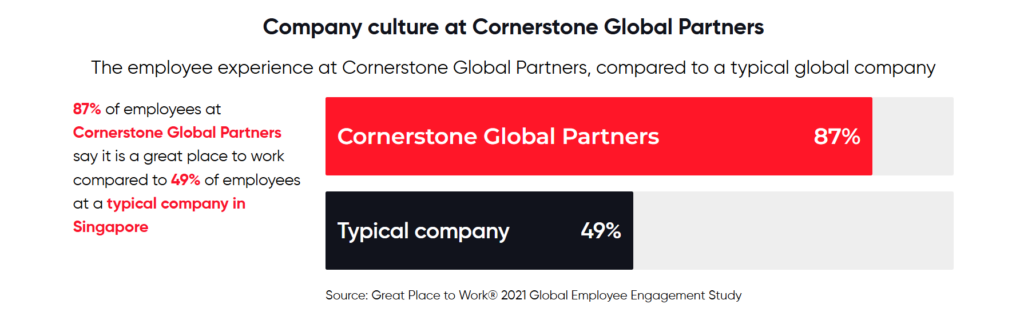
    Cornerstone Global Partners (CGP Group) is proud to be Certified™ by Great Place To Work® for 2024-2025 in Singapore. The prestigious award is based entirely on what current employees say about their experience working at Cornerstone Global Partners Singapore.

    Great Place To Work® is the global authority on workplace culture, employee experience, and the leadership behaviours proven to deliver market-leading revenue, employee retention and increased innovation.

    “The Great Place to Work Certification is a prestigious recognition based solely on real-time employee feedback about their workplace culture. Getting certified highlights our unwavering commitment to delivering exceptional employee experience and reflects the trust our team has in CGP. We celebrate this achievement with gratitude for our dedicated employees, whose efforts made this recognition possible. Together, we will continue to strive for even greater success and milestones!” – Sean Ng, Co-founder and MD, CGP Group APAC.

    “Great Place To Work Certification is a highly coveted achievement that requires consistent and intentional dedication to the overall employee experience,” says Sarah Lewis-Kulin, the Vice President of Global Recognition at Great Place To Work. She emphasizes that Certification is the sole official recognition earned by the real-time feedback of employees regarding their company culture. “By successfully earning this recognition, it is evident that our Singapore stands out as one of the top companies to work for, providing a great workplace environment for its employees.”

    According to Great Place To Work research, job seekers are 4.5 times more likely to find a great boss at a Certified great workplace. Additionally, employees at Certified workplaces are 93% more likely to look forward to coming to work, and are twice as likely to be paid fairly, earn a fair share of the company’s profits and have a fair chance at promotion.

    We’re Hiring

    Looking to grow your career at a company that puts its people first? Visit our careers page or LinkedIn!

    Keep up with the CGP Culture

    We’re all about having fun. If you want a taste of the CGP culture, meet us up on our Instagram account @cgp_apac

    About Cornerstone Global Partners

    Cornerstone Global Partners is an award-winning executive search, contingent recruitment, flexible staffing & HR outsourcing firm delivering talent services across SEA. We provide premium human resources and talent services from large multinational corporations to small and medium-sized businesses across mature and emerging markets in Asia. Our team of experts delivers customised talent solutions covering functions including sales, marketing, human resources, accounting & finance, legal & compliance, supply chain, manufacturing, information technology, operations, etc. Our holistic suite of talent services ensures you have the right talent, in the right roles, aligned with your business goals and culture.

    About Great Place to Work Certification™

    Great Place To Work® Certification™ is the most definitive “employer-of-choice” recognition that companies aspire to achieve. It is the only recognition based entirely on what employees report about their workplace experience – specifically, how consistently they experience a high-trust workplace. Great Place to Work Certification is recognized worldwide by employees and employers alike and is the global benchmark for identifying and recognizing outstanding employee experience. Every year, more than 10,000 companies across 60 countries apply to get Great Place To Work-Certified.

    About Great Place To Work®

    As the global authority on workplace culture, Great Place To Work® brings 30 years of groundbreaking research and data to help every place become a great place to work for all. Their proprietary platform and For All™ Model helps companies evaluate the experience of every employee, with exemplary workplaces becoming Great Place To Work Certified™ or receiving recognition on a coveted Best Workplaces™ List.

  • 8 Incredible Employee Engagement Activities And Why Do They Matter

    8 Incredible Employee Engagement Activities And Why Do They Matter

    ​What is that one aspect that can make or break an organisation’s substratum? Undeniably, it is employee engagement. Disengaged and less motivated employees compromise productivity and can hamper an organisation’s reputation. But it’s on you to create an environment that engages employees as they look to you for cues.

    “When leaders throughout an organization take an active, genuine interest in the people they manage, when they invest real time to understand employees at a fundamental level, they create a climate for greater morale, loyalty, and yes, growth.”- Patrick Lencioni.

    The tip is to exhibit strong leadership and focus on employee engagement and motivation. A host of activities can engage employees and boost their motivation.

    Here is our list of eight incredible employee engagement activities known for bettering workplace culture.

    8 Incredible Employee Engagement Activities

    1. Workplace Parties

    Work becomes fun when employers throw parties to celebrate accomplishments or other occasions. Some workplace party ideas to bring everyone together are:

    CGP Group Christmas Party 2022
      • Halloween parties

      • Thanksgiving dinners

      • Potluck meals

      • Christmas party

      • New Year’s Eve party

    Prefer choosing quality over quantity and making sure the celebrations count.

    ​

    2. Games, Tournaments & Competitions

    Games let the teams come together and have fun at work. The main objective of conducting games, tournaments & competitions is to:

    CGP Group Physical CGP Captain Ball
      • Inculcate team spirit among employees

      • Let them meet other teams

      • Acquire skills like problem-solving, communication & collaboration​

    Maintain a fun-filled workplace culture to help your people work in a stress-free environment.

    3. Special Days

    By mentioning ‘special day,’ we do not indicate celebrating some days with great pomp and show. Instead, we mean to have your employees enjoy special days such as “Pajama Day,” “Ethnic Outfit Day,” or “Bring Your Child To Work Day.”

    The benefits of special days are:

    • They refresh the employees’ minds.

    • They excite the employees.

    • They change the pace and instill the work environment with positivity.

    4. Lunch & Learns

    Better known as learning lunches, it is the best way to bring your employees together and make them learn. Instead of having alien speakers, ask a team member to present on a topic.

    One thing you need to bear in mind is to keep them short and sweet. Why? Because no one loves to have a long lunch meeting.

    5. Employee Training

    The employee retention process shall remain incomplete if you miss training your employees timely. Whether it’s a baby boomer or an experienced employee, every person expects to receive learning opportunities. Therefore, strategise to allow employees to learn at work and upskill themselves.

    You can have a weekly coaching session or provide your employees with online learning resources. Another profitable way is to invite a special speaker and teach your employees something new.

    6. Recognition Programs

    Be an exception and live by the core values. Create an employee recognition program that syncs with your organisation’s core values. However, the creation of such a program won’t be enough, and you have to ensure everyone on your team knows about it. Moreover, the program should make more sense, with you pointing to specific behaviours that exemplify them.

    7. Create a Local To-Do Things Guide

    Get your team together and ask them to pen down their favourite local places and things to do. The list can be kept as a reference for future team outings while allowing your employees to bond with each other.

    Talking about non-work matters gives them better chances to break the ice and bond with each other.

    8. Send out an Employee Survey

    The best way to make employees feel valued and engaged is by seeking honest feedback about their work. And the most appropriate way to seek feedback is by sending out an employee survey. It’s easier for employees to tell what they feel about work anonymously.

    You can ask questions like:

      • How’s your day going?

      • What changes/improvements would you like to bring to the existing work environment or within your team?

      • How happy are you with your current role?

      • Do you feel you are getting enough learning opportunities?

      • Are you satisfied with your compensation?

    Why do Employee Engagement Activities Matter?

    Employee engagement is about improving the workplace culture and aligning employees’ aims with organisational goals. For those running businesses, employee engagement activities keep their people hooked to the organisation for a long time. For those working every day, employee engagement activities play a crucial role in boosting their motivation.

    The benefits that can be reaped from employee engagement activities are:

      1. Increased productivity

      2. Better customer service

      3. Higher profitability

      4. Higher employee satisfaction

      5. Active participation of employees in company initiatives

      6. Brand Advocacy

    Conclusion

    Employee engagement is an organisation’s investment to enjoy the privilege of staying in business. If you take time to appreciate and engage employees, they will reciprocate in a thousand ways. Connect the dots between individual roles and organisational goals. That’s the new talent contract to improve employee retention.

    Over time, you will find that engaged employees believe in the cause of the organisation and are in the game for the game’s sake. After all, the current volatile and uncertain environment demands engaged employees for success and survival.

    FAQs

    1. What are employee engagement activities?

    Employee engagement activities are exercises that increase employee motivation and positive feelings about the work environment. These activities are also known as team engagement activities, resulting in lower absenteeism and turnover. Moreover, these are fun and enriching, urging the employees to take a more active role in the organisation.

    2. What are some employee engagement ideas?

    The most common employee engagement ideas are:

      • Workplace parties

      • Offer mentorship opportunities

      • Host happy hours

      • Establish culture committees

      • Have theme days or weeks

      • Help employees network

      • Implement diversity and inclusion

      • Host a game show

      • On-demand learning

    3. What is employee engagement, and why does it matter?

    Employee engagement is the term that describes the exercises that employers undertake to keep employees engaged. It increases employee motivation and lowers absenteeism and turnover. Employee engagement is necessary for an organisation as they help keep the employees engaged and boost their morale.

  • Employee Retention Metrics You Should Be Tracking

    Employee Retention Metrics You Should Be Tracking

    Millennials: the job-hopping people, are less interested in staying in their current jobs. As per a Gallup report, 21% of millennials are reported to have changed their careers within the past year.

    With this shocking revelation in the market, employers continue focusing on employee retention. Nevertheless, just mapping the route to retain employees won’t suffice. In fact, as an employer, you must also know the employee retention metrics you should be tracking.

    Why You Should Measure Employee Retention?

    #1. Understanding your workforce dynamics

    Measuring employee retention allows you to understand which employee leaves & when, and who stays. With the information, organisations can determine whether the top performers are staying or leaving.

    #2. Identifying issues in time

    Organisations can identify issues early and take appropriate action in time to correct the situation.

    #3. Strategising

    Measuring employee retention enables organisations to create an effective employee retention strategy after analysing the conditions.

    #4. Saving money & resources

    Focusing on employee retention measurement empowers organisations to work on retaining employees. Universally, companies that succeed at retaining their employees save themselves from spending money on hiring and training new employees.

    Before we delve deeper into the details, understand what employee retention can do to your company:

      • Fosters improvement in the company’s culture.

      • Enables employees to develop strong workplace relationships.

      • Increases employee productivity.

      • Raises employee engagement levels.

      • Reduces costs.

      • Increases revenue.

      • Improves employee morale.

      • Creates better employee experience.

    Now, you are prepared to read ahead. In this article, we define the employee retention metrics you should be tracking, and the reasons for doing so are the benefits mentioned above.​

    Common Employee Retention Metrics

    1. Employee retention rate

    The metric that lays the foundation for tracking employee retention is the employee retention rate. The term refers to the indication of a company’s ability to retain employees over a period of time.

    A company could be successful if it welcomes new hires regularly. However, its success reduces to half if, on the other hand, it fails to retain its existing employees.

    The employee retention rate is calculated by subtracting the number of employees who left from the total number of employees and dividing the remainder by the total number of employees. For conversion into a percentage, the number is multiplied by 100.

    2. Voluntary turnover rate

    The voluntary turnover rate is defined as the rate at which employees leave an organisation willingly. As a matter of fact, a low voluntary rate depicts that employees are happy with their organisation and enjoy working there.

    To calculate the voluntary turnover rate, let’s say, ten members resigned from their jobs voluntarily out of 200 employees. You can divide ten by 200 and then multiply the number by 100, which would give you a voluntary turnover rate of 5%.

    3. Involuntary turnover rate

    The involuntary turnover rate is precisely the opposite of the second metric. Simplifying it, the term refers to the percentage of employees dismissed or laid off by the organisation. The higher the rate, the poor an organisation’s workforce planning and employees’ career development strategies.

    You can calculate the rate in the same manner as mentioned for the voluntary turnover rate. The only change is dividing the number of employees dismissed or laid off from their jobs by the total number of employees. You can obtain the rate by multiplying the number by 100.

    ALSO READ: Career Mobility: A Key To Attracting And Retaining Talent

    4. Employee satisfaction rate

    Employees who are well recognised and rewarded timely always stay satisfied and happy with their jobs. Not only this, an organisation that cares for employee development also nurtures satisfied employees.  As a result, they tend to stick to a particular organisation for a relatively longer duration.

    Employers can measure employee satisfaction by asking the employees to rate the organisation on a scale of 1-10. The employees have to rate based on how likely they are to recommend you as an employer.

    5. Average employee tenure

    The tenure for which an employee stays with an organisation indicates their satisfaction with the organisation. Employers calculate the average employee tenure by averaging the tenures of all employees with the total number of employees. A company having employees stick to it for a longer duration enjoys a high employee retention rate.

    The metric allows the HR departments to identify & address concerns that bother the employees. Thus, they leave.

    6. Cost of employee turnover

    Acquiring new talent is costlier than retaining the existing ones. Furthermore, a company with high talent acquisition and low retention rates can never succeed in the long run.

    The formula to calculate the cost of employee turnover is summing up costs such as

      • Monthly salary,

      • Advertisement cost,

      • Background checks,

      • Cost of time invested by managers in conducting interviews,

      • Onboarding cost of new hires, and

      • Training cost

    7. Engagement scores

    Employee engagement is a metric that indicates whether or not an employee will remain with the company. Generally, HR personnel uses pulse surveys or engagement surveys to collect the required data.

    A pulse survey consists of short questions to understand employees’ perceptions of the work environment. Additionally, employers can measure engagement by asking a series of questions. The surveys can be conducted quarterly or annually.

    8. Flight risk

    It’s not always possible to predict the future and tell which employee will leave the organisation shortly. Nonetheless, some aspects can be counted to identify the same, which are:

      • Underpaid employees

      • Employees who perceive they are not being paid adequately

      • Employees that have recently switched jobs

      • Employees that feel the lack of career development opportunities

    By identifying these red flags, you can estimate the flight risk.

    Conclusion

    Knowing the employee retention metrics will not only help you understand the state of employee retention. While this goes above and beyond and helps you assess the effectiveness of your employee retention efforts. So take suitable measures now and make them work for the employees’ career development.

    ​At CGP Singapore, we have a comprehensive line of HR solutions that meet the needs of companies with distributed teams, including talent search, executive search, and contracting. Learn more about how we can help you bring great talents together across Asia.

    KNOW MORE

    FAQs

    1. What is the metric for employee retention?

    Employee retention refers to organizations’ practices and strategies to retain talented employees. The main objective is to reduce turnover during a specific period of time. The most common employee retention metrics are employee retention rate, retention rate per category, voluntary & involuntary turnover, employee satisfaction rate, and cost of employee turnover, and the list is endless.

    2. What is an example of a retention process?

    While there are many ways an organisation can retain its talented employees. However, as per the present circumstances, offering flexible work is the biggest example of an employee retention process. The employees remain productive and loyal to the organisation even when working from home. The reason is they feel valued by their employer as they can spend more time with their family when given the freedom to work from home.

  • How To Create A Supportive And Inclusive Work Environment For Mental Health

    How To Create A Supportive And Inclusive Work Environment For Mental Health

    “Companies that embrace diversity and inclusion in all aspects of their business statistically outperform their peers.” – Josh Bersin.

    Modern time demands diversity and inclusion to remain central to what an organisation does. The world knows creating a supportive and inclusive work environment starts from the top. But most importantly, the process begins with an in-depth understanding of the importance of employee well-being.

    A Forbes article says, “Mental health and diversity and inclusion (D&I) are closely connected.” Therefore, fostering an inclusive and supportive work environment is crucial to ensure the good mental health of your people. So, let’s get into further details and unveil what can be done to support employees.

    Link Between Inclusion & Mental Well-being

    Inclusion and mental well-being are strongly linked, and promoting inclusion can have a positive impact on individuals’ mental health.

    • Inclusive workplaces promote higher employee well-being.

    • Employees with good mental health are more inclusive.

    • Inclusive workplaces enable connection with others.

    • Inclusive workplaces support work-life balance.

    • Inclusive workplaces support a positive self-image.

    • Well-planned mental well-being initiatives recognise diversity in the needs of employees.

    • Diversity and inclusion programs recognise mental health and well-being as diversity issues.

    Mental Health & Inclusion: How Can Companies Build a Supportive Environment for Workforce

    #1. Understand Mental Health

    The first step toward creating an organisational culture that supports employees’ mental health is overcoming the stigma. People often don’t discuss their mental health as freely as they discuss other ailments.

    Organisational leaders have the power to break the stigma. To ease the process, the primary focus is to understand the term mental health and the issues that lead to disturbed mental states. It can begin with reading scholarly articles, surfing online resources, and talking to mental health counselors.​

    #2. Increase Awareness

    If you have people shying away from talking about their mental issues, trust us, you don’t have a healthy organisational culture. The need is to educate the workforce and help them manage their mental well-being without fearing ridicule.

    Hiring managers and managers must be trained to handle sensitive issues. The next duty is to direct employees to the best resources to help them fight mental health concerns. Therefore, offering solid training to the leaders on inclusion is crucial.​

    #3. Recognise the Needs of Different Employees

    Devising a well-being program isn’t enough if it lacks accessibility. The focus must be on language, literacy, religion, culture, age, and health status. Additionally, consider the presence of diverse talent within the organisation before designing a well-being program. This will help you in making it accessible to all employees.

    A well-devised program helps in promoting inclusion and a healthy organisational culture.​

    #4. Evaluate the current situation

    Keep a check on the current situation and identify the areas that need improvement. Then, at the next stage, create an action plan and measure the progress.

    The best way to understand the state of employees’ well-being and satisfaction is by conducting company-wide engagement surveys. This will help you strategise and identify appropriate actions to build a happier, healthier, and more productive workforce.

    Did you read it? What is Diversity & Inclusion in the Workplace, and Why is it Important?​

    #5. Track Engagement

    Continuously monitor your organisational culture and gather insights on employee mood, morale, and engagement. For better results, conduct a survey and measure aspects such as the kind of employee energy inside the company, employee engagement level, mood and morale of employees, and changes in company culture.

    The benefit of tracking engagement is developing an environment focused on employee well-being and mental health.​

    #6. Reduce Work Stress

    Employees who are distracted by another taxing task or carry a huge workload tend to feel depressed. Oppositely, people with low work stress can deliver higher levels of productivity. But unfortunately, today’s workforce sees a workplace as a source of anxiety and stress.

    The aim should be to reduce the workload levels and promote inclusion to protect employees’ self-esteem and self-worth.​

    #7. Make Language Adjustments

    The choice of words can soothe or trigger a situation. In other words, your chosen words can build a stigma around mental health or break it up. The crux is to make use of inclusive language. There are a few changes you can make to your language.

    • Use person-first language so the person is not defined by their mental state.

    • Refrain from using inappropriate language.

    • Avoid using certain words that can hurt someone deeply.

    • Be supportive and empathise.

    Final Words

    If a company fails to prevent its employees’ mental health from deteriorating, it can have serious consequences. And these after-effects will impact both individuals and the organisation as a whole. The worse that can follow is poor physical health and a sharp decline in their performance and productivity.

    In the words of Howard Schultz, former CEO of Starbucks, “A company’s most valuable asset is its people. When we take care of our employees, they take care of our customers, and that leads to growth and success.”

    An undeniable statement, indeed, that empowers you to start your journey of creating a supportive and inclusive work environment.

    FAQs

    1. How do you create a positive mental health environment?

    Creating a positive mental health environment is not a single person’s task, but it takes a lot of effort. Here are a few tips to help foster an environment supporting mental health.

    • Train supervisors and managers.

    • Introduce support-focused performance management.

    • Ensure the availability of resources to the team.

    • Have open and human-centric conversations with the team.

    • Offer learning opportunities to shape the employee experience.

    • Practice and model good boundaries.

    2. How can I be inclusive of mental health?

    To be inclusive in mental health, you must:

    • Always keep in mind that an employee is a person first.

    • Check-in with your employee timely.

    • Show them that you care and understand.

    • Have regular conversations with the employees about mental health.

    • Convey a message of diversity and inclusion.

  • The Employee Productivity-Happiness Loop: How One Influences The Other

    The Employee Productivity-Happiness Loop: How One Influences The Other

    ​Employee happiness has increasingly become an imperative in business. Forbes published certain statistics that revealed happy employees are as much as 20% more productive in the workplace than unhappy employees.

    Indeed, employees’ happiness is the key to unlocking productivity and letting it spread across the organisation. Promoting workplace happiness benefits organisations in several ways, including:

    • Higher creativity levels

    • More energetic individuals

    • Better output

    • Reduced burnout

    • Increased employee retention rates

    The happy attitude of the employees can turn your average profit-making organisation into a highly profitable venture. The reason is the link between employee happiness and productivity, which translates into better work and customer service.

    No magic trick is involved; let’s explore how employee productivity is directly proportional to the employees’ happiness level.​

    How does employee happiness impact productivity?

    Employee happiness brings significant transformation in the organisational setup and boosts productivity levels. Here is how happy employees are more productive and the benefits they bring to the company.

    #1. Happy employees foster meaningful relationships

    Meaningful relationships boost employee engagement by over 50%. When employees are happy, they are generally more engaged and motivated in their work, which can lead to improved performance and productivity. Additionally, when employees have positive relationships with their colleagues, they are more likely to feel supported and valued in their work, which can help to create a more positive and collaborative work environment. Therefore, organisations see higher productivity levels among their employees.

    Building meaningful relationships in the workplace can also help to foster a sense of community and belonging, which can be particularly important for remote or distributed teams who may not have the opportunity to interact in person on a regular basis. By creating opportunities for employees to connect with one another and form meaningful relationships, organizations can help to promote a more positive and supportive workplace culture.​

    #2. Happy employees are quite creative

    Certainly, No modern business can run smoothly without creative people!

    A clearer headspace lets employees generate innovative ideas and utilise them for organisational benefits. Research has shown that happy employees are more likely to engage in creative problem-solving and innovative thinking. For example, a study published in the Journal of Organizational Behavior found that employees who reported higher levels of happiness and well-being were more likely to engage in creative problem-solving at work.

    Additionally, they can confidently share their point of view and bring their best version to the workplace. And when their creativity is at its best, employee productivity will never cease to grow.

    Overall, employee happiness fosters a positive work environment that supports employee happiness and well-being. By doing so, organizations can help to promote greater creativity and innovation, which can be critical for success in today’s rapidly changing and competitive business landscape.​

    #3. Happy employees attract new talent

    Happy employees can be a valuable asset for organizations looking to attract new talent in several ways:

    • Positive Word-of-Mouth: When employees are happy and satisfied with their work, they are more likely to speak positively about their experiences to others, including potential new hires.
    • Referrals: Happy employees may be more likely to refer friends, family, or colleagues to open positions within the organization. Referrals can be a highly effective way to find new talent, as candidates who are referred by current employees are often more likely to be a good fit for the organization’s culture and values.
    • Employer Branding: Happy employees can also be an important part of an organization’s employer branding efforts. By highlighting the positive experiences of current employees through social media, marketing campaigns, and other channels, organizations can help to create a strong and attractive employer brand that can help to attract top talent.
    • Reduced Turnover: When employees are happy and satisfied with their work, they are less likely to leave the organization. This can help to reduce turnover and the associated costs of recruiting and training new employees, which can be attractive to potential new hires who are looking for a stable and supportive work environment.

    By investing in employee happiness, organizations can build a strong employer brand and reputation that can help to attract new talent and support long-term success.​

    #4. Happy employees are more engaged

    Engagement and happiness go hand in hand. Simply put, happier employees are more engaged and passionate toward their work. They strive to excel at everything they do, which converts into higher ownership of their growth. As a result, employers drive benefits from engaged employees who bring energy to their jobs.

    Research has shown that happy employees are more likely to be engaged in their work. For example, a study published in the Harvard Business Review found that employees who reported higher levels of happiness were more likely to be engaged in their jobs, as well as more likely to be productive and satisfied with their work.

    There are several reasons why happy employees may be more engaged. They are:

    • Generally more motivated and enthusiastic about their work.
    • More likely to feel a sense of connection and purpose in their work.
    • Likely to be highly engaged and productive, which can contribute to greater job satisfaction and overall well-being.

    #5. Happy employees possess more vital interpersonal skills

    Employers, co-workers, and customers find interaction with happy employees pleasant. Moreover, interpersonal skills help to facilitate effective communication and collaboration in the workplace where happy employees are:

    • More likely to be empathetic towards their colleagues and coworkers
    • Likely to be effective communicators
    • Better able to manage their own emotions and reactions
    • Efficient at resolving conflicts

    By investing in employee happiness and well-being, organizations can help to build a strong and cohesive team that is better able to achieve its goals and succeed over the long term. Motivated employees fuel the employers’ vested interest in the organisation’s financial growth with their productive work.​

    #6. Happy employees are healthier

    An employee’s physical health impacts organisational success. Visibly, happier employees bask in the glory of good health and deliver their best. They have positive attitudes and a sense of purpose in their work, which can contribute to greater overall life satisfaction and well-being. This, in turn, can have a positive impact on physical health.

    The motive behind present-day organisations prioritising their workforce’s mental and physical health is to increase productivity. Ultimately, with increasing productivity come better results for the company.​

    Tips for Building Happiness Among Your Team

    Building happiness among your team can be a challenging task, but it is also an essential one if you want to create a positive and productive work environment. Here are some key tips for building happiness among your team:

    1. Promote work-life balance – Employees deserve the opportunity to spend quality time with their family & friends. This will reduce burnout and absenteeism from work for general well-being reasons.

    2. Invest in employees’ professional growth – A company that invests in its employees’ professional growth is more likely to retain workers. You can offer them online courses to help them upgrade their skills and grow within the company.

    3. Develop an inclusive workplace – Work toward DEI (diversity, equality, and inclusion) goals by employing people from different cultures, creeds, and religions. On top of that, it must also include the prevention of discrimination based on physical abilities.

    4. Offer remote and hybrid working – A remote or hybrid working arrangement creates a better work-life balance. If you can offer your employees the freedom to work remotely and come to the office on pre-determined days, they will stick longer. But plan before you choose the suitable model.

    5. Recognise & celebrate their success – You must recognise and celebrate your team’s efforts instantly and without delay till the annual event. For instance, managers can thank their team members by gifting them goodies or taking them for a team lunch.

    6. Provide non-monetary benefits – Consider providing non-monetary benefits such as one-on-one lunch with team members or extra leave. While you can offer numerous non-monetary rewards to your employees, choose them wisely to suit your corporate setup.

    In summary

    Are your employees happy? Are you satisfied with the way your organisation is progressing toward its goals?

    Consider the options and implement the righteous strategies to infuse more happiness into your organisation. The current trends reveal workers turning down higher-paying jobs for more fulfilling ones. And this is what every company needs to identify and address wisely.

    Considering the path to employee happiness to be a straight line can downturn your functions. However, creating a unique employee happiness and wellness plan can make a difference. As the word spreads, more people will want to work with you.

    FAQs

    1. Why is employee happiness important?

    Happy employees always bring better output because of increased productivity. In other words, employee productivity is directly proportional to how happy the employees are in the organisation. A company that values its employees’ happiness gets employee loyalty in return and, thus, better customer service. A happy workforce exhibits:

    • Higher productivity levels

    • Reduced burnout

    • Less absenteeism

    • Enhanced creativity levels

    2. What factors contribute to employee happiness in the workplace?

    Factors that contribute to employee happiness in the workplace are:

    • Meaningful work

    • Employee empowerment

    • Feedback, recognition, and growth

    • Coworker relationships

    • Organisational trust

    • Work-life balance

  • Remote Workforce Essentials: Perks And Benefits That Promote Work-Life Balance

    Remote Workforce Essentials: Perks And Benefits That Promote Work-Life Balance

    Referred to as the ability to work from anywhere, anytime, remote work has become a full-blown movement globally. Market projections dictate remote work is here to stay, and opportunities for job seekers will continue to increase through 2023.

    ​ According to Statista, 67% of respondents indicated having a flexible schedule as the most significant benefit of working remotely. The flexibility to choose work location ranked second.

    That’s a close-to-reality statistic. But if you think the employee benefits conclude with these two aspects, you’re probably mistaken. This article outlines the top 9 employee perks and benefits you could offer your employees to align with this new way of working.

    Top 9 Employee Perks & Benefits for Remote Workers

    #1. Health & Wellness Programs

    Wellness programs help employees attract success in every sphere— physical, emotional, virtual, financial, and career. A healthy workforce builds a successful organisation; thus, you must cater to their mental well-being and good health.

    Despite having a remote team, companies can still ensure the provision of health and wellness perks. For instance, employers can provide virtual gym memberships or discounts for healthy food delivery subscriptions and motivate them to maintain a balanced diet.​

    #2. Childcare Benefits

    Employees always appreciate & value employers who offer benefits that embrace their family’s well-being. And when these benefits include their children, there arises an instant sense of gratification among employees.

    Organisations offer educational assistance for remote workers’ kids. Alternatively, employers who cannot afford high expenses can send birthday gifts for employees’ children or grant them leave to spend the day together.​

    #3. Learning & Development Opportunities

    Learning and development opportunities are the heart & soul of an employee’s professional goals. When an organisation allows employees to learn and develop their skills, the workforce feels obliged to be the organisation’s part.

    Companies can arrange a training program for the entire team and should consider seeking their opinion before choosing a particular skill. On the other hand, you can let them choose their preferred webinar or course.​

    #4. Insurance Plans

    Present-day employees priortise getting insurance plans to safeguard themselves and their families against uncertainty. It gives remote workers financial security but choosing the right plan may get tricky owing to the high costs.

    Organisations can offer subsidised insurance plans to their employees, which will relieve them of burden & financial insecurity. Luckily, many insurance firms provide corporate insurance plans that offer the most optimum option to suit employees.

    RELATED POST: The Evolving Role of HR: Creating the Best WFH & Hybrid Work Environment​

    #5. Home office improvement allowance

    No remote worker can produce high-quality output just by accessing relevant software and apps. Put another way, offering equipment such as a computer or a laptop is necessary. Providing employees with the mentioned things indicates that the organisation is happy to invest in its people.

    Apart from essential equipment, employers can also offer an allowance for employees to purchase home office furniture. Employees can use the funding to purchase office chairs, work desks, system accessories, and furnishings.

    ALSO READ: What are the Most Important Non-salary Benefits for Top Talent?​

    #6. Flexible hours

    One of the most sought-after benefits employees look for is a flexible work schedule. Nowadays, employees prioritise work-life balance and prefer working at times suitable to them.

    When employees are allowed to adjust their schedules accordingly, it enables them to produce the best output. Moreover, they can meet deadlines effectively and fulfill their responsibilities on time.​

    #7. Paid Time Off

    Undeniably, remote workers don’t have to report to the office for work. However, that doesn’t mean they shouldn’t be entitled to paid time off. Most remote workers fail to distinguish between work and personal life.

    Times have changed, and organisations offer paid vacation or create programs that recognise top performers and offer them vacation leave credits.​

    #8. Team-building Events

    Remote working has become the new normal, but employees may miss meeting their colleagues in person. Fortunately, companies have started seeing it as an opportunity to make employees meet virtually and indulge in team-building activities.

    Undoubtedly, communication and relationship-building are crucial for remote workers. Therefore, companies can hold virtual meetings that assist in employee connection formation. For instance, employers look for events that any onsite would do and make them a part of their remote working. Team lunch-outs and happy hours are among the most sought-after activities to create a team bond.​

    #9. Home care services

    Working from home can become daunting if the household chores distract employees. To increase their productivity, companies can facilitate their employees with various home care services to help them concentrate on work.

    Successful Perks are Those That Employees Will Value 

    In the words of Ken Matos, ”People today really value workplace flexibility and remote work because it allows them to focus their energies on work and life as opposed to commuting.”

    Visibly, remote work is more than a mere trend. As the current and future state of work, it will continue bringing employees and employers virtually closer. Although the idea isn’t new, the benefits transform business models globally. Remote work creates a happier workforce where employees can spend quality time with family, walk their pets, and contribute to household chores. But then the perks shouldn’t cost organisations their performance and reputation.

    Need assistance to fast-track your hiring needs? CGP Singapore is here!

    Are you looking to fill positions in your organisation? CGP Singapore knows how to attract the right talent powered by the relevant skills. Get in touch with us today to know more about our recruitment processes, or submit your vacancy, and we’ll reach out to discuss your hiring needs.

    KNOW MORE

    FAQs

    1. How does flexible scheduling benefit remote workers?

    Flexible scheduling benefits remote workers in numerous ways:

    • Provides a better work-life balance

    • Improves health and well-being

    • Increases productivity and job satisfaction

    • Boosts employee engagement

    • Reduces stress and burnout rates

    • Saves time and commute costs

    • Provides a better living standard

    2. How can employee engagement and recognition programs benefit remote workers?

    The easiest way to retain remote employees is by engaging and supporting them through recognition. In a way, organisations prove to employees that they care about their employees’ well-being. As a result, remote workers feel valued and connected to the organisation, which makes them more loyal to their employers and boosts their productivity. Moreover, it gives them a sense of freedom and responsibility simultaneously.

    3. How do time management resources benefit remote workers?

    Time management resources are a powerful tool to increase remote work productivity. People working remotely can track their time and identify the tasks that take up most of their time and effort. As a result, they can prevent time loss or wastage and perform better within a precise time frame.

  • Why Employee Upskilling Is Essential During Economic Uncertainty?

    Why Employee Upskilling Is Essential During Economic Uncertainty?

    The year 2023 started with economic uncertainty looming worldwide and is gradually becoming a real problem for organisations. Consequently, businesses may consider cost-cutting and slashing their workforce. There’s a lot of uncertainty, but organisations can pull down storm shutters to combat the unpredictable times ahead.

    Now, the question is how?

    LinkedIn Global Talent Trends, October 2022, reveals the importance of opportunities for upskilling and career development and how people place them on their top priorities.

    Additionally,  the World Economic Forum’s Future of Jobs Reports states that because of the growing uptake of technology and automation, half of the workforce will need reskilling by 2025.

    In this blog, we will help you understand how employee upskilling focusing on relevant knowledge and skillsets to reduce the skill gap can help you improve work efficiency and innovation rate, thus nullifying the effects of current market uncertainty.

    Reasons to Upskill Employees

    #1. Boosts Motivation & Morale

    Imagine having two different teams. While team A comprises continuous learners, team B has people who don’t learn much and perform only what’s required.

    Which team would be motivated and committed to producing the best output? Without any doubt, it would be team A.

    Unarguably, if your employees come across a lack of learning opportunities, their work will start becoming burdensome. But, on the flip side, employee upskilling always brings job satisfaction among employees. Sending your team for upskilling courses shows your commitment to their professional development, increasing motivation at work, increasing productivity, reducing attrition rates, and improving job satisfaction. As a result, there arises no point in disagreeing on the benefits of having an invested and engaged team to fight economic instability.​

    #2. Saves on Recruitment Costs

    Organisations that train existing employees are said to have better talent retention rates and save the cost of replacement hiring. Of course, every time an employee leaves, it brings a financial burden, and things worsen during economically uncertain times. Nonetheless, upskilling your existing employees is a much more cost-effective way to hire and train replacements, especially when the economy is unsettled.

    Employee upskilling makes the organisation more agile and responsive to changing times without disrupting the organisation’s social capital.​

    #3. Prepares a Well-prepared Team for the Future 

    Employee upskilling helps team members develop varied skills and abilities. On top of that, it makes them prepared for the changes that lie ahead in the market. Once you identify the benefits of skill programs, there will be no looking back. Your employees will get proof that their career development matters to you.

    When the economy suffers turbulence, your organisation can fill in the gaps without new hires. In other words, upskilling your team will help you have your existing team drive toward goals by playing more than one organisational role. Thus, saving the company from the odds of economic uncertainty.​

    #4. Helps Workers See the Bigger Picture

    In the wake of economic uncertainty, millions of organisations like yours have understood the importance of upskilling. Straight from the shoulder, employee upskilling not only focuses on a promotion or a salary increase but also embraces other crucial factors. While an efficient upskilling program can boost employees’ confidence at work, it also improves their quality of life.

    Career advancement leads to better work-life balance and instills a sense of purpose while making work more interesting. Moreover, modern-day organisations also could nurture better employee experience and create a healthy workplace. Therefore, you can always maintain the best levels of talent retention even during uncertain times by making them reflect on what they might gain.​

    #5. Perseveres Relationships and Teamwork

    Upskilling your employees help improve collaboration and productivity. And when we mention improved teamwork and productivity, we indicate its benefits for your organisation during economically uncertain times. The fact that only some new hires can fit into the role as per your expectations, employee upskilling will keep you afloat without fail. Additionally, you can maintain the best composition of your company’s social capital.

    At this point, you have learned the benefits of employee upskilling, but we haven’t concluded. It would be considered incomplete if we didn’t discuss how to level up the benefits of upskilling. So let’s have a look.

    Get an up-to-date view of ever-changing employment landscape in Southeast Asia to optimise your recruitment strategies to retain top talent.

    Download 2023 Salary Trends Report​

    Getting Through the Uncertainty Ahead

    Leaders must adopt a transparent approach

    Leaders must see uncertainty in the economy as an opportunity to recap and make the necessary adjustments. An adaptive approach by leaders will provide more clarity to employees about the short-term goals and priorities of the organisation.

    Encourage Team Collaboration

    Nurture a work environment that promotes collaboration and knowledge sharing among employees. Nothing can overpower a strong connection of an employee with their colleagues and further strengthens company culture. You just need to know the ways to develop a high-performance team.

    Understand the skills gap

    Identify the difference between the skills your people have and the skills your company needs in the future. It will give you a better idea of designing and developing your skills program to fill the gap.​

    Leveling up: Where to Begin With Employee Upskilling?

    Upskilling could be in any form. From business courses to webinars, build learning paths with your employees customised to the skills they wish to acquire, and get insights into their progress to ensure they’re on the right track. Here we have collated some of the resources

    • SkillsFuture Series – which provides training courses across emerging skills in the four economic growth pillars – Digital, Green, Care, and Industry 4.0.

    • Udemy Business is another useful online learning platform that offers courses on technical and soft skills alike

    • At LinkedIn Learning with Lynda, where you can access business, technology, and creative courses taught by industry experts from various sectors and get course recommendations based on your employees’ unique skill sets.

    • Edx.org is another useful resource offering expert-led to build career-critical skills – ranging from executive education to professional certifications to build today’s in-demand skills.

    Final Words

    Upskilling provides benefits to both employees and organisations. Times have changed, and money is not the only factor that motivates the workforce. Currently, job seekers are looking for meaningful jobs aligned with their professional goals. In that case, organisations can offer upskilling opportunities to their people and make their job roles more purposeful.

    Our exceptional recruitment consultants at CGP Singapore’s team can help you spot suitable candidates and fill the vacant positions within your organisation.

    We pride ourselves on our personalized approach to matching top talent with the perfect job opportunity. Our team of experienced positive recruiters uses the latest technology and modern techniques to ensure a seamless and successful hiring process.

    Get in Touch

    FAQs

    How can employee upskilling help during economic uncertainty?

    Upskilling helps employees prepare for the future of work and boosts their competitiveness. Employers offering skills programs to their employees will help future-proof their organisation and sail through uncertain times due to economic reasons. Moreover, employers that invest in their people always gain their employees’ trust and loyalty.

    How can employee upskilling help with career development?

    Skill development happens over time and is a natural process. However, people who choose to upskill themselves in a planned way can get more benefits, such as

    • Fosters continuous self-improvement

    • Increases competitiveness in the market

    • Helps secure better jobs

    • Qualifies an employee for promotion

    • Assists in progressing toward goals

  • The Importance Of Continuous Learning And Professional Development

    The Importance Of Continuous Learning And Professional Development

    “Anyone who stops learning is old, whether at twenty or eighty. Anyone who keeps learning stays young.”

    The saying by Henry Ford indicates the importance of continuous learning for human existence. On top of that, it hints at the many benefits of being a life-long learner. Investing in skills and knowledge can help job seekers to stand out to potential employers and increase their chances of landing their dream jobs.

    At the same time, employers investing in continuous learning opportunities enrich their employee skills throughout their work life to keep up with the ever-changing corporate work. Therefore, whether you are an employer or job seeker, continuous learning and development are essential to:

    • Remain competitive in the market,
    • Enhance career prospects,
    • Achieve growth & business success, and
    • Advance innovation.

    Thus, it is important to prioritize learning and development throughout one’s career to ensure ongoing success and fulfillment. Let’s delve deeper into this topic.

    What is Continuous Learning?

    Continuous learning refers to undeterred and self-motivated persistence to acquire knowledge and skills. The driving force behind the term is the development of future opportunities and the expansion of skill sets. A continuous learner builds a defense against stagnation and strives to reach their full potential.

    Continuous learning can also help you stay competitive in your industry. By staying on top of industry trends and emerging technologies, you can position yourself as an expert in your field and increase your value to potential employers.

    • 50% of all employees will need reskilling by 2025, as the adoption of technology increases, according to the World Economic Forum’s Future of Jobs Report.

    • Critical thinking and problem-solving top the list of skills employers believe will grow in prominence in the next five years.

    What is Professional Development?

    Professional development includes numerous learning opportunities like academic degrees and non-formal learning opportunities. There are multiple ways to facilitate professional development, including sessions, communities of practice, technical assistance & supervision.

    A professional development program aims to make individuals more effective and efficient at their jobs, and to provide them with the skills necessary to handle new responsibilities and challenges. In an ever-changing job market, it is a lifelong process that helps individuals adapt and stay relevant.​

    Continuous Learning in the Workplace

    For Employers:

    #1. Prepare Employees for Promotions

    Continuous learning and development of an individual professionally allow employees to expand their knowledge base. As a positive outcome, they consider taking on senior positions in the organisation, which implies preventing incurring costs for new hires.

    Besides, the organisation will always have employees that help drive success by stepping up and using what they’ve learned.

    #2. Improves Employee Retention

    The corporate landscape is highly competitive, and various employee skills stay in high demand. However, finding suitable candidates at the right time isn’t as easy as it seems. An organisation that fosters go-getters and offers a good learning & development program never ceases to succeed.

    #3.Achieve Organisational Goals

    Helping your employees reach higher levels of knowledge can generate new ideas and perspectives, boost morale, and raise overall employee performance. This, in turn, make employees feel valued thus, they aim to contribute better to organisation’s goals and foster a forward-thinking innovation culture in the workplace.​

    For Employees:

    #1. Boosts Profile and Experience

    Employees that are constantly learning never face hurdles in their professional life. Additionally, they start adding skills to their profiles, which makes them irreplaceable in the organisation. And in case there arises a need to switch jobs, continuous learning allows them to adapt to the competitive market.

    #2. Uplifts Confidence

    A feeling of accomplishment is the immediate outcome of continuous learning. Employees experience a rise in confidence and self-sustenance. Also, employees feel more prepared to take on new challenges and explore new opportunities.

    #3. Prepared for the Unexpected

    Lifelong learning lets employees adapt to unexpected situations. For instance, if one is laid off from their current job, they will be ready to step out of their comfort zone and find new opportunities with new skills.

    #4. Changes Attitude

    Unceasing determination to learn and develop opens minds and changes attitudes. Universally, continuous learning is the minimum requirement to succeed in any field. The business environment is quickly changing, and only a lifelong student can manage to understand & grasp the leading practices and emerging tools.

    #5. Promotes mental flexibility

    The ability to adapt to change becomes quicker due to continuous learning. In a way, lifelong learning and professional development promote lateral thinking and mental flexibility. Lateral thinking is the ability to think more creatively and expansively. Because learning continuously builds knowledge, it allows employees to spot future opportunities.

    Did you read? Best Practices for Positive Employee Experience and Retention Rate​

    What Does a Continuous Learner Look Like?

    A continuous learner will:

    • Always be curious to learn something new

    • Learn a wide variety of things

    • Look out for new ways of doing things

    • Keep abreast of current and future trends & technologies

    • Exhibit flexibility and adaptability to change

    • Be active on social media to track the latest developments

    Tips Supporting Continuous Learning & Professional Development

    There are several ways to pick up new continuous learning activities. Based on the industry and skill type, supporting sources to continue learning could include:

    • Register for online skill programs & courses

    • Subscribe to publications as per your area of interest

    • Connect with a global network of people

    • Listen to podcasts

    • Read online articles

    Conclusion

    People who develop the ability to acquire and apply new knowledge to their work and life will be mountain movers in society for years to come.

    Do you know the most fantastic thing about the lifelong journey of learning? You might head the wrong way down or make a U-turn and still reach your destination if you remain determined and curious to learn.

    Cornerstone Global Partners (CGP) Singapore considers its people the most significant asset. Therefore, we are always looking for enthusiastic, determined, motivated & hardworking professionals who are also active learners.

    If you are skillful and an ardent learner and wish to join our team, click here.

    If you are looking for a job in other sectors, register here.

    If you are an employer and looking for suitable candidates, contact us.

    FAQs

    1. How can continuous learning and professional development benefit an organization?

    Continuous learning in the workplace:

    • Expands employee skill sets

    • Increases skills & knowledge

    • Generates new ideas and perspectives

    • Boosts morale

    • Enhances employees’ overall performance.

     As a result, continuous learning and professional development enable organisations to fill new and internal promotion positions and save the cost of new hires.

    2. How do continuous learning and professional development help employees advance their careers?

    Continuous learning and professional development help employees develop critical skills. As a result, employees grow professionally and personally while achieving their full potential.

  • Using Employee Engagement Surveys To Drive Recruiting

    Using Employee Engagement Surveys To Drive Recruiting

    It has now become obvious that employee engagement is acritical for a company’s success, given its links to job satisfaction and employee morale. Companies can achieve crucial competitive advantages with highly engaged employees which in turn help organisations achieve their mission, execute strategy and generate important business results.

    Thus, it is imperative that you are regularly measuring engagement efforts and analysing feedback to make informed decisions about attracting and retaining top talent. This is where Employee Engagement Surveys can assist you in gathering this information.

    Why is Employee Engagement Data Important?

    An employee engagement survey can be defined as a questionnaire that measures employees’ dedication, motivation, and enthusiasm for their jobs. Veritably, such surveys collect quantifiable and unquantifiable data on engagement drivers and areas of improvement.

    Employee engagement data provides information to organisations that help them make better decisions about benefits they offer employees and employee development programs. Another use of the data is driving the recruitment process.

    Modern-day job seekers look for information about the work environment and culture. Therefore, you can use this data to provide them with accurate information on relevant factors.

    This blog will help organisational leaders and hiring managers to learn how to drive talent acquisition and foster employee motivation and retention.

    Employee Engagement Surveys – What are the key advantages?

    #1. Measures the Engagement and Satisfaction of New Employees

    An employee engagement survey holds substantial importance when measuring employee engagement and satisfaction. Studies have shown that new hires will likely quit their jobs within the first month of joining if they don’t find company culture matching their expectations. Therefore, conducting these surveys in the initial stages of an employee’s career is essential to determine their vision and expectations.

    Make your purpose and the list of survey questions attuned to determine the engagement levels of new hires. Consequently, you can use the data to make your recruitment process more meaningful. Also, ensure to ask relevant questions from the employees to check how satisfied or unsatisfied they are and whether they are learning.​

    #2. Tracks Specific Employee Satisfaction Targets

    While an annual or bi-annual employee engagement survey encompasses every aspect of an employee’s life, pulse surveys differ. As a matter of fact, a pulse survey focuses on a specific metric and conducts frequent reviews, which boosts employee engagement.

    These surveys are conducted once a month and are short. And the results of pulse surveys allow employers to compare them and track changes. Finally, hiring managers can use these results to improve the onboarding process.​

    #3. Attracts Top Talent

    Nowadays, job seekers using social media to learn about an organisation have become a norm. For that reason, you must feature positive survey results and promote them across your social media handles. Additionally, you can also speak through employee testimonials and showcase the happiness of your people.

    Sharing results on social media has credibility because job candidates are likely to believe the current employees of an organisation. Indeed, you can expect more job applications if your employees discuss the organisation’s work culture and growth opportunities in the testimonial videos. Besides, your company can leverage its potential to attract top talent as well as improve employee retention rates by conducting timely surveys and ushering in their roles’ longevity.​

    #4. Assesses the Onboarding Process

    How to judge the effectiveness of your onboarding process? It is a known fact that employees tend to quit their new jobs during the initial months, and you can never wholly determine the resignation or quitting reasons. This is probably due to the absence of employee engagement surveys. This is where employee engagement surveys play a critical role.

    Conducting employee surveys for new team members assesses the onboarding process effectively. Ascertain the effectiveness of your onboarding process by asking relevant questions from the new hires. To make them feel valued and improve the survey results, you can also seek their feedback on how to improve, for instance, day-to-day activities.

    ​ALSO READ: 7 Common Onboarding Mistakes Companies Make And How To Avoid Them​

    #5. Fosters a Positive Environment

    While you likely see the benefits of employee engagement surveys for your organisation, the employees might feel missed out. By this, we mean to indicate the importance of opening the line of communication between the management and employees. When you seek their feedback, their goals start aligning with your organisation’s mission & vision. Moreover, the employees get instilled with a sense of security and believe the organisation is responsive to their ideas.

    This leads to improved retention rates, further boosting the organisation’s reputation and, thus, drives the recruitment process.​

    Tips To Better Use Employee Engagement Data for Talent Acquisition

    1. Engage Potential Employees Initially – Make sure you devote time to communicate with the job candidates and focus on the importance of employee engagement and how they perceive it. Once they show interest, introduce the current employee engagement data and tell them how you do it. This will give an idea of how working together will be in the future— to you and the candidate.

    2. Be Open & Honest – Prevent your organisation from portraying an image that befools job seekers. Instead, you must present authentic information so the candidates can make an informed decision. In other words, provide what the job seekers want and show them accurate data to attract genuine candidates.

    3. Build a Team of Brand Ambassadors – The first thing you must understand is that your organisation is a brand. Hence, you should build a team of employee ambassadors, encourage them to share why they love working with your entity and spread the word. It will surely derive great results from your recruitment process.

    Conclusion

    Employee engagement surveys can be counted as equivalent to storytelling. How? Well! It narrates your organisation’s story to the world.

    The most valuable assets of your organisation are your employees. Therefore, take their opinion seriously and mark the beginning of improvements in employee experience and recruitment.

    ​At CGP, we have a comprehensive line of HR solutions that meet the needs of companies with distributed teams, including talent search, executive search, and contracting. Learn more about how we can help you bring great talents together across Asia.

    KNOW MORE

    ALSO READ:

  • What Are The Most Important Non-salary Benefits For Top Talent?

    What Are The Most Important Non-salary Benefits For Top Talent?

    How do we ensure that the best talent is attracted?

    And then, how to make them stick around?

    That’s where employee benefits and perks can be a dealmaker or a dealbreaker. Although non-salary benefits are only a part of talent acquisition and retention strategy, they form the most crucial part when attracting and keeping hold of top talent.

    We will explore the essential non-salary benefits that will make your best employees stay. This is a must-read post even if you already have a list of non-salary benefits to offer your employees. After all, if there are any of them that you don’t provide, adding them can ease your retention worries.

    What are Non-salary Benefits?

    Non-salary benefits refer to the non-monetary rewards that employees receive for working with your organisation. Therefore, we define non-salary benefits as benefits that do not directly add money to the employees’ bank accounts.

    From the employees’ point of view, benefits are the reasons for them to choose working with your organisation over others. In simple words, benefits are what set you apart from other businesses.​

    Attract & Retain Top Talent Effectively

    While health insurance and retirement benefits are the factors job seekers consider while weighing career options. Howbeit, numerous other non-salary compensation aspects determine a person’s employment decision.

    Here are the vital non-salary benefits that can help you outgrow competitors by placing top talent within your organisation.

    #1. Health Insurance

    Modern-day employees don’t even consider joining an organisation that doesn’t provide a health insurance plan. In point of fact, getting health insurance is the holy grail of their employment decision. Therefore, including health insurance as a part of job offers has become a norm in the corporate world.

    #2. Paid Time Off & Vacation Days

    At present, job seekers rank paid time off and vacation days as the second most important non-salary benefit in the company. Most assuredly, in a world with an entity like Google that offers 30 paid days off annually, your organisation might get overshadowed in its absence.

    #3. Retirement Plans

    Employees not only intend to get a fixed monthly salary but also strive to secure their future. And there could be nothing better for them than obtaining retirement benefits. Admittedly, employees invest their money in different plans, but those options cannot replace retirement benefits. Once your organisations’ people hit their 40s, they start finding how much money they need to retire and ways to source it.

    #4. Flexible Working

    Flexible working options have become the new normal, whether it’s Gen X, millennials, or Gen Z. Seemingly, every age group has its share of responsibilities and point of view that requires flexibility in work. This gives them the right opportunities to balance their personal and professional life.

    #5. Employee Development Plans

    Your list of non-salary benefits in the company is incomplete if it does not include employee development plans. Being an excellent option to show genuine care towards employees, you must have a plan for employees’ growth & development. Such programmes will assist you in upskilling, cross-training, and setting new goals for your current workforce’s personal development.

    #6. Wellness Benefits

    Employees want their employers to consider them as assets that must never depreciate. By introducing health and wellness benefits, you can ensure their good health and make them feel valued in your business. For instance, you can provide health club memberships, yoga or meditation sessions, or chiropractor visits to make the workplace less stressful.

    #7. Meal Allowance

    It has become apparent that offering employees a complete employee benefits package is important. In this context, meal allowance can make your people feel more valued and appreciated. Moreover, the option is cost-effective and puts both employers and employees in a win-win situation.

    #8. Employee Savings Account

    Nowadays, employees look beyond a paycheck. Therefore, employers must acknowledge their job offers’ role in fulfilling their employees’ dreams. Offering an employee savings account can provide additional financial benefits that employees could use for buying their dream home close to nature after retirement or paying their children’s tuition fees.

    #9. Employee Assistance Programmes

    An employee assistance programme provides counseling for employees and their family members conducted by professional therapists. Generally, they provide training on mental well-being and also offer resilience resources. Invest in your people and understand they are human first.

    #10. Reward programmes

    ‘Start of the month’

    ‘5th work anniversary’

    ‘The most dedicated employee’

    Employees love being recognised for their work and dedication. You can boost their morale and earn their loyalty by rewarding them suitably. On top of that, such rewards float in the market through social media handles and bring mass recognition to your organisation.​

    Conclusion

    Are you prepared to offer non-salary compensation to your people? If your answer is affirmative, it’s time to go beyond salary. Make non-salary benefits a part of your offers, or the employees will soon find an employer that does.​

    FAQs

    1. What are the benefits given to employees?

    Traditionally, most benefits given to employees fall under the four categories:

    • Medical insurance

    • Life insurance

    • Retirement plans

    • Disability insurance

    2. What are the common employee benefits?

    The common employee benefits that organisations give to employees are:

    • Corporate discounts

    • Paid vacation

    • Paid sick leaves

    • Performance bonus

    • Office perks

    • Paid parental leaves

    • Childcare facilities

    • Wellness programs

    • Employee training

    • Profit-sharing

    3. What are non-salary benefits?

    Non-salary benefits include employer expenditures on employee healthcare, retirement programs, disability insurance, and maternity benefits. This compensation is provided in addition to the base salary and can be both cash and non-cash. It includes but isn’t limited to cash awards, gift certificates, vehicle allowance, club memberships, or other special benefits.

    4. Why are benefits more important than salary?

    Benefits are more important than salary because they act as a source of motivation for employees. Moreover, they give them enough reasons to stay loyal to the organisation. For instance, paid maternity leaves allow employees to look after their newborns. As a result, they feel more valued and connected to their organisation by maximising their contribution to the company’s growth and development. Therefore, these benefits are highly important for organisations wishing to retain their workforce and accelerate their success.