Tag: employee experience

  • 8 Incredible Employee Engagement Activities And Why Do They Matter

    8 Incredible Employee Engagement Activities And Why Do They Matter

    ​What is that one aspect that can make or break an organisation’s substratum? Undeniably, it is employee engagement. Disengaged and less motivated employees compromise productivity and can hamper an organisation’s reputation. But it’s on you to create an environment that engages employees as they look to you for cues.

    “When leaders throughout an organization take an active, genuine interest in the people they manage, when they invest real time to understand employees at a fundamental level, they create a climate for greater morale, loyalty, and yes, growth.”- Patrick Lencioni.

    The tip is to exhibit strong leadership and focus on employee engagement and motivation. A host of activities can engage employees and boost their motivation.

    Here is our list of eight incredible employee engagement activities known for bettering workplace culture.

    8 Incredible Employee Engagement Activities

    1. Workplace Parties

    Work becomes fun when employers throw parties to celebrate accomplishments or other occasions. Some workplace party ideas to bring everyone together are:

    CGP Group Christmas Party 2022
      • Halloween parties

      • Thanksgiving dinners

      • Potluck meals

      • Christmas party

      • New Year’s Eve party

    Prefer choosing quality over quantity and making sure the celebrations count.

    ​

    2. Games, Tournaments & Competitions

    Games let the teams come together and have fun at work. The main objective of conducting games, tournaments & competitions is to:

    CGP Group Physical CGP Captain Ball
      • Inculcate team spirit among employees

      • Let them meet other teams

      • Acquire skills like problem-solving, communication & collaboration​

    Maintain a fun-filled workplace culture to help your people work in a stress-free environment.

    3. Special Days

    By mentioning ‘special day,’ we do not indicate celebrating some days with great pomp and show. Instead, we mean to have your employees enjoy special days such as “Pajama Day,” “Ethnic Outfit Day,” or “Bring Your Child To Work Day.”

    The benefits of special days are:

    • They refresh the employees’ minds.

    • They excite the employees.

    • They change the pace and instill the work environment with positivity.

    4. Lunch & Learns

    Better known as learning lunches, it is the best way to bring your employees together and make them learn. Instead of having alien speakers, ask a team member to present on a topic.

    One thing you need to bear in mind is to keep them short and sweet. Why? Because no one loves to have a long lunch meeting.

    5. Employee Training

    The employee retention process shall remain incomplete if you miss training your employees timely. Whether it’s a baby boomer or an experienced employee, every person expects to receive learning opportunities. Therefore, strategise to allow employees to learn at work and upskill themselves.

    You can have a weekly coaching session or provide your employees with online learning resources. Another profitable way is to invite a special speaker and teach your employees something new.

    6. Recognition Programs

    Be an exception and live by the core values. Create an employee recognition program that syncs with your organisation’s core values. However, the creation of such a program won’t be enough, and you have to ensure everyone on your team knows about it. Moreover, the program should make more sense, with you pointing to specific behaviours that exemplify them.

    7. Create a Local To-Do Things Guide

    Get your team together and ask them to pen down their favourite local places and things to do. The list can be kept as a reference for future team outings while allowing your employees to bond with each other.

    Talking about non-work matters gives them better chances to break the ice and bond with each other.

    8. Send out an Employee Survey

    The best way to make employees feel valued and engaged is by seeking honest feedback about their work. And the most appropriate way to seek feedback is by sending out an employee survey. It’s easier for employees to tell what they feel about work anonymously.

    You can ask questions like:

      • How’s your day going?

      • What changes/improvements would you like to bring to the existing work environment or within your team?

      • How happy are you with your current role?

      • Do you feel you are getting enough learning opportunities?

      • Are you satisfied with your compensation?

    Why do Employee Engagement Activities Matter?

    Employee engagement is about improving the workplace culture and aligning employees’ aims with organisational goals. For those running businesses, employee engagement activities keep their people hooked to the organisation for a long time. For those working every day, employee engagement activities play a crucial role in boosting their motivation.

    The benefits that can be reaped from employee engagement activities are:

      1. Increased productivity

      2. Better customer service

      3. Higher profitability

      4. Higher employee satisfaction

      5. Active participation of employees in company initiatives

      6. Brand Advocacy

    Conclusion

    Employee engagement is an organisation’s investment to enjoy the privilege of staying in business. If you take time to appreciate and engage employees, they will reciprocate in a thousand ways. Connect the dots between individual roles and organisational goals. That’s the new talent contract to improve employee retention.

    Over time, you will find that engaged employees believe in the cause of the organisation and are in the game for the game’s sake. After all, the current volatile and uncertain environment demands engaged employees for success and survival.

    FAQs

    1. What are employee engagement activities?

    Employee engagement activities are exercises that increase employee motivation and positive feelings about the work environment. These activities are also known as team engagement activities, resulting in lower absenteeism and turnover. Moreover, these are fun and enriching, urging the employees to take a more active role in the organisation.

    2. What are some employee engagement ideas?

    The most common employee engagement ideas are:

      • Workplace parties

      • Offer mentorship opportunities

      • Host happy hours

      • Establish culture committees

      • Have theme days or weeks

      • Help employees network

      • Implement diversity and inclusion

      • Host a game show

      • On-demand learning

    3. What is employee engagement, and why does it matter?

    Employee engagement is the term that describes the exercises that employers undertake to keep employees engaged. It increases employee motivation and lowers absenteeism and turnover. Employee engagement is necessary for an organisation as they help keep the employees engaged and boost their morale.


  • The Connection Between Employee Recognition And Retention

    The Connection Between Employee Recognition And Retention

    Employee recognition has never been more critical than today, owing to the current marketplace scenario. Considering the knock-on effect of the Great Resignation and “quiet quitting,” human resources teams have started prioritising employee recognition.

    It is essential for employers to:

    • Recognise employers for their contributions

    • Make them feel connected to their work, and

    • Boost morale

    But what benefit would it do? Precisely, the collective energy of these factors leads to employee retention. This blog lays out the connection between employee recognition and retention.

    Before we proceed, if your organisation isn’t still aware of the potential of an employee recognition program or looking to optimize your current strategy, read our previous blog to understand How to Build an Employee Recognition Program that Inspires and Motivates.

    Employee Recognition: What it is & its importance?

    Recognising employees is acknowledging and letting your staff know their work and contributions are appreciated. Moreover, it aims to make the workplace feel more engaging and inclusive.

    You will be closer to realising your team’s full potential if you acknowledge their work regularly. And this act would result in employees staying loyal to the organisation.

    A little recognition goes a long way, and you’ll find:

    • Happier team

    • Motivated & highly competent employees

    • Increased employee retention

    However, they will likely lose interest if someone doesn’t feel appreciated while performing their job. Adding more to the woes, it’s hard for employees to gain a sense of accomplishment and value in their work.

    Connection Between Employee Recognition & Retention

    A recent Great Place To Work survey found that employee recognition was most important to 37% of employees. In addition, teams scoring in the top 20% of engagement experience 59% fewer turnovers.

    Unfortunately, a good number of organisations still fail to recognise their employees. As a consequence, people cease to give their best output. On the contrary, if employees are satisfied with their jobs, they become more enthusiastic about their work.

    RELATED READ: The Employee Productivity-Happiness Loop: How One Influences the Other

    A culture of periodic recognition and small gestures goes a long way and facilitates retaining top talent. Understand it with an example:

    George works at XYZ organisation and works toward fulfilling his personal growth and organisational goals. Additionally, he takes charge of giving his best and motivates his team to do the same. However, his Manager, Jenny, never recognises his efforts and performance and dismisses his ideas publicly. But she tries incorporating those ideas into her team’s functions under her name. George initially tries communicating his issues to Jenny but starts losing interest. Consequently, he takes leaves and ignores what is being done as a team. On top, he starts seeking better job opportunities. 

    What do you infer from the example? Without any doubt, the organisation won’t be able to retain George. So, here employee retention is directly proportional to the recognition George gets. The higher the appreciation and praise, the better it is for employers and employees.​

    Tips to Make Employee Recognition Programs Effective for Better Retention

    #1. Be specific and clear

    Employees always relate to meaningful recognition that is tied to a specific accomplishment. For instance, hitting a sales benchmark can be considered a metric to measure performance. This approach will motivate them to repeat appreciated behaviours to perform better.

    #2. Be creative

    Appreciation should go beyond just thanking an employee for their performance. Think creatively and understand what appreciation means to your people. More importantly, it should not only include cash rewards. You must understand what matters the most to your employees and devise a program. For example, employees can be rewarded with opportunities to upskill themselves through online courses, mentorship programs, or networking events.

    Alternatively, you can offer them to work flexibly or give them an extra day off to spend with their family. The market also sees organisations providing discount coupons or membership cards.

    #3. Be consistent

    Act promptly. Don’t wait for the year-end event to recognise your employees for a thing they achieved six months back. Mainly, recognition seems more meaningful to employees when given in time. Ensure appreciating great performers timely by having formal systems in place, and you will never have to let go of a star employee abruptly.​

    Conclusion

    The importance of employee recognition boils down to the need for one-on-one connection. Admittedly, sustaining a culture of recognition fosters employee retention.

    Tom Rath, an American consultant on employee engagement, strengths, and well-being and author, spoke about the potential of employee recognition.

    Employees who report receiving recognition and praise within the last seven days show increased productivity, get higher scores from customers, and have better safety records. They’re just more engaged at work.

    Employee recognition isn’t a single-stage function— it’s a company-wide strategy for everyone.

    Repeat after us:

    Recognise. Acknowledge. Celebrate the differences in each other. Foster a harmonious workplace.

    ALSO READ:

    FAQs

    1. Why is employee recognition important for retention?

    Recognition is an effective way to retain employees. Organisations that recognise their people’s roles and performance will likely have highly motivated and passionate employees. Recognised employees are happier and stick around for an extended period. Therefore, employers can expect their businesses to operate smoothly and make profits.

    2. How can an organization recognize and retain its employees?

    The best methods for organisations to recognise and retain their employees are:

    • Allow employees to speak their minds

    • Show appreciation & respect

    • Encourage input and feedback

    • Identify high performers and appreciate them

    • Don’t micromanage

    • Offer growth opportunities to the employees

    • Provide flexibility

  • The Importance Of Continuous Learning And Professional Development

    The Importance Of Continuous Learning And Professional Development

    “Anyone who stops learning is old, whether at twenty or eighty. Anyone who keeps learning stays young.”

    The saying by Henry Ford indicates the importance of continuous learning for human existence. On top of that, it hints at the many benefits of being a life-long learner. Investing in skills and knowledge can help job seekers to stand out to potential employers and increase their chances of landing their dream jobs.

    At the same time, employers investing in continuous learning opportunities enrich their employee skills throughout their work life to keep up with the ever-changing corporate work. Therefore, whether you are an employer or job seeker, continuous learning and development are essential to:

    • Remain competitive in the market,
    • Enhance career prospects,
    • Achieve growth & business success, and
    • Advance innovation.

    Thus, it is important to prioritize learning and development throughout one’s career to ensure ongoing success and fulfillment. Let’s delve deeper into this topic.

    What is Continuous Learning?

    Continuous learning refers to undeterred and self-motivated persistence to acquire knowledge and skills. The driving force behind the term is the development of future opportunities and the expansion of skill sets. A continuous learner builds a defense against stagnation and strives to reach their full potential.

    Continuous learning can also help you stay competitive in your industry. By staying on top of industry trends and emerging technologies, you can position yourself as an expert in your field and increase your value to potential employers.

    • 50% of all employees will need reskilling by 2025, as the adoption of technology increases, according to the World Economic Forum’s Future of Jobs Report.

    • Critical thinking and problem-solving top the list of skills employers believe will grow in prominence in the next five years.

    What is Professional Development?

    Professional development includes numerous learning opportunities like academic degrees and non-formal learning opportunities. There are multiple ways to facilitate professional development, including sessions, communities of practice, technical assistance & supervision.

    A professional development program aims to make individuals more effective and efficient at their jobs, and to provide them with the skills necessary to handle new responsibilities and challenges. In an ever-changing job market, it is a lifelong process that helps individuals adapt and stay relevant.​

    Continuous Learning in the Workplace

    For Employers:

    #1. Prepare Employees for Promotions

    Continuous learning and development of an individual professionally allow employees to expand their knowledge base. As a positive outcome, they consider taking on senior positions in the organisation, which implies preventing incurring costs for new hires.

    Besides, the organisation will always have employees that help drive success by stepping up and using what they’ve learned.

    #2. Improves Employee Retention

    The corporate landscape is highly competitive, and various employee skills stay in high demand. However, finding suitable candidates at the right time isn’t as easy as it seems. An organisation that fosters go-getters and offers a good learning & development program never ceases to succeed.

    #3.Achieve Organisational Goals

    Helping your employees reach higher levels of knowledge can generate new ideas and perspectives, boost morale, and raise overall employee performance. This, in turn, make employees feel valued thus, they aim to contribute better to organisation’s goals and foster a forward-thinking innovation culture in the workplace.​

    For Employees:

    #1. Boosts Profile and Experience

    Employees that are constantly learning never face hurdles in their professional life. Additionally, they start adding skills to their profiles, which makes them irreplaceable in the organisation. And in case there arises a need to switch jobs, continuous learning allows them to adapt to the competitive market.

    #2. Uplifts Confidence

    A feeling of accomplishment is the immediate outcome of continuous learning. Employees experience a rise in confidence and self-sustenance. Also, employees feel more prepared to take on new challenges and explore new opportunities.

    #3. Prepared for the Unexpected

    Lifelong learning lets employees adapt to unexpected situations. For instance, if one is laid off from their current job, they will be ready to step out of their comfort zone and find new opportunities with new skills.

    #4. Changes Attitude

    Unceasing determination to learn and develop opens minds and changes attitudes. Universally, continuous learning is the minimum requirement to succeed in any field. The business environment is quickly changing, and only a lifelong student can manage to understand & grasp the leading practices and emerging tools.

    #5. Promotes mental flexibility

    The ability to adapt to change becomes quicker due to continuous learning. In a way, lifelong learning and professional development promote lateral thinking and mental flexibility. Lateral thinking is the ability to think more creatively and expansively. Because learning continuously builds knowledge, it allows employees to spot future opportunities.

    Did you read? Best Practices for Positive Employee Experience and Retention Rate​

    What Does a Continuous Learner Look Like?

    A continuous learner will:

    • Always be curious to learn something new

    • Learn a wide variety of things

    • Look out for new ways of doing things

    • Keep abreast of current and future trends & technologies

    • Exhibit flexibility and adaptability to change

    • Be active on social media to track the latest developments

    Tips Supporting Continuous Learning & Professional Development

    There are several ways to pick up new continuous learning activities. Based on the industry and skill type, supporting sources to continue learning could include:

    • Register for online skill programs & courses

    • Subscribe to publications as per your area of interest

    • Connect with a global network of people

    • Listen to podcasts

    • Read online articles

    Conclusion

    People who develop the ability to acquire and apply new knowledge to their work and life will be mountain movers in society for years to come.

    Do you know the most fantastic thing about the lifelong journey of learning? You might head the wrong way down or make a U-turn and still reach your destination if you remain determined and curious to learn.

    Cornerstone Global Partners (CGP) Singapore considers its people the most significant asset. Therefore, we are always looking for enthusiastic, determined, motivated & hardworking professionals who are also active learners.

    If you are skillful and an ardent learner and wish to join our team, click here.

    If you are looking for a job in other sectors, register here.

    If you are an employer and looking for suitable candidates, contact us.

    FAQs

    1. How can continuous learning and professional development benefit an organization?

    Continuous learning in the workplace:

    • Expands employee skill sets

    • Increases skills & knowledge

    • Generates new ideas and perspectives

    • Boosts morale

    • Enhances employees’ overall performance.

     As a result, continuous learning and professional development enable organisations to fill new and internal promotion positions and save the cost of new hires.

    2. How do continuous learning and professional development help employees advance their careers?

    Continuous learning and professional development help employees develop critical skills. As a result, employees grow professionally and personally while achieving their full potential.

  • How To Build An Employee Recognition Program That Inspires And Motivates

    How To Build An Employee Recognition Program That Inspires And Motivates

    Everyone likes to feel recognised and rewarded for a job well performed. Don’t you? And undoubtedly, your employees are no exception to it. Everyone who works in the corporate world yearns for recognition of their work by employers.

    According to Gallup, if companies double the number of employees they recognise every week, there will be:

    • 24% improvement in work quality

    • 27% reduction in absenteeism

    • 10% reduction in staff shrinkage

    Regardless of your company’s size, formulating an employee recognition program that inspires and motivates is essential. However, if your organisation isn’t still aware of the potential of an employee recognition program and how to build one, this blog post is for you.

    Let’s get started.

    What is employee recognition?

    Employee recognition involves multiple ways that an organisation uses to appreciate its employees for their contribution. A company can recognise its employees for several factors, such as performance achievements, reaching milestones, exhibiting professional behavior, etc. Employee recognition can take various forms, such as

    1. Peer-to-peer recognition

    2. Manager-led recognition

    3. Leadership-led recognition

    Having an employee recognition strategy offers several benefits to employers. These benefits include motivating employees for high performance, increasing employee engagement, and retaining top talent, thus providing a sense of security in their value to the company and motivating them to continue great work.

    According to an employee survey by Great Place To Work, recognition makes employees feel promotions are fair and spurs innovation and extra effort 

    Compared to those who do not consistently feel recognized at work, people who do feel recognized at work are

    • 2.6x more likely to think that promotions are fair

    • 2.2x more likely to say innovative thinking is embraced

    • 2.0x more likely to say people here are willing to go above and beyond

    4 MUSTs of Employee Recognition

    To build an employee recognition program that inspires and motivates, ensure the incorporation of 4 MUSTs.

    1. M- Meaningful – Recognition must be detailed & meaningful, and the concerned employee should be aware of his actions that the organisation is recognising & rewarding.

    2. U- Unified – Have a unified initiative to allow all to give and receive recognition under one brand.

    3. S- Spotlight – Moments of recognition must be brought into the limelight to celebrate achievements and let everyone across the company know about them.

    4. T- Timely – Avoid delays and send moments of recognition instantly that are accessible anytime, anywhere.

    How to build a successful employee recognition program?

    As you create your employee recognition program, it’s important to remember what you intend to achieve to move in the right direction. We are listing down the steps you must follow to create a program that recognises employees effectively & efficiently.

    1. Create a Business Case for the Program

    The first step is to comprehend the tangible and intangible benefits of the program and how they will bring organisational success. Next, conduct detailed research to identify benefits and assess scalability when your team’s strength varies. You also need to know what impact it will bring on finances.

    Ultimately, the actions will lead you to secure the necessary budget and resources.

    2. Outline Program Objectives

    You should disseminate information among the employees about the evaluation process and criteria for evaluation. Employees should be well aware of the behaviour and actions that will be rewarded. The process will allow the employees to self-assess and determine whether they qualify for getting rewarded.

    Another factor you need to consider here is the frequency of awards which should be limited to quarterly, half-yearly, and yearly.

    3. Consider Multi-dimensional Reward Options

    Explore reward and recognition options apart from financial incentives. Present-day employees value additional reward options such as health packages, training opportunities, family travel leaves, etc. Considering the potential of non-financial incentives, you can plan to incorporate them into the employee recognition program.

    4. Train Managers

    You cannot go all out with a program and tell your employees if your managers aren’t ready for it. On the flip side, things can become convenient for you if you train your managers before introducing the idea to the whole organisation. Teach managers about employee recognition and the importance of immediate & personal recognition.

    5. Launch & Implement

    Once you are ready with your organisation’s employee recognition program, you should plan its launch. But remember not to launch it behind closed doors— all employees should receive its communication.

    Decide on a communication channel based on your business and ensure its effective use for communication. Moreover, every team member should also know its purpose and use.

    6. Evaluate

    Plan to find answers to the following questions:

    • What is the positive impact of the program on employee performance?

    • Is it increasing their productivity?

    • How will it help you retain employees in the long run?

    To ease things, you can set performance benchmarks and assess whether these benchmarks are being met. This will help you evaluate the program’s effectiveness.

    7. Update timely 

    You cannot learn how to inspire employees and keep them motivated unless you update the program. Ensure the perks and rewards you offer to match the employees’ expectations. Seek feedback from your team regularly and keep a close eye on the market trends. Finally, determine whether the employee recognition program requires modification and decide on further action.

    At the End

    Recognition is a top driver of employee engagement. Employees who believe they will be recognised, are more likely to be highly engaged. The right time to bring the program into action is now. Align your activities with organisational goals and start taking the initiative to build a well-thought employee recognition program.​

    Find the Right Talent with CGP Singapore…

    We are a team of expert consultants that can help you hunt for qualified candidates. Talking about the numbers, in recent years, we have placed over 5,000 mid-to-high-end professionals across organisations worldwide. So if your company is looking for suitable candidates, we can help you.

    Contact us to know more

    FAQs

    1. How to create a successful recognition program?

    Creating a successful recognition program can be overwhelming if you don’t do it right. To make it a success, consider the following points:

    1. Create a business case for the program

    2. Outline program objectives

    3. Consider multi-dimensional reward options

    4. Train managers

    5. Plan for a successful launch and implementation

    6. Evaluate & update timely

    2. What makes a good employee recognition program?

    A good employee recognition program comprises the following features:

    1. It allows for immediate recognition of employees.

    2. It occurs timely— quarterly, half-yearly, or yearly.

    3. It includes financial and non-financial options.

    4. It provides autonomy to employees.

    5. Update it timely.

     3. What are the best recognition strategies?

    The best employee recognition strategies are:

    1. Make it public

    2. Be specific

    3. Recognise good performance immediately

    4. Align employee’s accomplishments with the company

    5. Be mindful of incentives

    6. Evaluate the program

    7. Diversify rewards

  • How To Hire For Job Fit Over Culture Fit?

    How To Hire For Job Fit Over Culture Fit?

    Think of this: Jenny is a software developer with a suitable skill set and knowledge. Your organisation interviewed to close the tech job opening and selected her for the job role. Unfortunately, though she possesses all the tech knowledge and experience, she could not qualify for the job fit assessment.

    Assessment findings: Jenny isn’t assertive and doesn’t possess strong communication skills. Moreover, she isn’t comfortable communicating with the clients.

    What could happen next? Why didn’t things work well despite Jenny having all the skills and knowledge? Presumably, you didn’t measure for job fit when hiring, or you were clueless about how to hire for job fit over culture fit.

    Let’s first begin by understanding both the concepts – job fit and culture fit.

    What is a job fit?

    A fine line differentiates hiring for a job fit from hiring a talented employee. Being a holistic hiring concept, job fit allows employers to understand better what the candidate needs to fit into the position. It intends to determine whether they’ll fit in the organisation’s environment, what a good job fit looks like, and its assessment. The term combines soft skills, hard skills, values, and cultural fit.

    ​ As LinkedIn defines, establishing job fit helps identify and place individuals in positions where they are likely to perform at their full potential.

    What is a culture fit?

    Business culture comprises values and beliefs that define the organisation’s vision and mission. In literal terms, culture fit matches the candidates with business culture. It is about hiring a candidate more likely to adapt to the company’s culture and get along with your team.

    Why does job fit matter?

    You need to be confident about the candidate before hiring them. And job fit is an add-on to the basic job hiring process. It also indicates candidates’ productivity & engagement levels and how satisfied they will be in their new role. Missing out on including job fit in the hiring process will make employees dissatisfied with their job and seek employment elsewhere.

    As a recruiter or hiring manager, you need to know they have skills and understand what keeps them motivated. For instance, an engineer may have all the required skills & knowledge to justify the role. However, a difference between their and the company’s values can ultimately result in overall job satisfaction.

    In a recent survey of 2,500 millennial and Generation Z applicants, 72% of respondents were surprised or regretted accepting a role because the position or company was very different from what they believed it would be.

    Thus, it is important for both employers and employees to evaluate the role and especially for employees to understand how the organization will or won’t align with their values, potential, and future goals.

    Here are some tips for evaluating and hiring for job fit.

    How to hire for job fit?

    Obtain a Thorough Understanding of the Role

    As an employer, to best assess job fit, understand precisely what you expect from the candidate. First, look at the role’s content, job responsibilities, and skills the candidate must possess. Then, once you analyse the position, you’ll be able to figure out which profiles could be considered.

    For candidates, it is important to study the job description and organization thoroughly. Researching well about the role, company & culture can help candidates get more clarity to match expectations with their current skill sets.​

    Perform Pre-employment Testing

    Rather than employing a candidate based on the factors associated with the job, perform pre-employment testing. Here’s the job fit checklist for you to consider.

    • Technical skills

    • Soft skills

    • Cultural fit

    • Values & beliefs

    • Experience & Education

    Apart from analysing candidates based on these factors, you can assess candidates’ behaviour by presenting them with scenarios. Give them options and see what they choose to sail through a particular situation.

    Past Webinar: Reduce Risk & Identify S.T.A.R Candidates Using Behavioural Based Interview (BBI) Techniques​

    Develop a Streamlined Interview Process

    Bring the information you obtained in the first phase and develop a unique interview process. Nowadays, interviews aren’t just restricted to asking typical questions but also embrace behavioural questions. Such questions aim to know the work environment within which the candidate prefers working. You can also have a work assignment and see how the candidate would perform the job in real-time.​

    Identify What Keeps Candidates Motivated

    There is always a factor that motivates candidates to love their job while keeping boredom away. While one may prefer a healthy work environment, others may consider a salary package as motivation. It is up to you to identify whether or not the candidate will eventually be happy in the job.​

    Make a Far-sighted Move

    Focus on the long-term perspective and ask yourself whether the candidate would stay with your organisation in the long run. Additionally, keep a check on the internal mobility programs to ensure their growth with the organisation to retain them for a long.​

    Align Job Fit with Organisational Fit

    When you hire a candidate, you hire for both— job fit & organisational fit. Admittedly, your hiring process must assess both to reach the best hiring decision. However, most candidates prefer quitting their jobs if they find either of the factors missing.​

    Make it a Two-way Process

    Unarguable, as an employer, you are entitled to ask questions during the interview process. But making it a two-way process will allow candidates to speak and explore more about the duties and responsibilities.

    Answering candidates’ questions about the environment, culture, and communication practices can help them better assess and align their interests, values, and future goals.

    Benefits of Hiring for Job Fit

    According to a report by IDC and Workday, the top 3 countries with the highest expected employee turnover rate are Singapore, Malaysia, and Australia. The survey mentions that 46% of employees in Singapore are likely to leave their jobs within a year – the main reasons being work-life balance, career prospects, and better compensation.

    While there is a majority of reasons leading to these findings, not hiring for job fit is quite dominant. As a result, employees leave their jobs due to a lack of motivation, unhealthy relationships with managers, and burnout. Even so, hiring managers can avoid such situations by analysing employee job fit.

    We are listing down the benefits of hiring for job fit.

    • Decreases employee turnover

    • Improves retention

    • Sources better candidates

    • Improves candidates’ performance

    • Leads to better team collaboration

    Final Thoughts

    Gone are the days when employers hired candidates based on their resumes because candidates overstate the facts as well as when a mere interview decided a candidate’s employment fate. Instead, if you hire for job fit over culture fit, you’ll be endowed with a more productive, highly motivated workforce with high adaptability rates.

    Are you looking for suitable candidates for your organisation? CGP Singapore can be your recruitment partner. We can introduce you to our pool of qualified candidates and ease your recruitment journey.

    Contact our team to learn more about our services for job hiring in Singapore. Till then, Happy Working!

    Submit a Vacancy

    Find an Expert

    FAQs

    1. What is the risk of hiring based on the cultural fit?

    Hiring for cultural fit can cause serious issues for companies. First, if you try to build a homogenous team of culturally fit people, you are reinforcing biases and categorising them based on past experiences. Secondly, every candidate cannot fit into one model, and imposing the same can make them quit. Thirdly, hiring for cultural fit is more based on superficial traits than core competencies.

    2. How do you check the candidate on culture fit?

    To check the candidate on culture fit, you need to address the following factors:

    • Know your company culture

    • Match the candidate’s preference with your company’s culture

    • Ask cultural fit questions

    • Make room for candidates for self-assessment

    • Keep biases at bay

    • Analyse decisions

    3. Should you hire for cultural fit?

    Hiring employees that match your company culture is a good sign and leads to an improved retention rate and increased expertise and capabilities of the employees. However, this alone shouldn’t be the metric used for recruiting candidates, and you must also consider hiring for job fit to place better employees.

  • 7 Common Onboarding Mistakes Companies Make And How To Avoid Them

    7 Common Onboarding Mistakes Companies Make And How To Avoid Them

    Onboarding a new employee can be a make-and-break experience for both the employee and the employer. Good onboarding experience can make your employees your future brand advocates, but at the same time, a poor experience can lead to lower confidence, lower engagement, and even a risk of quitting the job.  Did you know?

    • According to research, 28% of hired employees will quit their new job within three months of joining. This fact has a lot to do with the onboarding process.

    • Another study reveals that 88% of new hires think their employer did a poor job of onboarding them.

    Don’t forget that hiring and retaining talent is costly, and no employer would want to see their team among this 28% or 88%. Would you?

    Notably, to many employers, onboarding means the candidate entering the doors of their workplace and signing the contract. But do you feel onboarding is restricted, as defined here?

    Well! It is not, indeed. Factually, employers often fail to understand the essence of the onboarding process. It is crucial to employee engagement from day 1 of their joining. This article will help you identify common onboarding mistakes and how to avoid them.

    ​

    “Onboarding is the magic moment when new employees decide to stay engaged or become disengaged.”

    Upcoming Webinar:

    Join our free webinar on March 29th at 11 am SGT to hear from a panel of recruitment experts on how you can deliver a positive experience throughout the candidate-employee journey and minimize the onboarding gaps to minimize talent impact. Register Now!

    Upcoming Webinar - Beyond Hiring: Onboarding Strategies for Candidate Engagement & Retention

    Common Employee Onboarding Mistakes 

    #1 Delaying the onboarding process

    Employers do not start pre-boarding by supplying the necessary paperwork ahead of time. Consequently, employees feel adrift and ignored, as the company doesn’t prioritise its onboarding process. A bigger threat is that until the employee joins your organisation, your new hire might still communicate with other employers and get tempted to accept their offer.

    How to avoid it?

    • Begin your process, and don’t wait until the employee starts working officially for the organisation.

    • Provide them with the essential documents before they join so they have ample time to read, digest, and develop a connection.

    • Take care of the administrative work in advance and chart out their first day.

    • Incorporate modern onboarding tools to let new hires access their intro dashboard, and upload documents at their convenience.

    Related Read: How to Keep Candidates Engaged – Pre- and Post-Offer Management

    #2 Overwhelming your new hires

    Overloading your team’s newest members is detrimental to the onboarding process. Adding to the employee’s woes, providing them with all the information in one go can make them anxious and encourages procrastination. Besides, if you leave your employee alone to figure out things from there, they might feel excluded and burdened.

    How to avoid it?

    • Streamline the process with a slow & focused onboarding strategy.

    • Consider having an internal document that answers the questions pertinent to policies & procedures.

    • Ensure regular check-ins with your new hire with a more consistent and structured approach.

    • Extend some processes like peer and management introductions over a week or more.

    #3. Setting unclear goals & expectations

    Setting clear goals and expectations is synonymous with employee engagement. However, employers that set unclear or unrealistic goals make way for the disorganisation of their workforce.

    ​

    It has been witnessed that employees with goals are 3.6 times more likely to be committed to their organisation.

    How to avoid it?

    • On average, it takes six months for an employee to feel entirely prepared. Therefore, you must use that time to check their progress and seek feedback.

    • Be transparent & upfront with every new hire.

    • Build a central place that displays company goals and team initiatives.

    • Let top leaders on company goals educate managers to educate further and guide the team.

    #4. Ignoring generational gaps

    Having unbiased onboarding practices isn’t wrong. But a general onboarding process may leave certain employees in a state of uncertainty regarding their roles. Additionally, sticking to the stereotypical onboarding process won’t let the new hires feel included. And expecting a baby boomer to require the same onboarding as provided to Gen Zer lands employers in chaos.

    How to avoid it?

    • Have a flexible onboarding process to suit new hires of all ages.

    • Ask hires what onboarding method they would prefer.

    • Keep in mind the person’s age before proceeding.

    • Give them time to experiment with all the available options.

    #5. Considering onboarding as just completing paperwork

    Looking at onboarding as an administrative task limits the process’s potential. In other words, most employers don’t recognise it as integrating the person into the organisation, its culture & environment.

    How to avoid it?

    • Connect new hires to someone inside the organisation to serve as an ambassador.

    • Shoot an email to the new member before their first day about what to wear, where to park the vehicle, and more.

    • Ask the new hires to complete a questionnaire about their favourite food & drinks to treat them upon joining.

    • Make them feel valued & welcomed rather than just getting the paperwork done.

    Related Read: Best Practices for Positive Employee Experience and Retention Rate

    #6. Failing to provide management support

    When organisations don’t consider employee onboarding a part of routine responsibilities, it doesn’t seem very easy. As a result, they fail to devote time to the onboarding process as they see it outside their job role.

    How to avoid it?

    • Organise and schedule the onboarding process well in advance.

    • Provide ample time for supervisors to conduct one-to-one meetings with the new hires.

    • Educate personnel from the management on the importance of avoiding onboarding mistakes.

    • Provide leaders with tools & resources to provide their input.

    #7. Negative feedback loop

    ​

    75% of employees who do receive feedback feel that it is incredibly important to their work.

    Things become challenging for the employees when employers feel tempted to move to the next task without assessing their performance. Furthermore, employees also start to feel disinterested if they aren’t provided with timely feedback or asked for one.

    How to avoid it?

    • Provide feedback to the new hires and ask them to identify loopholes in the process.

    • Gather & analyse feedback received from the new hires.

    • Ensure continuous conversation.

    Conclusion

    The corporate world is going through the “Quiet Quitting” phase that has brought a downfall in the current scenario. Upon identifying the reasons, it has been observed that inappropriate onboarding processes have led the market here.

    Related Read: Quiet Quitting, what is it and how can you combat it?

    As Amy Hirsh Robinson, Principal of Interchange Group, a mobile application consulting firm in Los Angeles, stated: “Onboarding is the magic moment when new employees decide to stay engaged or become disengaged.”

    Aim to live and let new hires live the magic moment while setting clear expectations and following the correct procedures. If people enjoy their work, they will be more engaged and productive.

    At CGP Singapore, we promote a healthy onboarding process for new hires to assist them in adapting to the work environment. By doing so, we see ourselves setting an example in the market for other employers to follow.

    We hope to have covered all the common onboarding mistakes and ways to tackle them in advance.

    Need a recruitment agency? Work with CGP today!

    Let CGP Singapore help you find suitable candidates for your growing organisation. We can be your recruitment partner of choice to guide you through the complete hiring journey so you can offer an exceptional experience to your potential candidate.

    ​

    FAQs

    1. What are the 5C’s of onboarding?

    The 5C’s of onboarding make the employees feel valued & admired and are as follows:

    1. Compliance with organisational rules & standards – HR Managers must begin the onboarding process by informing the new hires about your company’s rules and policies. This is done to make them aware of the necessity to comply with them.

    2. Clarification of organisation responsibilities & expectations – This component deals with informing new hires about their duties and expectations of the organisation from them.

    3. Cultural introduction to attract & retain required talent – HR Managers must give a fascinating introduction to the new hires about the organisation’s culture to earn their loyalty.

    4. Connections building for optimal outcomes – An HR Manager’s role is to ensure an engaging connection with the newly hired team and assist them with their role.

    5. Check back during the transition period  – Recruiting Manager must properly check new employees, especially during transition, to ensure employee satisfaction.

    2. What are the three phases of employee onboarding?

    • Hype phase: This phase is the pre-induction and starts before the employee enters the premises. Companies can send animations explaining the company’s vision and mission and what is expected from them on the first day.

    • Immersion phase: The phase begins on day one and signals the employee’s growth. This intends to let the employees immerse themselves in the business.

    • Cultivate phase: This phase is about the employee’s learning and growth within the business and reassures the employee’s decision to join the company.

    3. What is an onboarding checklist?

    An onboarding checklist is a way for hiring managers to organise the steps to guide new hires through their initial days at the company. In addition, it provides a starting point for procedures that the recruiting managers must follow.

  • Quiet Quitting, what Is It And How Can We Combat It?

    Quiet Quitting, what Is It And How Can We Combat It?

    In this post covid era, quite a few novel behaviours have emerged that have encouraged new sound bites, discussions, and hot topics one of which is “Quiet Quitting.”

    For some, this is a ridiculous term giving voice to lazy workers who want to get paid for doing the absolute minimum but for others, it’s a very real epidemic that has seen current and potential employers rethink their retention strategies so as not to lose talent.

    What is Quiet Quitting?

    Wikipedia states that “Quiet quitting is an application of work-to-rule, in which employees work within defined work hours and engage in work-related activities solely within those hours. Despite the name, the philosophy of quiet quitting is not connected to quitting a job outright, but rather doing precisely what the job requires.” In essence, it refers to employees who put no more effort into their jobs than absolutely necessary.

    Ultimately, there seems to be a generational divide which has been present for years whereby Millennials have been asking “What can my employer do for me?” which was a definitive shift from the, “What can I do for my employer” mentality of previous times.

    It is fact that Quiet Quitting is definitely something that is more popular among younger workers, but that is not to say there has been a change in the attitudes of older employees, especially since the covid epidemic.​

    Workforce Dissatisfaction – Time to Address It

    Another buzz phrase that has raised its head in this new era is “The Great Resignation” where people have decided to leave rather than do unfulfilling work. This together with Quiet Quitting refers to workforce dissatisfaction that must be addressed and which can no longer be ignored.

    As a Generation X, I was intrigued to see people rather not work than have no income to speak of or in fact a much lower income should they choose to do what they want rather than what they needed to. Covid then introduced WFH or Hybrid working and significantly reinforced the notion that work is an activity, not a place that was embraced by both young and old. This could definitely be down to a previously undiscussed level of collective burnout that employees were experiencing but had not addressed.​

    Hidden Signs Your Employees are Quiet Quitting at Work

    As both an Employer and Recruiter, I would strongly recommend that you recognise hidden signs your employees are in Quiet Quitting mode at work. Of course, there are many signs but one basic sign is noticing an undesired change in behavior in the way people interact with others. Other signs could include getting disengaged from the work, no more taking initiatives, isolating from the team and having a changed perception of work.

    Disengagement in work

    Disengaged employees often exhibit a slow working tempo, are easily distracted, and have minimal contribution. They basically demonstrate an overall lack of interest.

    A lack of initiative

    At some point in time, employees tend to lose interest in putting their best foot forward and give up on their responsibilities to initiate things that can bring great results for the organisation.

    Individual isolation from the team

    Isolation at work is a type of social isolation that can fill an employee with a feeling of being separate from others. Gradually, the person appears disengaged and stops interacting with co-workers, ultimately impacting overall productivity.

    Changed perception of work

    Employee output and motivation are directly proportional to their perception of work. Employees can never feel satisfied with their job if their perception of work and the organisation’s vision & mission are not aligned.

    ​Related Read: Best Practices for Positive Employee Experience and Retention Rate

    ​What leaders can do to combat quiet quitting?

    Cornerstone Global Partners (CGP) recently completed an online poll to ask “What leaders can do to combat quiet quitting?”

    We received 125 votes.

    Stay Always Updated with CGP Singapore. Follow Us on LinkedIn

    ​Let’s talk about each one of them.

    Build relationships, be upfront, and be open about workload

    No organisation can ever succeed if it doesn’t communicate well with its team members. Leaders ought to cultivate an environment that values relationships within teams and is open about expectations while letting employees speak up and share their side of the story when required.

    Re-engage and motivate your employees – show gratitude

    Valuing employees and making them feel a part of the organisation can bring exemplary results. Leaders must motivate employees by acknowledging their efforts and rewarding them. This also boosts the employee retention rate.

    Encourage sustainable growth – invest in employee growth

    A company grows when its employees do. Most employees believe a company that values their growth & development is more likely to have their loyalty. The management must ensure uninterrupted learning for its employees, so they continue to evolve.

    Maintain boundaries and respect work-life balance

    An organisation’s environment should also promote respecting boundaries and being mindful of work-life balance to march forward in the right direction.​

    In the end…

    In addition, it is integral that employers listen to employees and foster a praising and awarding culture. If people enjoy their work, no matter where it is they are working from, then a natural outcome will be more engagement and productivity.

    At CGP Singapore, We help employees better manage work and personal needs by offering Flexible Work Arrangements. We are committed towards building a better workplace and work environment for our staff, thus helping our employees to achieve good work-life balance and a fulfilling career. Share your interest if you are looking to join our unique, fun, and innovative business and become future hiring experts. Know More Here

  • Cornerstone Global Partners Singapore Adopts 8 Tripartite Standards

    Cornerstone Global Partners Singapore Adopts 8 Tripartite Standards

    Enhancing Company Ability and Potential to Pool and Retain Talent

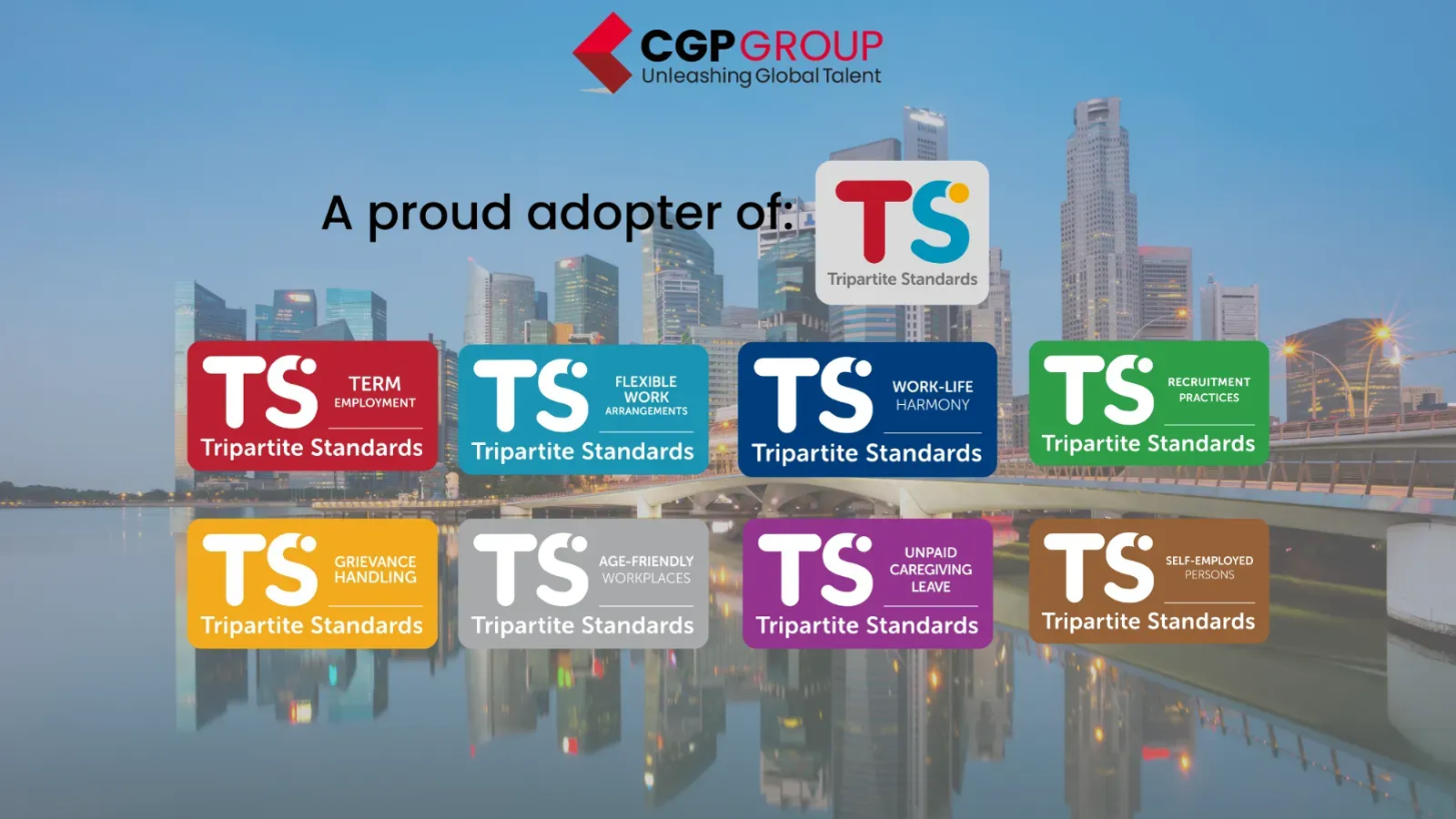
    ​CGP Singapore (hereafter, “CGP” or “The Company”) is proud adopter of the Tripartite Standards on the following 8 standards:

    • Recruitment Practices
    • Age-Friendly Workplace Practices
    • Unpaid Leave for Unexpected Care Needs
    • Employment of Term-Contract Employees
    • Flexible Work Arrangements
    • Grievance Handling
    • Contracting with Self-employed persons
    • Work-life Harmony

    The achievement in the adoption of these Tripartite Standards benchmarked our strong commitment to foster a conducive, progressive and healthy workplace for our staff, in addition to our high standards of staff training and development.

    What do these standards mean?

    The Tripartite Standards is a new initiative that was jointly developed by the Ministry of Manpower, National Trades Union Congress and the Singapore National Employers Federation that identifies and recognises employers who have implemented fair and progressive employment practices.

    Each Tripartite Standard comprises a set of verifiable, actionable employment practices in a specific area of employment which employers can publicly commit to adopt and implement at their workplaces.

    These standards help us showcase our strengths and establish our presence to:

    • Be recognised as an employer of choice.
    • Be recognised for your progressive employment practices.
    • Motivate your employees.
    • Enhance our ability and potential to pool and retain talent

    Building a better workplace for you

    By adopting the Tripartite Standards, we are committed towards building a better workplace and work environment for our staff, thus helping our employees to achieve good work-life balance and a fulfilling career. We will continue to ensure that our staff is treated fairly and with respect, and we will do our best to support them to achieve their full potential.

    Tripartite Standard on Recruitment Practices (RP)

    We assess and select job applicants through merit-based and inclusive hiring practices. This is especially important in a global and diverse workforce environment.

    Tripartite Standard on Flexible Work Arrangements

    We help employees better manage work and personal needs by offering Flexible Work Arrangements.

    Tripartite Standard on Age-Friendly Workplace Practices

    We value our older employees and support them with training and workplace health programmes.

    Tripartite Standard on Unpaid Leave for Unexpected Care Needs

    We help our employees to manage unexpected situations with leave for caregiving needs.

    Tripartite Standard on Employment of Term-Contract Employees

    We offer term contract employees the same benefits (leave entitlements, notice period, and training) as our full-time employees.

    Tripartite Standard on Grievance Handling

    We foster a more harmonious workplace with proper procedures to manage grievances.

    Tripartite Standard on Contracting with Self-Employed Persons

    We foster a stronger working relationships with self-employed persons by promoting progressive employment practices for service contracts

    Tripartite Standard on Work-Life Harmony

    We establish a work-life strategy to include flexible work arrangements, leave schemes, and employee support schemes to support our employees to effectively manage responsibilities and aspirations in the spheres of work and personal life.

    ​The Tripartite Standards initiative has reshaped the employment landscape in Singapore where it constitutes a positive step forward to develop a holistic framework for employment practices in Singapore. To ensure, CGP upholds its promise to promote inclusivity, agility, sustainability, and fairness in the workplace so our employees can realize their full potential, we are constantly reviewing our existing practices to check if we meet the specifications of the Tripartite Standards.

    Visit tafep.sg to learn more about the Tripartite Standards.

  • Best Practices For Positive Employee Experience And Retention Rate

    Best Practices For Positive Employee Experience And Retention Rate

    Employee retention has become a pertinent problem for many companies in the Asia Pacific. According to a survey finding from PwC Global, only 57% of employees in APAC are satisfied with their jobs and at least one in five desires to switch to a new employer.

    Changes in workplace expectations and possible manpower restructures are escalating due to imminent global inflation. Coupled with uncertainties and disruptions of the pandemic over the past 2 years, many people are spurred to reflect on how they are treated at work, re-evaluate their priorities, and eventually quit their jobs in pursuit of a better quality of life.

    Ongoing trends of the Great Resignation and Quiet Quitting are already in full swing and have become obvious manifestations of global workforce discontent.

    These trends raise an essential question – How can employers then ensure employee happiness, prevent further disengagement, and foster positive employee experience and retention rate?

    But, before that first understand what is employee experience and why it is important.​

    What is Employee Experience?

    Employee Experience is a holistic combination of all the interactions an employee experiences during its journey with an organization – from recruitment to onboarding and career development, to exiting the organization. These interactions include people, systems, policies and workspaces.

    ​ Employee experience includes everything – how an employee feels, how they perceive their potential and abilities, and the effect on their well-being.

    Employee experience is a pivotal factor that significantly impacts employee satisfaction and is very crucial throughout the entire employee journey. In the wake of the COVID-19 pandemic, everything about employee experience has fundamentally changed versus earlier times. Employee expectations and so do their priorities have shifted.

    Chris Lui, Director – Corporate Services Recruitment Team at Cornerstone Global Partners Singapore, shares best practices to help you deliver a positive employee experience as well as optimize retention rate.​

    Advocate Employee Wellness and Invest in Employee Growth

    The aftermath of the pandemic has taken a significant toll on both the physical and mental well-being of the workforces, hence supporting employee well-being by talking to them and gathering feedback is the biggest way to prevent disengagement and improve the employee experience.

    Offering merely a hybrid remote work environment should not be the sole solution, but genuinely checking in on teams to gauge their overall happiness towards work and aligning their career paths go a much longer way, providing a sense of fulfilment and meaning.​

    Encourage to Have Authentic and Heart-to-Heart Engagements

    Employees need to be able to trust their managers, which also requires employer transparency. Traditional hierarchical structures and top-down, command-and-control approaches may not work anymore and may further create a transparency gap.

    Employees want to feel empowered and secure in what they do and how they are being invested in their growth within the company, hence a heart-led leader that displays traits of empathy, vulnerability, and humility demonstrates tenacity and credibility to their employees, and will stand out during turbulent times at work.​

    Offer Fair and Competitive Compensation

    …but not as the sole factor to retain talent

    Manpower restructures post-pandemic have led to increasingly heavy workloads as employees are putting in even more hours than before, inspite of remote work privileges. It is therefore important to re-assess employee wages based on industry standards to prevent them from looking at greener pastures.

    However, hasty reliance on compensation counter-offers to retain talent attempting to move on with no basis towards their work productivities is clearly unsustainable and may create a wrong signal to employees where they feel a shift of power in their favour to ask for unrealistic remuneration demands beyond their actual work capabilities.

    Hence, employees must be clear and transparent about the pay structure and employers should increase bonuses and their wages only when employees have demonstrated that their value is truly deserving of it.

    In fact, offering skill specialization through specialist training or adding motivators to existing roles through increasing autonomy and task variety are more often than not better alternatives to increase job satisfaction and retention for the employee.​

    At the end…

    Employee retention will always be a constant concern for many companies, but the main key strategy for employee retention is to always make sure that employees are heard, and feel appreciated. Whether it is financial incentives, education and skill enhancement growth opportunities, or well-being benefits, feeling valued at the workplace fosters a sense of fulfilment and resilience, despite a volatile economic landscape today.

    ​At CGP, we have a comprehensive line of HR solutions that meet the needs of companies with distributed teams, including talent search, executive search, and contracting. Learn more about how we can help you bring great talents together across Asia.

    Know More​

    ALSO READ: