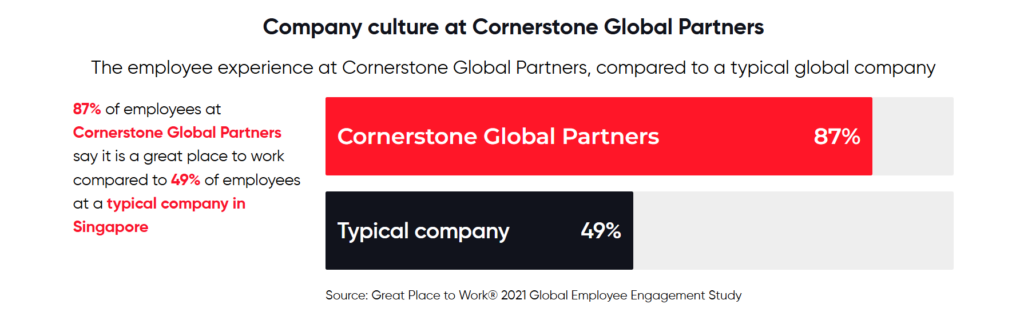
Cornerstone Global Partners (CGP Group) is proud to be Certified™ by Great Place To Work® for 2024-2025 in Singapore. The prestigious award is based entirely on what current employees say about their experience working at Cornerstone Global Partners Singapore.
Great Place To Work® is the global authority on workplace culture, employee experience, and the leadership behaviours proven to deliver market-leading revenue, employee retention and increased innovation.
“The Great Place to Work Certification is a prestigious recognition based solely on real-time employee feedback about their workplace culture. Getting certified highlights our unwavering commitment to delivering exceptional employee experience and reflects the trust our team has in CGP. We celebrate this achievement with gratitude for our dedicated employees, whose efforts made this recognition possible. Together, we will continue to strive for even greater success and milestones!” – Sean Ng, Co-founder and MD, CGP Group APAC.
“Great Place To Work Certification is a highly coveted achievement that requires consistent and intentional dedication to the overall employee experience,” says Sarah Lewis-Kulin, the Vice President of Global Recognition at Great Place To Work. She emphasizes that Certification is the sole official recognition earned by the real-time feedback of employees regarding their company culture. “By successfully earning this recognition, it is evident that our Singapore stands out as one of the top companies to work for, providing a great workplace environment for its employees.”
According to Great Place To Work research, job seekers are 4.5 times more likely to find a great boss at a Certified great workplace. Additionally, employees at Certified workplaces are 93% more likely to look forward to coming to work, and are twice as likely to be paid fairly, earn a fair share of the company’s profits and have a fair chance at promotion.
We’re Hiring
Looking to grow your career at a company that puts its people first? Visit our careers page or LinkedIn!
Keep up with the CGP Culture
We’re all about having fun. If you want a taste of the CGP culture, meet us up on our Instagram account @cgp_apac
About Cornerstone Global Partners
Cornerstone Global Partners is an award-winning executive search, contingent recruitment, flexible staffing & HR outsourcing firm delivering talent services across SEA. We provide premium human resources and talent services from large multinational corporations to small and medium-sized businesses across mature and emerging markets in Asia. Our team of experts delivers customised talent solutions covering functions including sales, marketing, human resources, accounting & finance, legal & compliance, supply chain, manufacturing, information technology, operations, etc. Our holistic suite of talent services ensures you have the right talent, in the right roles, aligned with your business goals and culture.
About Great Place to Work Certification™
Great Place To Work® Certification™ is the most definitive “employer-of-choice” recognition that companies aspire to achieve. It is the only recognition based entirely on what employees report about their workplace experience – specifically, how consistently they experience a high-trust workplace. Great Place to Work Certification is recognized worldwide by employees and employers alike and is the global benchmark for identifying and recognizing outstanding employee experience. Every year, more than 10,000 companies across 60 countries apply to get Great Place To Work-Certified.
About Great Place To Work®
As the global authority on workplace culture, Great Place To Work® brings 30 years of groundbreaking research and data to help every place become a great place to work for all. Their proprietary platform and For All™ Model helps companies evaluate the experience of every employee, with exemplary workplaces becoming Great Place To Work Certified™ or receiving recognition on a coveted Best Workplaces™ List.
“Companies that embrace diversity and inclusion in all aspects of their business statistically outperform their peers.” – Josh Bersin.
Modern time demands diversity and inclusion to remain central to what an organisation does. The world knows creating a supportive and inclusive work environment starts from the top. But most importantly, the process begins with an in-depth understanding of the importance of employee well-being.
A Forbes article says, “Mental health and diversity and inclusion (D&I) are closely connected.” Therefore, fostering an inclusive and supportive work environment is crucial to ensure the good mental health of your people. So, let’s get into further details and unveil what can be done to support employees.
Link Between Inclusion & Mental Well-being
Inclusion and mental well-being are strongly linked, and promoting inclusion can have a positive impact on individuals’ mental health.
Employees with good mental health are more inclusive.
Inclusive workplaces enable connection with others.
Inclusive workplaces support work-life balance.
Inclusive workplaces support a positive self-image.
Well-planned mental well-being initiatives recognise diversity in the needs of employees.
Diversity and inclusion programs recognise mental health and well-being as diversity issues.
Mental Health & Inclusion: How Can Companies Build a Supportive Environment for Workforce
#1. Understand Mental Health
The first step toward creating an organisational culture that supports employees’ mental health is overcoming the stigma. People often don’t discuss their mental health as freely as they discuss other ailments.
Organisational leaders have the power to break the stigma. To ease the process, the primary focus is to understand the term mental health and the issues that lead to disturbed mental states. It can begin with reading scholarly articles, surfing online resources, and talking to mental health counselors.
#2. Increase Awareness
If you have people shying away from talking about their mental issues, trust us, you don’t have a healthy organisational culture. The need is to educate the workforce and help them manage their mental well-being without fearing ridicule.
Hiring managers and managers must be trained to handle sensitive issues. The next duty is to direct employees to the best resources to help them fight mental health concerns. Therefore, offering solid training to the leaders on inclusion is crucial.
#3. Recognise the Needs of Different Employees
Devising a well-being program isn’t enough if it lacks accessibility. The focus must be on language, literacy, religion, culture, age, and health status. Additionally, consider the presence of diverse talent within the organisation before designing a well-being program. This will help you in making it accessible to all employees.
A well-devised program helps in promoting inclusion and a healthy organisational culture.
#4. Evaluate the current situation
Keep a check on the current situation and identify the areas that need improvement. Then, at the next stage, create an action plan and measure the progress.
The best way to understand the state of employees’ well-being and satisfaction is by conducting company-wide engagement surveys. This will help you strategise and identify appropriate actions to build a happier, healthier, and more productive workforce.
Continuously monitor your organisational culture and gather insights on employee mood, morale, and engagement. For better results, conduct a survey and measure aspects such as the kind of employee energy inside the company, employee engagement level, mood and morale of employees, and changes in company culture.
The benefit of tracking engagement is developing an environment focused on employee well-being and mental health.
#6. Reduce Work Stress
Employees who are distracted by another taxing task or carry a huge workload tend to feel depressed. Oppositely, people with low work stress can deliver higher levels of productivity. But unfortunately, today’s workforce sees a workplace as a source of anxiety and stress.
The aim should be to reduce the workload levels and promote inclusion to protect employees’ self-esteem and self-worth.
#7. Make Language Adjustments
The choice of words can soothe or trigger a situation. In other words, your chosen words can build a stigma around mental health or break it up. The crux is to make use of inclusive language. There are a few changes you can make to your language.
Use person-first language so the person is not defined by their mental state.
Refrain from using inappropriate language.
Avoid using certain words that can hurt someone deeply.
Be supportive and empathise.
Final Words
If a company fails to prevent its employees’ mental health from deteriorating, it can have serious consequences. And these after-effects will impact both individuals and the organisation as a whole. The worse that can follow is poor physical health and a sharp decline in their performance and productivity.
In the words of Howard Schultz, former CEO of Starbucks, “A company’s most valuable asset is its people. When we take care of our employees, they take care of our customers, and that leads to growth and success.”
An undeniable statement, indeed, that empowers you to start your journey of creating a supportive and inclusive work environment.
FAQs
1. How do you create a positive mental health environment?
Creating a positive mental health environment is not a single person’s task, but it takes a lot of effort. Here are a few tips to help foster an environment supporting mental health.
Train supervisors and managers.
Introduce support-focused performance management.
Ensure the availability of resources to the team.
Have open and human-centric conversations with the team.
Offer learning opportunities to shape the employee experience.
Practice and model good boundaries.
2. How can I be inclusive of mental health?
To be inclusive in mental health, you must:
Always keep in mind that an employee is a person first.
Check-in with your employee timely.
Show them that you care and understand.
Have regular conversations with the employees about mental health.
Referred to as the ability to work from anywhere, anytime, remote work has become a full-blown movement globally. Market projections dictate remote work is here to stay, and opportunities for job seekers will continue to increase through 2023.
According to Statista, 67% of respondents indicated having a flexible schedule as the most significant benefit of working remotely. The flexibility to choose work location ranked second.
That’s a close-to-reality statistic. But if you think the employee benefits conclude with these two aspects, you’re probably mistaken. This article outlines the top 9 employee perks and benefits you could offer your employees to align with this new way of working.
Top 9 Employee Perks & Benefits for Remote Workers
#1. Health & Wellness Programs
Wellness programs help employees attract success in every sphere— physical, emotional, virtual, financial, and career. A healthy workforce builds a successful organisation; thus, you must cater to their mental well-being and good health.
Despite having a remote team, companies can still ensure the provision of health and wellness perks. For instance, employers can provide virtual gym memberships or discounts for healthy food delivery subscriptions and motivate them to maintain a balanced diet.
#2. Childcare Benefits
Employees always appreciate & value employers who offer benefits that embrace their family’s well-being. And when these benefits include their children, there arises an instant sense of gratification among employees.
Organisations offer educational assistance for remote workers’ kids. Alternatively, employers who cannot afford high expenses can send birthday gifts for employees’ children or grant them leave to spend the day together.
#3. Learning & Development Opportunities
Learning and development opportunities are the heart & soul of an employee’s professional goals. When an organisation allows employees to learn and develop their skills, the workforce feels obliged to be the organisation’s part.
Companies can arrange a training program for the entire team and should consider seeking their opinion before choosing a particular skill. On the other hand, you can let them choose their preferred webinar or course.
#4. Insurance Plans
Present-day employees priortise getting insurance plans to safeguard themselves and their families against uncertainty. It gives remote workers financial security but choosing the right plan may get tricky owing to the high costs.
Organisations can offer subsidised insurance plans to their employees, which will relieve them of burden & financial insecurity. Luckily, many insurance firms provide corporate insurance plans that offer the most optimum option to suit employees.
No remote worker can produce high-quality output just by accessing relevant software and apps. Put another way, offering equipment such as a computer or a laptop is necessary. Providing employees with the mentioned things indicates that the organisation is happy to invest in its people.
Apart from essential equipment, employers can also offer an allowance for employees to purchase home office furniture. Employees can use the funding to purchase office chairs, work desks, system accessories, and furnishings.
One of the most sought-after benefits employees look for is a flexible work schedule. Nowadays, employees prioritise work-life balance and prefer working at times suitable to them.
When employees are allowed to adjust their schedules accordingly, it enables them to produce the best output. Moreover, they can meet deadlines effectively and fulfill their responsibilities on time.
#7. Paid Time Off
Undeniably, remote workers don’t have to report to the office for work. However, that doesn’t mean they shouldn’t be entitled to paid time off. Most remote workers fail to distinguish between work and personal life.
Times have changed, and organisations offer paid vacation or create programs that recognise top performers and offer them vacation leave credits.
#8. Team-building Events
Remote working has become the new normal, but employees may miss meeting their colleagues in person. Fortunately, companies have started seeing it as an opportunity to make employees meet virtually and indulge in team-building activities.
Undoubtedly, communication and relationship-building are crucial for remote workers. Therefore, companies can hold virtual meetings that assist in employee connection formation. For instance, employers look for events that any onsite would do and make them a part of their remote working. Team lunch-outs and happy hours are among the most sought-after activities to create a team bond.
#9. Home care services
Working from home can become daunting if the household chores distract employees. To increase their productivity, companies can facilitate their employees with various home care services to help them concentrate on work.
Successful Perks are Those That Employees Will Value
In the words of Ken Matos, ”People today really value workplace flexibility and remote work because it allows them to focus their energies on work and life as opposed to commuting.”
Visibly, remote work is more than a mere trend. As the current and future state of work, it will continue bringing employees and employers virtually closer. Although the idea isn’t new, the benefits transform business models globally. Remote work creates a happier workforce where employees can spend quality time with family, walk their pets, and contribute to household chores. But then the perks shouldn’t cost organisations their performance and reputation.
Need assistance to fast-track your hiring needs? CGP Singapore is here!
Are you looking to fill positions in your organisation? CGP Singapore knows how to attract the right talent powered by the relevant skills. Get in touch with us today to know more about our recruitment processes, or submit your vacancy, and we’ll reach out to discuss your hiring needs.
1. How does flexible scheduling benefit remote workers?
Flexible scheduling benefits remote workers in numerous ways:
Provides a better work-life balance
Improves health and well-being
Increases productivity and job satisfaction
Boosts employee engagement
Reduces stress and burnout rates
Saves time and commute costs
Provides a better living standard
2. How can employee engagement and recognition programs benefit remote workers?
The easiest way to retain remote employees is by engaging and supporting them through recognition. In a way, organisations prove to employees that they care about their employees’ well-being. As a result, remote workers feel valued and connected to the organisation, which makes them more loyal to their employers and boosts their productivity. Moreover, it gives them a sense of freedom and responsibility simultaneously.
3. How do time management resources benefit remote workers?
Time management resources are a powerful tool to increase remote work productivity. People working remotely can track their time and identify the tasks that take up most of their time and effort. As a result, they can prevent time loss or wastage and perform better within a precise time frame.
Managing a team is more than guiding the team members and delegating tasks to generate the desired results. The central aspects of giving your employees a healthy work environment and supporting the team’s mental health are tied to the team management function.
Why investing in mental health is imperative?
As per Mercer (2021), almost 50% of employees worldwide report being stressed in everyday life. A recent study by Cigna shows that stress-related illnesses cost Singapore’s economy about US$2.3 billion (S$3.2 billion) annually and account for about 18% of the country’s total health expenditure (Cigna stress report, 2019). Singapore ranks as the second highest among the nine countries in the Asia-Pacific (APAC) region surveyed regarding healthcare spending attributable to stress-related illnesses.
Fortunately, employers are striving to extend employee mental health support in every phase of the employee’s corporate journey within their organisations. There are numerous ways managers can consider supporting their team’s mental health.
Here is our list of strategies for doing this, curated by our team of expert consultants.
#1. Understand the Factors Causing Workplace Stress
An optimum level of stress is good and leads to enhancing organisational performance. But considering the increasing levels of workplace stress, there is a pressing need to check and control the factors instigating stress at work. While minor to significant issues could increase stress levels, the most prominent are excessive workload, non-cooperative seniors, unhealthy work environments, and below-average learning opportunities.
#2. Give Employees Space to Pause & Seek Support
Organisational health and employees’ mental health run alongside and are inseparable. The need of the hour is to make employees feel supported and give them enough space to seek support after a required pause.
Expect situations to change that may lead to employees requiring a breather.
#3. Encourage Employees to Take Earned Vacation or Paid Time Off
Spending some time away from work can refuel employees’ productivity and motivation. Leaders and managers can encourage their people to take some time off and release them from the guilt of requesting genuine leaves.
Alternatively, managers could consider organising team events for recreational purposes.
#4. Normalise Mental Health Talks
Let’s face it; no one wants to talk about mental health. But regardless, the stigma attached to having conversations around mental health should be discarded. If organisations cannot encourage employees to have a heart-to-heart talk about mental health, their people will keep doubting their self-sufficiency and develop more severe symptoms.
“Employers that provide mental health and counselling benefits create a stronger social bond and engender greater employee loyalty.”
#5. Check-in on the Team Members Regularly
Asking your team members about their health and family is the firmest step you can take towards ensuring employees’ good mental health. While they might not share if anything is wrong with them, you can still tell them they have someone who is all ears.
Additionally, managers can identify an effective way to extend employee mental health support to remote employees.
#6. Practice Transparency
Managers must inform their people sufficiently, be it the micro-tasks that cater to an employee’s daily work schedule or meeting with the CEO. From a practical viewpoint, a lack of agenda for tasks, irrespective of their nature, can cause unnecessary anxiety among the team members. Ensure your people know what you expect from them in a particular situation or a meeting.
#7. Be Inclusive
Present-day managers cannot afford to overlook the importance of being accommodating and offering flexibility. As a manager, educate yourself about what’s happening in your people’s lives and support them in the required manner. For instance, you can offer flexible working hours (of course, not at the cost of the organisation’s goals) to team members having childcare responsibilities or ailing parents to look after. Be generous and realistic to the safest extent.
#8. Promote Mental Well-being Throughout the Company
Invest in building an open culture that supports the organisation’s idea of prioritising mental health over other factors. Spread the word and make every employee know you treat mental health on the same terms as physical health. Also, have policies and strategies in place to ensure support to the team members.
#9. Set Reasonable Expectations
It’s important that managers recognise the employees who might be struggling and have a one-on-one with them. Engaging them in healthy conversations and guiding them on how the organisation and its policies can mend the situation and improve their psychological state. And the best person to remove stress by setting reasonable expectations is a manager.
Team support will, thus, follow to ensure the good mental health of the employees across the organisation.
#10. Support Employees’ Pursuits of Fun
Make sure your employees take some time out for fun. For example, encourage them to utilise coffee breaks to interact with one another on non-work related topics. Besides, managers can ask them to list their preferred activities for fun outside work.
Implementing a well-being programme
As the number of employees suffering from mental illnesses increases due to changes caused by the pandemic, the need for accessible healthcare is paramount. To address this issue, digital healthcare tools offer several apps to scale up treatments. EAPs, well-being webinars, flexible benefits, and mental health training are current solutions most organisations have in place.
Although digital mental health solutions provide a great alternative for maintenance and preventive care, one-to-one clinical therapy will still be essential to mental health management.
Before deciding which digital solution to invest in, employers should reflect on their objectives and employees’ characteristics and preferences.
Here is a checklist of what you can do to implement a future-proof mental well-being programme:
Determine your objectives and how to achieve and measure their success.
Adopt a holistic well-being pathway that meets your organisation’s objectives by engaging a wellness consultant.
Collect feedback from your employees through focus groups and engagement surveys.
Engage a wellness consultant to help plan your well-being framework for the year
Conclusion
“The workplace is often the most stressful place a person finds themselves in; employees and managers need to watch for signs of deteriorating mental health in fellow colleagues.”
The only silver lining to building a stress-free workplace is ensuring the continuous provision of employee mental health support. Opportunely, in the end, your people will always remember how you cultivated a healthy work environment that reflects their loyalty towards the organisation.
Contact the most dynamic team of specialist recruitment consultants to hire highly skilled professionals. We are just a click away.
Managers have all the rights to bring the required transformation in the organisation’s environment and policies to promote mental health. First, they must understand the factors that cause stress among the employees. Second, they must give enough space for employees to pause and unwind. Third, they must practice transparency and normalise mental health conversations. Additionally, they must consider promoting an inclusive workplace and set reasonable expectations.
How can managers support employee well-being?
Managers can incorporate the necessary policy changes and invest in training to educate the workforce about mental health. Apart from this, they can bring small changes throughout the organisation and their way of helping employees manage stress levels.
How can managers support their teams?
Managers can support their team by:
Talking to them and knowing what is troubling them at work.
Diversity is a way of life, and we know intuitively that it matters. Many studies have showcased and proved the benefits a diverse workforce can bring to organisations, and the meteoric rise of conversations around the concept further confirms it.
Amidst the rising importance of workplace diversity, social media showcases some discussions around racial injustice, systemic racism, and biases. These conversations keep reintroducing millennials to the importance of racial diversity in the workplace – a term that constitutes the largest chunk of the term diversity.
Today, workplace diversity & inclusion (D&I) goes beyond the dialogue of gender, race, and ethnicity and is more than policies, programs, or headcounts.
According to a survey done by Glassdoor, 67% of job seekers consider workplace diversity as an important factor when considering employment opportunities, and more than 50% of current employees want their workplace to do more to increase diversity.
What is Racial Diversity?
“Racial diversity is the acknowledgment and celebration of differences between racial groups. Diversity recognizes and values differences within and between racial identities, noting the intersectionality of many groups, including ethnicity, gender, age, national origin, religion, disability, sexual orientation, socioeconomic status, education, marital status, language, and physical appearance. It also involves different ideas, perspectives, and values.” – Howard University School of Law Library.
In simpler terms, racial diversity in the workplace refers to the range of similarities and differences individuals possess that make them unique. It enriches the work culture and enables employers to access a wider pool of talented professionals.
Importance of Racial Diversity in the Workplace
The definition of a workplace being nothing more than a place where a person comes and works from nine to six is obsolete. Present-day employees want to work in an inclusive place where they are accepted irrespective of their racial identities and racial groups. When an organisation brings people together from all walks of life, it’s amazing what can be accomplished.
Great Place to Work Institute defines a diverse and inclusive workplace as one that makes everyone, regardless of who they are or what they do for the business, feel equally involved in and supported in all work areas. The “all areas” part is important.
Nowadays, organisations promote racial diversity and let people know they acknowledge the concept through social media platforms.
With diversity and inclusion gradually becoming an integral part of recruitment practices, employers have started focusing more on hiring a diverse workforce.
Various factors contribute to letting recruiters incorporate diversity & inclusion into the workplace.
How to support & promote Diversity & Inclusion at work?
#1. Bring Leaders to the Forefront
Promoting diversity & inclusion is a complex issue as organisations have to deal with deep-seated beliefs and implicit & explicit biases present in the workplace culture. Notwithstanding, when leaders drive change, it doesn’t solely revolve around impacting employee attitude. In fact, it involves self-reflection as leaders must first identify and understand their own feelings towards a racially diverse workforce and what they will face working with them. This will help them assess their leadership style and create opportunities to promote diversity.
You can, for instance, ask them to be a spokesperson for overcoming racial discrimination or mentor racial groups within the organisation. Alternatively, you can also show them the benefits of having a diverse workforce.
#2. Offer Feedback Channel
In her book Diversity in the Workplace, Bärí A. Williams presents numerous interviews with business leaders on how to battle unconscious bias and provides examples of successes that were lifted up by diversity.
This success, in real life, can only come if we start being vocal about race in the workplace. To speak up, you should first acknowledge that talking about race can bring awkwardness, and you must validate others’ feelings to remove their discomfort. Be open to hearing and learning from others’ experiences. Listen more to others and be genuinely interested in creating a better workplace for everyone.
#3. Revisit the Hiring Practices
HR teams must closely check the recruitment process and see how they can make their organisation completely inclusive. Recruiters must be open to receiving applications from candidates belonging to different races. Additionally, the hiring panel must also comprise interviewers from different racial groups, which will prevent bias from happening during job interviews.
Even the job descriptions should seem to welcome racial diversity and must avoid using phrases related to race. Such recruitment practices will help you have a more racially-diverse workforce.
Recognised for Our Progressive Employment Practices
At CGP Singapore, we have recently adopted Tripartite Standards that comprise a set of verifiable, actionable employment practices in a specific area of employment that employers can publicly commit to adopt and implement at their workplaces.
#4. Conduct Training
Racial equity is an underrated term, but it contains a deep-rooted meaning. By promoting and creating employee training programs, organisations can boost racial diversity within the work environment. Present work cultures make it imperative to invest in training people across the organisation to promote racial diversity.
According to reports, a 1% improvement in racial diversity similarities between upper and lower management boosts company efficiency by $729 to $1590 per year per employee.
There must be some upskilling at the employee and organisational level to prepare them for racial equity and racial diversity.
#5. Formulate & Implement an Anti-discrimination Policy
An anti-discrimination policy must firmly establish that discrimination is not tolerated in the company. The policy must set out clear expectations and desired behavior in the workplace. Besides, there should be a defined complaint procedure to make it easy for employees to raise their concerns that can be further investigated.
Doing this brings inclusion to the organisation and creates a work environment that compliments racial diversity.
An Insight into Racial Diversity in Singapore
Singapore is among the most innovative and prosperous hubs in the world, with a high concentration of immigrants. Singapore achieved independence in 1965, and its founding fathers instituted measures to promote racial and ethnic unity.
This South-East Asian island nation is popular for its technology-ready aspects and being multicultural, with a mix of people of Chinese, Malay, and Indian descent. The population consists of different religious faith groups, including Buddhists, Christians, Muslims, and Hindus. Singapore’s ethnic and religious diversity has resulted in relative racial harmony in society and the corporate world. Moreover, it has set an example for other nations to learn.
Conclusion
Racial diversity in the workplace is pivotal for both parties– employers & employees. According to a report, racially and ethically diverse companies perform better financially. Such companies are 35% more likely to outperform their respective national industry medians’ financial returns.
And the statistic that proves why racial diversity is an important aspect for employees is:
A racially diverse environment fosters progressive change and collaborative team works, and the organisation should head in the right direction. Not as a way to match what society asks but because it brings ample benefits and the way it impacts the environment.
FAQs
1. What are the different types of diversity in the workplace?
There are 4 types of diversity in the workplace, which include:
Internal diversity: Internal diversity refers to situations that a person is born into. In other words, these things are the ones that a person doesn’t choose for himself and are impossible to change. The examples are race, ethnicity, age, national origin, cultural identity, gender, and physical ability.
External diversity: This refers to the characteristics that other people and surroundings heavily influence. However, a person can change these aspects.
Organisational diversity: Organisational diversity refers to the differences between people assigned to them within a workplace and distinguishes one employee from another.
Worldview diversity: Worldview diversity changes with time and includes internal, external, and organisational characteristics.
2. Is racial diversity important in the workplace?
Yes. Racial diversity is important in the workplace as it boosts employee engagement and productivity. It makes the workplace comfortable for everyone across the organisation.
3. What are the three ways to handle diversity?
The three best ways to handle diversity are:
Highlighting personal uniqueness and appreciating individual differences.
Developing policies adhering to company goals that are accessible for everyone to review & understand.
Continuing to evolve with employers, understanding changes, adjusting existing policies, and working on new diversity and challenges.
“What is the miracle drug to mitigate workplace challenges?” This is believed to be the most common question asked by every employer.
Employees feel that “It is how committed we are to the work, goals, and values of the organisation, which is a result of the organisation’s approach towards making us feel valued and engaged.”
Before understanding how employee engagement can benefit the company, let us decipher the term employee engagement. It is one of the critical indicators in gauging work satisfaction and refers to how happy the employees are with their professional roles and passionate about what they do.
As Ken Blanchard said,
“Connect the dots between individual roles and the goals of the organization. When people see that connection, they get a lot of energy out of work. They feel the importance, dignity, and meaning in their job.”
Top recruitment firms in Singapore advocate that organisational success starts with employee engagement, and leaders are responsible for keeping employees inspired, informed, and valued. Teams go from being good to being great when they are genuinely engaged. Let’s explore this more closely.
Benefits of Employee Engagement
Boosts Team Performance
Employee engagement benefits the team as the employees naturally perform better when they work with a group of engaged employees. Amazingly, employee morale is very contagious and spreads faster across the organisation.
Employers that motivate their people are more successful with higher organisational profitability. So, whether you are trying to engage your team by giving them challenges or opportunities, you do it for everyone’s good.
Improves Retention Rates
As per a 2021 study, 73 percent of employees would consider quitting their jobs even if they weren’t looking for a job change at the moment. Employees cite lack of recognition, internal office conflicts, and lack of pay raise as some of the reasons for quitting.
Engaging employees can reduce turnover and hiring costs.
According to Forbes, engaged employees are more likely to stay motivated and committed to their employer. This factor drives the organisation forward and empowers it to achieve its goals efficiently.
Reduces Burnout & Improves Mental Wellness
The World Health Organization defines employee burnout as an “occupational phenomenon resulting from chronic workplace stress that has not been successfully managed,”
An organisation that bothers to keep the stress level among employees under control brings good results– for itself & employees. Additionally, conducting a workplace wellness program leads to better employee experience and engagement.
Fosters Employee Loyalty
When you keep your employees engaged, they will start developing an emotional connection with the organisation that will foster loyalty on their part. Other factors that strengthen their loyalty are making them feel appreciated, giving them autonomy to make some decisions in urgent situations, and not micromanaging them.
Healthy competition among teams makes the workplace healthier. Therefore, it is necessary to recognise people’s performance and attitude towards work. You can make your people work well on a team level by praising and appreciating them.
Engaged teams also become a bunch of great innovators who work relentlessly to think beyond their capacity and bring out-of-the-box ideas to the table. And because the top recruitment firms in Singapore collaborate only with organisations that uphold their employee engagement strategies, it becomes necessary for every organisation to keep employees engaged in getting the best talent.
Better Sales & Customer Service
Anyone can become a salesman, but not every salesman can be equally efficient. So then, where does the difference lie? The level of motivation, persistence, and engagement a salesman possesses makes him stand out from the crowd.
The correlation between positive employee experience and positive customer experience proves the importance of keeping employees engaged. The more engaged your sales & customer service team, the better.
Promotes Growth
Increased growth includes but is not limited to selling more products or services. Engaged employees organically assist organisations in strengthening their bond with customers, bringing a 10% increase in customer ratings. Further, it can result in a 20% increase in sales & profitability.
There has been enough evidence proving happy employees make happy customers. And when you have happy customers, the organisation will itself grow.
Generates Employee Advocacy
Employee advocacy is the biggest perk of employee engagement. Team members start feeling happy and proud to work for and with their employers and naturally become brand ambassadors.
The concept positively impacts marketing, branding, and talent acquisition efforts and exposes your brand to a broader audience.
Final Thoughts
Employee engagement isn’t another corporate buzzword but is the kingpin that stands to support an organisation’s growth. It’s a process and an ongoing commitment to keeping the employees engaged. People want to be treated as people and know they matter.
Cornerstone Global Partners, the most sought-after recruitment agency in Singapore, advocates organisations must give an unrivalled commitment to employee engagement. Having effective strategies in place helps create a better work culture, reduce staff turnover, increase productivity, and build better work and customer relationships.
“A group of people get together and exist as an institution we call a company so they are able to accomplish something collectively that they could not accomplish separately – they make a contribution to society, a phrase which sounds trite but is fundamental.” – David Packard, the late co-founder of Hewlett-Packard.
We are among the top recruitment firms in Singapore and follow this quote and spread its importance to let organisations acknowledge the necessity to keep the employees engaged.
As defined by some experts, employee engagement refers to the degree of commitment a person feels to the organisation and its goals. While some explain it as the extent to which a person cares about his job. Engaged employees care about their work and keep a check on how their work is contributing to the organisation.
Why is employee engagement important?
Employee engagement has been proven to reduce staff turnover, boost productivity & efficiency, improve customer service, and increase profitability. In addition, an engaged team makes it easier to run a business by letting the leaders focus on higher-value activities like innovation, process improvement, and growth & development to keep the organisation running smoothly.
In this post covid era, quite a few novel behaviours have emerged that have encouraged new sound bites, discussions, and hot topics one of which is “Quiet Quitting.”
For some, this is a ridiculous term giving voice to lazy workers who want to get paid for doing the absolute minimum but for others, it’s a very real epidemic that has seen current and potential employers rethink their retention strategies so as not to lose talent.
What is Quiet Quitting?
Wikipedia states that “Quiet quitting is an application of work-to-rule, in which employees work within defined work hours and engage in work-related activities solely within those hours. Despite the name, the philosophy of quiet quitting is not connected to quitting a job outright, but rather doing precisely what the job requires.” In essence, it refers to employees who put no more effort into their jobs than absolutely necessary.
Ultimately, there seems to be a generational divide which has been present for years whereby Millennials have been asking “What can my employer do for me?” which was a definitive shift from the, “What can I do for my employer” mentality of previous times.
It is fact that Quiet Quitting is definitely something that is more popular among younger workers, but that is not to say there has been a change in the attitudes of older employees, especially since the covid epidemic.
Workforce Dissatisfaction – Time to Address It
Another buzz phrase that has raised its head in this new era is “The Great Resignation” where people have decided to leave rather than do unfulfilling work. This together with Quiet Quitting refers to workforce dissatisfaction that must be addressed and which can no longer be ignored.
As a Generation X, I was intrigued to see people rather not work than have no income to speak of or in fact a much lower income should they choose to do what they want rather than what they needed to. Covid then introduced WFH or Hybrid working and significantly reinforced the notion that work is an activity, not a place that was embraced by both young and old. This could definitely be down to a previously undiscussed level of collective burnout that employees were experiencing but had not addressed.
Hidden Signs Your Employees are Quiet Quitting at Work
As both an Employer and Recruiter, I would strongly recommend that you recognise hidden signs your employees are in Quiet Quitting mode at work. Of course, there are many signs but one basic sign is noticing an undesired change in behavior in the way people interact with others. Other signs could include getting disengaged from the work, no more taking initiatives, isolating from the team and having a changed perception of work.
Disengagement in work
Disengaged employees often exhibit a slow working tempo, are easily distracted, and have minimal contribution. They basically demonstrate an overall lack of interest.
A lack of initiative
At some point in time, employees tend to lose interest in putting their best foot forward and give up on their responsibilities to initiate things that can bring great results for the organisation.
Individual isolation from the team
Isolation at work is a type of social isolation that can fill an employee with a feeling of being separate from others. Gradually, the person appears disengaged and stops interacting with co-workers, ultimately impacting overall productivity.
Changed perception of work
Employee output and motivation are directly proportional to their perception of work. Employees can never feel satisfied with their job if their perception of work and the organisation’s vision & mission are not aligned.
Build relationships, be upfront, and be open about workload
No organisation can ever succeed if it doesn’t communicate well with its team members. Leaders ought to cultivate an environment that values relationships within teams and is open about expectations while letting employees speak up and share their side of the story when required.
Re-engage and motivate your employees – show gratitude
Valuing employees and making them feel a part of the organisation can bring exemplary results. Leaders must motivate employees by acknowledging their efforts and rewarding them. This also boosts the employee retention rate.
Encourage sustainable growth – invest in employee growth
A company grows when its employees do. Most employees believe a company that values their growth & development is more likely to have their loyalty. The management must ensure uninterrupted learning for its employees, so they continue to evolve.
Maintain boundaries and respect work-life balance
An organisation’s environment should also promote respecting boundaries and being mindful of work-life balance to march forward in the right direction.
In the end…
In addition, it is integral that employers listen to employees and foster a praising and awarding culture. If people enjoy their work, no matter where it is they are working from, then a natural outcome will be more engagement and productivity.
At CGP Singapore, We help employees better manage work and personal needs by offering Flexible Work Arrangements. We are committed towards building a better workplace and work environment for our staff, thus helping our employees to achieve good work-life balance and a fulfilling career. Share your interest if you are looking to join our unique, fun, and innovative business and become future hiring experts. Know More Here
Employee retention has become a pertinent problem for many companies in the Asia Pacific. According to a survey finding from PwC Global, only 57% of employees in APAC are satisfied with their jobs and at least one in five desires to switch to a new employer.
Changes in workplace expectations and possible manpower restructures are escalating due to imminent global inflation. Coupled with uncertainties and disruptions of the pandemic over the past 2 years, many people are spurred to reflect on how they are treated at work, re-evaluate their priorities, and eventually quit their jobs in pursuit of a better quality of life.
Ongoing trends of the Great Resignation and Quiet Quitting are already in full swing and have become obvious manifestations of global workforce discontent.
These trends raise an essential question – How can employers then ensure employee happiness, prevent further disengagement, and foster positive employee experience and retention rate?
But, before that first understand what is employee experience and why it is important.
What is Employee Experience?
Employee Experience is a holistic combination of all the interactions an employee experiences during its journey with an organization – from recruitment to onboarding and career development, to exiting the organization. These interactions include people, systems, policies and workspaces.
Employee experience includes everything – how an employee feels, how they perceive their potential and abilities, and the effect on their well-being.
Employee experience is a pivotal factor that significantly impacts employee satisfaction and is very crucial throughout the entire employee journey. In the wake of the COVID-19 pandemic, everything about employee experience has fundamentally changed versus earlier times. Employee expectations and so do their priorities have shifted.
Chris Lui, Director – Corporate Services Recruitment Team at Cornerstone Global Partners Singapore, shares best practices to help you deliver a positive employee experience as well as optimize retention rate.
Advocate Employee Wellness and Invest in Employee Growth
The aftermath of the pandemic has taken a significant toll on both the physical and mental well-being of the workforces, hence supporting employee well-being by talking to them and gathering feedback is the biggest way to prevent disengagement and improve the employee experience.
Offering merely a hybrid remote work environment should not be the sole solution, but genuinely checking in on teams to gauge their overall happiness towards work and aligning their career paths go a much longer way, providing a sense of fulfilment and meaning.
Encourage to Have Authentic and Heart-to-Heart Engagements
Employees need to be able to trust their managers, which also requires employer transparency. Traditional hierarchical structures and top-down, command-and-control approaches may not work anymore and may further create a transparency gap.
Employees want to feel empowered and secure in what they do and how they are being invested in their growth within the company, hence a heart-led leader that displays traits of empathy, vulnerability, and humility demonstrates tenacity and credibility to their employees, and will stand out during turbulent times at work.
Offer Fair and Competitive Compensation
…but not as the sole factor to retain talent
Manpower restructures post-pandemic have led to increasingly heavy workloads as employees are putting in even more hours than before, inspite of remote work privileges. It is therefore important to re-assess employee wages based on industry standards to prevent them from looking at greener pastures.
However, hasty reliance on compensation counter-offers to retain talent attempting to move on with no basis towards their work productivities is clearly unsustainable and may create a wrong signal to employees where they feel a shift of power in their favour to ask for unrealistic remuneration demands beyond their actual work capabilities.
Hence, employees must be clear and transparent about the pay structure and employers should increase bonuses and their wages only when employees have demonstrated that their value is truly deserving of it.
In fact, offering skill specialization through specialist training or adding motivators to existing roles through increasing autonomy and task variety are more often than not better alternatives to increase job satisfaction and retention for the employee.
At the end…
Employee retention will always be a constant concern for many companies, but the main key strategy for employee retention is to always make sure that employees are heard, and feel appreciated. Whether it is financial incentives, education and skill enhancement growth opportunities, or well-being benefits, feeling valued at the workplace fosters a sense of fulfilment and resilience, despite a volatile economic landscape today.
At CGP, we have a comprehensive line of HR solutions that meet the needs of companies with distributed teams, including talent search, executive search, and contracting. Learn more about how we can help you bring great talents together across Asia.
The COVID-19 pandemic has triggered companies to evaluate their current in-office work setup and transition to more flexible structures, such as work-from-home (WFH) and hybrid work. While some businesses now have a fully remote workforce, others ask employees to work partly remotely and come into the office at least once or twice a week.
According to Accenture, 63% of high-growth companies use a hybrid work arrangement to boost efficiency and productivity. Other studies report that although 44% of global companies don’t welcome work-from-home (WFH), 16% operate entirely remotely.
These recent workplace trends suggest the need of assessing your existing work model and analysing which structure can get your employees to show up motivated. To help you get started, we covered the three most common work environments and provided some tips on choosing the right one for your business.
What Are the Different Types of Work Models?
1. In-office or Onsite
Long before the coronavirus outbreak, your company and many other employers across the world mandated in-person work.
Employees reported for work every day to fulfil their responsibilities and engage in business activities like meetings.
If you plan on sticking to the traditional workplace, keeping your staff happy and productive can be less stressful. However, opting for the in-office work model may expose your business and people to many risks, especially with COVID-19 still around.
Pros
Cons
1. Centralised Infrastructure & Support System
The best part about in-office environments is that your employees can get the most out of your
facilities and systems.
Your staff have their designated desks that facilitate social interaction and meet certain
standards. They have access to a fast and stable Internet connection, additional monitors,
printers, equipment, and other resources.
Additionally, any in-house IT support can address hardware and software problems easily and
quickly compared to online.
1. High Operating Costs
One of the most obvious downsides of an in-office work environment is high operating costs. You must provide a furnished and comfortable workspace to your employees, cover electricity and Internet bills, and other office expenses.
2. Foster a Strong Company Culture
As clichéd as it may seem:‘teamwork makes the dream work’. Teamwork inspires stronger bonds
and builds a healthy, productive working atmosphere.
When your employees interact face-to-face, they can work on projects more efficiently. They
develop a better understanding of their roles, helping build a solid company culture.
2. Lack of Work Flexibility
Your employees will chase deadlines no matter where they work from. They may need to work
overtime to meet their deadlines. To hit their target date, they may bring unfinished work home.
This can lead to disproportionate work-life balance as well as security issues.
3. Direct Control & Effective Management
Being physically in the same place allows for direct control and effective management. Your team
leads or managers can monitor the progress of the individual tasks and the whole project with daily check-ins or weekly meetings…
Since everyone communicates face-to-face, driving innovation is easier. The quick exchange of information and impromptu discussion can lead to surprising ideas and facilitate real-time
decision-making.
3. Health and Safety Risks
With the ongoing COVID-19 scare, embracing the in-office work model may likely expose your employees to the virus. Imagine the daily commute to the office and the number of people (whose destinations are unknown) your employees engage with every day. Things like this may increase the risks of spreading and contracting coronavirus.
Even in the post-pandemic world, working in the office still comes with workplace hazards and health risks. Open spaces may facilitate the spread of diseases, and employees may deal with biological, physical, safety, and psychosocial hazards.
2. Remote or Work from Home (WFH)
Work-from-home (WFH) or remote work is a working style that allows professionals to perform their duties outside the traditional office environment. While some companies have already implemented the WFH setup pre-pandemic, several businesses transitioned to remote work when COVID-19 hit.
Here are a few WFH statistics that prove this work arrangement is currently in demand:
Remote work is more common in cities with high-income levels. – Pragli
67% of U.S. employers allow their employees to work remotely, while 36% of them encourage their employees to work from home. – Seyfarth
Like the in-office work model, WFH also has a fair share of highs and lows. Here are some things your business will experience if you adopt the remote work model:
Pros
Cons
1. Low Utility Costs
Building a remote team entails fewer costs than hiring office-based employees. The offsite setup
saves you from high operational expenses, including electricity bills, Internet packages, team
budget, and office equipment. Plus, you won’t need to acquire janitorial service to keep the
workplace clean.
1. Risk of Error
Working offsite can lead to an increase in human error. WFH employees are more likely to make mistakes at work because of various reasons, such as digital distractions, household chores, family matters, and television.
Erroneous output could sabotage productivity and efficiency. For instance, tasks that require heavy revisions could make your project go over budget, potentially impacting your company reputation.
When you switch to remote work permanently, you help reduce COVID-19-induced stress and
manage the risks of coronavirus. By allowing your employees to work remotely, you also
create happy, motivated, and productive workers.
2. Slower Operations
Slowed operations is a common disadvantage of the work from home setup. Your employees may not deliver high-quality outputs on time, and you may experience challenges in maintaining s internal due to the following:
poor Internet bandwidth
underperforming home office equipment
inability to access valuable resources on time
3. Flexibility
Another good thing about remote work is that it offers flexibility. The WFH setup offers the same
level of flexibility from the management to your employees.
Your teams can work anywhere and have the option to work on a flexible schedule – not strictly
9am to 5 pm. This flexible work arrangement provides a better work-life balance. It also benefits
your business long-term by strengthening loyalty, attracting talent, and improving retention.
3. Lack of Community
Aristotle said, “Man is by nature a social animal; an individual who is unsocial naturally and not accidentally is either beneath our notice or more than human. Society is something that precedes the individual.”
Spending time only on a computer can cause burnout. Imagine sitting alone on the WFH office desk with only a TV in the background and no team members to talk to. Isn’t that boring? While it’s possible to conduct video team calls, no virtual call will beat the feeling of seeing and talking with someone face-to-face.
3. Hybrid Work
Hybrid work combines in-office working and remote setups. This model is the best option if you want your employees to spend more time working in their homes but also benefit from in-person appearances at the office.
Many employers favour hybrid working arrangements as they offer the best of both worlds. Let’s take a closer look at the good and bad sides of having a hybrid workforce:
Pros
Cons
1. Lower Expenses
Compared to full-time onsite work, the hybrid model provides you with opportunities to reduce operational costs. With fewer employees in the office, you can cut down on office supplies and overhead costs and or even consider moving to a smaller space, minimising expenses.
1. Requires More Control
One major setback of a hybrid workplace is it requires more management control. It’s tricky for the managers to monitor employees with varied work setups. It also makes it harder to resolve conflicts.
2. Adaptable Workforce
If the WFH work model supports flexibility, hybrid working takes the flexibility up a notch. You can
ask your employees to come into the office when necessary, while others remain at home.
According to Future Forum’s Remote Employee Experience Index, flexibility is a key driver that
makes hybrid work a desirable model. Being able to work on a flexible schedule and work in a
physical office influences overall employee experience.
2. Divided, Isolated Workforce
In a hybrid workplace, your employees may struggle to maintain relationships with colleagues. Remote workers may feel left out because they miss out on side-of-desk conversations, team lunches and hangouts that their in-office colleagues experience.
3. Improve Employee Experience
The hybrid environment can improve employee experience and work satisfaction. For instance,
letting your workers visit the office to use the company’s facilities or resources helps them do
their jobs better.
3. Weakened Company Culture
Hybrid working may also dilute your company culture. Since team unity is lacking, team members may lose touch with the ethics and values that underpin a brand.
Factors to Consider When Choosing a Work Model
Business Growth Stage: The business lifecycle is divided into five stages: development, start-up, growth, expansion, and maturity. Assess which stage your business is at, then select a working setup your company can sustain.
Suppose you’re a newly-formed start-up and you lack the economic resources. Setting up a physical office is costly, so implementing remote work is ideal.
Company Team Size: How big is your team? Do you have around 50 to 100 employees or employ less than 20 people? Questions like these will help guide you in choosing the best work model for your business.
Transition Tools: Having the right tools is critical when transitioning to remote work or hybrid work. Your company must have the technology to manage geographically dispersed teams effectively.
Wrapping Up!
The in-office, work from home, and hybrid work models have their own advantages and disadvantages. As you figure out a new normal, make sure to understand your company’s current situation and boundaries.
If you plan on hiring more team members to work full-time in the office, remotely, or hybrid-flexible, CGP is the company to call. We offer different hiring solutions that can help you find the best talent for your business. Our services include talent search, executive search, contracting, and recruitment process outsourcing (RPO).
Tricia Liverpool is the General Manager for CGPO2O Search business overseeing 9 different verticals in Singapore. With over 20 years of recruitment experience gained across Australia and Asia Pacific, Tricia founded Leo Harper specifically to service the Communications industry whether that be placing Senior PR Managers or Communications Heads to the MDs of Creative Agencies. She partnered with Fortune 500 companies in Singapore, mainland China, Hong Kong, Malaysia, Indonesia, Thailand and Australia with her USP being people in the industry can be confident they are dealing with someone who was from the industry.
Prior to running her own business, Tricia was the Managing Director of a major UK owned Singapore based recruitment business, working across 7 different verticals. She was instrumental in starting the contracting desk in order to serve the changing Asian recruitment model and doubled the size of the organisation before venturing out on her own.
Where are you from and tell us a bit about your background?
I am originally from the UK but left in 1996 to spend a few months in Hong Kong. 25 years later and I have since moved to Sydney, Melbourne, back to Sydney then Singapore, Bali, and back to Singapore!
How did you fall into recruitment?
I was dating someone who worked for a large British recruitment firm, so I spent a lot of time in their reception waiting for him and listening to the buzz of what was happening in the office. I began figuring out how to “join the dots’ in regards to candidates, clients, and roles and became quite adept at asking questions and making suggestions. His boss eventually suggest I make the move to Australia to join a completely new recruitment business he was setting up and the rest is history.
How has Covid-19 situation impacted the culture of the business?
I started at CGP in the middle of this year at the height of WFH and so I had never had the luxury of meeting the team either in a professional or social environment. However, I was struck by the camaraderie of the teams even before we finally got to see each other in the flesh, albeit briefly, in the new office we moved into in June. The Covid-19 situation has definitely meant less interaction and less of an ability to promote a corporate culture.
As a leader of a business, what have you learnt during such unprecedented times?
That every opinion matters. Given we do not have a traditional physical presence in the office, remote working has meant that we spend a lot of time on Zoom calls and it is easy for fatigue to set in and for people to not contribute. Therefore, it is even more important that everyone has a chance to be heard as it can be quite isolating otherwise. We encourage feedback at all levels and allow individuals to take the reigns away from purely the management.
Has CGP needed to evolve as a business?
Definitely but that has more to do with growth than covid. Having started in China the company is now expanding rapidly in Singapore and South East Asia so we have had to ramp up our hiring and ensure our brand is relevant to this region hence the new website, the added headcount and even the new office.
How has CGP supported the mental health of its employees?
We already had a regular HIIT session instigated by our Head of Marketing and we also engage in regular virtual games with fun prizes at month end which have proved to be popular. More recently we have recently signed up for a Wellness App called Isabel to help our employees to focus on everything from meditation to financial wellbeing to nutrition.
What other initiatives has CGP come up with to help employees stay engaged?
A monthly newsletter to share results, new joiners, new client wins etc. “Virtual Gong” i.e. a placements board that is shared via WhatsApp. Food deliveries to reward/surprise employees who are WFH. Remote training sessions to foster their development.
Given the changes in the economy, what does onwards and upwards look like for the business?
We are ahead of target and intend to keep the momentum in 2022. We will be adding a couple new disciplines to increase our value proposition and focus on promoting from within. We also intend to increase our footprint in the Southeast Asian region.
If you could go back in time, would you have changed any of the decisions you have made during such challenging times?
No, so far the journey with CGP has been rewarding and if I am honest since I ran my own business before joining, the WFH scenario has made the transition easier. I have had more time to plan whilst being in my home office and look at the strategy for growth. I am very much looking forward to 2022.
What advice would you give to those considering recruitment?
I always equate recruitment consultants to being part Matchmaker, part Private Detective and part Counsellor. Since people are our commodity, a recruitment consultant must be comfortable in knowing there is never a day that’s the same as the next and if you are comfortable with that, then it can be an exciting and lucrative career choice. Also, there is a severe lack of talent in the market currently and so it is a very busy time!