
Tag: workplace culture

  • Cornerstone Global Partners Earns Great Place to Work Certification™ in Singapore

    Cornerstone Global Partners Earns Great Place to Work Certification™ in Singapore

    Cornerstone Global Partners (CGP Group) is proud to be Certified™ by Great Place To Work® for 2024-2025 in Singapore. The prestigious award is based entirely on what current employees say about their experience working at Cornerstone Global Partners Singapore.

    Great Place To Work® is the global authority on workplace culture, employee experience, and the leadership behaviours proven to deliver market-leading revenue, employee retention and increased innovation.

    “The Great Place to Work Certification is a prestigious recognition based solely on real-time employee feedback about their workplace culture. Getting certified highlights our unwavering commitment to delivering exceptional employee experience and reflects the trust our team has in CGP. We celebrate this achievement with gratitude for our dedicated employees, whose efforts made this recognition possible. Together, we will continue to strive for even greater success and milestones!” – Sean Ng, Co-founder and MD, CGP Group APAC.
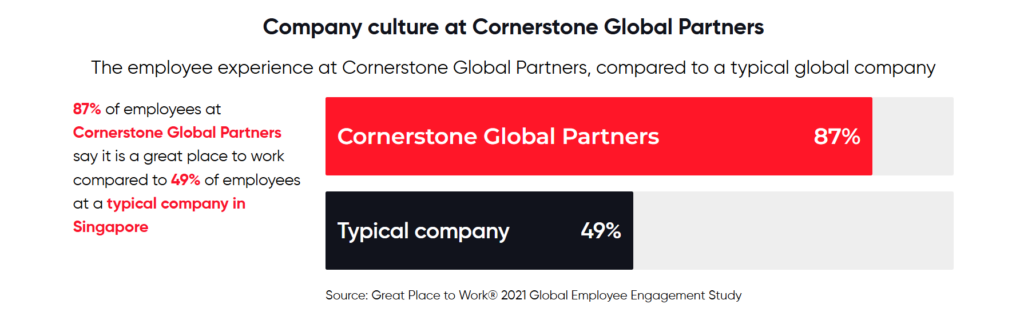
    “Great Place To Work Certification is a highly coveted achievement that requires consistent and intentional dedication to the overall employee experience,” says Sarah Lewis-Kulin, the Vice President of Global Recognition at Great Place To Work. She emphasizes that Certification is the sole official recognition earned by the real-time feedback of employees regarding their company culture. “By successfully earning this recognition, it is evident that our Singapore stands out as one of the top companies to work for, providing a great workplace environment for its employees.”

    According to Great Place To Work research, job seekers are 4.5 times more likely to find a great boss at a Certified great workplace. Additionally, employees at Certified workplaces are 93% more likely to look forward to coming to work, and are twice as likely to be paid fairly, earn a fair share of the company’s profits and have a fair chance at promotion.

    We’re Hiring

    Looking to grow your career at a company that puts its people first? Visit our careers page or LinkedIn!

    Keep up with the CGP Culture

    We’re all about having fun. If you want a taste of the CGP culture, meet us up on our Instagram account @cgp_apac

    About Cornerstone Global Partners

    Cornerstone Global Partners is an award-winning executive search, contingent recruitment, flexible staffing & HR outsourcing firm delivering talent services across SEA. We provide premium human resources and talent services from large multinational corporations to small and medium-sized businesses across mature and emerging markets in Asia. Our team of experts delivers customised talent solutions covering functions including sales, marketing, human resources, accounting & finance, legal & compliance, supply chain, manufacturing, information technology, operations, etc. Our holistic suite of talent services ensures you have the right talent, in the right roles, aligned with your business goals and culture.

    About Great Place to Work Certification™

    Great Place To Work® Certification™ is the most definitive “employer-of-choice” recognition that companies aspire to achieve. It is the only recognition based entirely on what employees report about their workplace experience – specifically, how consistently they experience a high-trust workplace. Great Place to Work Certification is recognized worldwide by employees and employers alike and is the global benchmark for identifying and recognizing outstanding employee experience. Every year, more than 10,000 companies across 60 countries apply to get Great Place To Work-Certified.

    About Great Place To Work®

    As the global authority on workplace culture, Great Place To Work® brings 30 years of groundbreaking research and data to help every place become a great place to work for all. Their proprietary platform and For All™ Model helps companies evaluate the experience of every employee, with exemplary workplaces becoming Great Place To Work Certified™ or receiving recognition on a coveted Best Workplaces™ List.


  • CGP Singapore Commerce Team Hosts Client Appreciation Evening

    CGP Singapore Commerce Team Hosts Client Appreciation Evening

    Annual Client Appreciation Evening

    CGP Singapore’s Commerce recruitment team recently hosted a distinguished client appreciation event, showcasing the company’s commitment to fostering strong partnerships and celebrating mutual successes. The evening, held in collaboration with the renowned Wines and Spirits brand Moët Hennessy, brought together our valued clients from diverse industries, including beauty, travel retail, retail, e-commerce, and FMCG.

    The event provided a platform for networking, camaraderie, and a deep appreciation for the trust and support our clients have extended to CGP Singapore. A highlight of the evening was a guided wine-tasting session led by MJ van Vuuren DipWSET, Wine Estate Director at Moët Hennessy, providing attendees with a deeper understanding of the wines’ origins and profiles.

    cgp partners client annual appreciation dinner 331
    Guests experiencing the nuances of 4 exceptional wines

    As the evening concluded, we reaffirmed our dedication to providing exceptional service and building enduring relationships with our clients. The company looks forward to continuing our journey of growth and collaboration in the years to come.

    CGP Singapore’s Commerce Practice comprises three key functions: Accounting & Finance, Human Resources and Sales, Marketing & Digital. Visit the provided links to learn more about our expertise and get in touch with the team for hiring needs.


  • How To Build Positive Employer Branding Through Social Media?

    How To Build Positive Employer Branding Through Social Media?

    ​For as long as the competitive corporate world has existed, employer branding will play a vital role in dictating business success.  Fundamentally, employer branding is a company’s identity that reflects a well-crafted vision, mission, character, and personality to attract new candidates and retain the existing ones.

    What is Employer Branding?

    Your employer brand is how others perceive your company, including your employees. Whether you realise it or not, every competent leader has the potential to build an employer brand that can leave an indelible mark on the audience’s mind. 

    ​“A strong employer brand can give a company a significant advantage in the war for talent. It can help the company attract top candidates, improve employee engagement, and reduce turnover.”

    In the truest sense, employer branding is a company’s message to the world about who they are and what makes them unique.

    Building a Positive Employer Branding

    A company’s reputation matters more than ever for job seekers, as most of them would not apply for or continue to work for an employer with a bad reputation. In other words, modern-day job hunters prioritise their career development over other factors and, thus, prefer working with high-ranking and respectable employer brands.

    While you spend plenty of time creating a compelling brand story around your products & services, how do you intend to build an employer brand?

    Let us lay a road map for you to make a successful employer brand with social media.​

    From Like to Hires: Role of Social Media

    The most important aspect to understand here is that social media isn’t just about posting job openings and hoping for the best. To be effective, every company needs to develop a strategic social media strategy that aligns with their branding and helps them attract the right talent.

    #1 Attract relevant & competent candidates

    On average, a job opening receives around 250 applications. Out of the received ones, the recruitment team interviews 6-7 candidates and hires the best among them. However, there are chances you may receive applications that do not match your job opening. As a consequence, you may end up losing time going through the not-so-fit resumes.

    Using social media, you can promote your employer brand your way with word-specific targeting. Moreover, you can send out messages through social media networks regarding the qualities you seek in candidates before hiring. Only then can you simplify your employer branding and hiring process. 

    MUST READ: How Can Employers Access a Wider Pool of Talent​

    #2 Approach candidates where they are

    Be it coffee breaks or after-office time, job seekers spend their time scrolling through social media for career development. And this is the opportunity that you must grab to reach out to them. With social media presence, there is a likelihood that job hunters follow your employer brand and stay updated with the latest job openings.

    Furthermore, candidates can directly apply for the job role directly if they get attracted toward the employer brand – a combination of your company’s vision, mission & goals.​

    #3 Engage current employees

    Running a business successfully isn’t all about attracting new talent but also involves retaining the existing ones. So show your current team off to the outside world and the organisation internally. Who knows how your existing employees can source candidates and fill job vacancies?

    For instance, to promote a positive employer brand, you can put up content such as team outings, career development activities, annual award nights, and more. 

    Let’s get started…

    Portray your company as a favourable employer using the tips mentioned below.

    • Establish a tone – Choose a style of your employer brand voice and stay consistent with it. Also, ensure to post regularly and at the right time. Finally, do not forget to keep your tone friendly and one that can set you apart from the competitors.
    • Choose your content smartly – While you may be flooded with content ideas for posting, choosing the right content is upon your wisdom. Furthermore, ensure the pictures and videos you share are consistent with your brand colours.
    • Always be responsive – Your employer branding story must not end with the development of the brand. Instead, it must mark the onward journey of being responsive to your audience and engaging them in various ways.
    • Choose social media networks wisely – Bear in mind that each social media network has different success metrics, and you must choose suitable platforms wisely. More importantly, it is not necessary to utilise all the platforms for employer branding, which means you can select the desired combination. 

    Wrapping Up

    Today’s candidates are digitally savvy, and the only way to reach out to them is through the creation of a strong employer brand. There is no shortage of reasons to promote your employer brand through social media.

    But one question you must answer: How to make continuous & the best use of social media for positive employer branding? Here’s what you can begin with:

    • Start sharing positive employee testimonials and the company’s success stories. 
    • Highlight your company culture and values. 
    • Engage with potential clients on social media

    If you can follow the insights we shared in this blog, you will surely step up your social media game to strengthen your employer brand.

    RELATED READ:

    FAQs

    1. How can social media improve employer branding?

    You need to build a strong employer brand if you wish to attract top talent. Modern organisations make use of social media to develop and improve employer branding. Using social media, employers can communicate who they are and what makes them different from others. In today’s time, job seekers search about organisations before applying for a role, and an organisation with a strong employer brand stands a better chance to hire top talent.

    2. Why is social media good for employers?

    Social media has become a part of everyone’s life. Employers can also use social media to stay visible to job seekers and present themselves as reputable and trustworthy. Additionally, they can let job seekers know what makes them better than other employers. The recruitment team can attract more job applications and hire competent candidates.

  • How To Foster Innovative Thinking In Your Team?

    How To Foster Innovative Thinking In Your Team?

    As a leader, what are the most effective ways to activate your team’s creativity? Well! The answer that must top your list is developing a mindset of curiosity and innovative thinking. And, we are pretty sure you also consider our response apt.

    The business world is growing in a fast-paced environment fueled by new technologies and changing market trends. Businesses that can consistently come up with new and better ways of doing things are the ones that will thrive. Employers must identify opportunities to foster innovation in their teams to keep up-to-date with the dynamic world. However, the question is: how do you bring about innovative thinking among your people?

    To foster creativity and innovation within and across teams, you must create a culture for your workforce to empower them to share their ideas freely. Your role is to let mindsets thrive. To help, we offer insights on cultivating an innovative culture within your organisation.

    Must Read: How Can Employee Engagement Benefit the Company?

    Cultivating Innovative Culture

    #1 Create a supportive and open environment

    Create a safe workplace culture for your team that discourages judgment and encourages idea-sharing. If you build an environment that enables employees to share their ideas and suggestions, you ensure your organisation’s long-term success.

    #2 Keep things fun

    Life is too short to be anything but happy. Likewise, work life is too short to be lived under stress at all times. Therefore, ensure you have a relaxed atmosphere with lots of laughter, a stress-free work schedule, and one that supports creativity.

    #3 Keep toxic workers away

    No matter how healthy your work environment is, things won’t work as expected if you have a few toxic people. So on that note, it is always better to let go of that toxic set of people. As a result, the rest employees will feel psychologically safe.

    #4 Set boundaries

    Boundaries create innovative people. While you may assume freedom is a synonym for innovation, boundaries create innovation. So establish boundaries, let your team know that they exist, and train them to be innovative within those boundaries.

    #5 Embrace experimentation & risk-taking

    Strive to create a collaborative environment that encourages experimentation and risk-taking. Simply put, driving disruption requires a culture that allows employees to learn from failures at work that helps them capitalise on the disruptive potential.

    #6 Promote collaboration

    Unity is strength!

    The phrase applies to the business world, too. Bring together a bunch of smart workers for the generation of new ideas. This way, team building helps employees get introduced to new perspectives and improvise their thinking capacities.

    #7 Invest your confidence

    The most crucial step towards building an innovative workplace culture is investing trust & confidence in your team. Be a leader that cares about your people’s aspirations & feelings and shows complete confidence in their potential to think and work innovatively.

    ALSO READ: Learn how to promote leadership development in your organisation

    #8 Challenge your teams

    Run a drill where employees switch roles with each other for a day. The exercise might take time to bring results, but it helps deepens relationships and boosts team morale. The onus is on you to devise a balanced strategy before undertaking the exercise.

    #9 Recognise & acknowledge

    When an employee comes up with a new and innovative idea, make sure you recognise and acknowledge them. It’s essential for you to make your team members feel recognised for their contribution and receive feedback. This will encourage them to continue thinking outside the box.

    #10 Foster outside-the-box thinking

    Ask your team to come out of their shells and look at other industries to see how they solve problems. In other words, the world around your organisation has a lot to teach, but it is on your team to grasp it at the right time.

    Key Takeaway

    Fostering innovation is a process— it does not happen overnight. So help your organisation stay ahead of the curve by crafting a winning strategy. Certainly, and shortly, you will be on the road to building a workplace culture that will make your employees feel comfortable and think freely.

    About CGP Singapore

    We are a team of the most professional recruiters delivering Executive Search, Contracting, Recruitment Process Outsourcing (RPO), and Human Resources Outsourcing services to multi-national and domestic firms. With over 1000k pre-screened mid- to senior-level candidates in our database, we can assist you in finding the right fit for the vacant positions within your organisation.

    We have won multiple industry awards and recognitions demonstrating our capabilities, dedication, and efforts to deliver the best recruitment products and services to job seekers, clients and partners.

    • 2022 Best Executive Search Firm 2022 (HR Vendors of the Year, Singapore and HK),
    • 2022 Most Popular Recruitment Agency (Fast Jobs Employer Awards, Singapore),
    • 2020-2022 Best Recruitment Portal (HR Vendors of the Year, Singapore),
    • 2020-2022 “Bole” Award of Shanghai Human Resources Service,
    • And more.

    In 2020, the Ministry of Manpower’s HCP (EA) Programme recognised CGP for our efforts around investing in human capital, adopting fair and progressive workplace practices, and helping employers strengthen their Singaporean core. We are one of the first 5 agencies to receive the MARK Award from the Ministry of Manpower.

    If you are looking for talented professionals to help your organisation achieve its goals, contact the experts at Cornerstone Global Partners (CGP) Singapore and access cutting-edge talent.

    Be a one-of-a-kind leader for your company and build a forward-thinking team with us.

    FAQs

    1. How do you encourage innovative thinking in the workplace?

    To encourage innovative thinking in the workplace, leaders must become the most exemplary role models for their teams. Secondly, they must create a safe and healthy workplace culture to enable workers to share their ideas freely. Next, team collaboration must bring brilliant minds together that can work collectively to achieve organisational goals. Also, the organisation must recognise and acknowledge the contributors who share their impactful suggestions and ideas.

    2. What is the best way to foster innovation?

    While there are various ways to foster innovation, the best way is to build an environment that makes its people psychologically safe for idea-sharing. This helps encourage people to come forward and contribute with their ideas without fearing judgment.

  • How To Conduct A Performance Review?

    How To Conduct A Performance Review?

    Employee performance is something your organisation values immensely – and befittingly so. You cannot expect productivity, profitability, and success to knock at your organisation’s door if you don’t have a superlative employee performance review strategy. However, simply caring about your employees’ performance won’t justify your efforts in running your business. This is where employee performance review enters the picture.

    While conducting employee performance reviews provides an opportunity for managers to assess an employee’s performance, identify areas for improvement, and set future goals, these reviews can be difficult to conduct effectively. Doing poorly can lead to resentment, decreased productivity, and even turnover.

    This blog entails the right ways to conduct a performance review. So stay glued to the post for everything you’ve ever wanted to learn about employee evaluation. By following the tips in this blog post, you can conduct performance reviews that help your employees reach their full potential.

    Conducting a Performance Review: How to Make it Successful?

    The Basics

    The temptation to give your employees feedback in one go or just before a review might lead you in the wrong direction. Instead, plan and identify the best time of the year to conduct performance reviews.

    Look for particular processes or schedules that your organisation needs to follow.

    Additionally, consider the budgeting process to determine the right time to hand out bonuses. Finally, make sure to have ample time to dedicate to this activity without hampering the business functions.

    Decide & unveil the employee evaluation process and communicate the same to your employees.

    Let us now proceed toward learning the aspects that can help organisations conduct good performance reviews.

    #1. Set goals & expectations

    The best way to set goals and expectations is to meet with your employees at the beginning of the year and share your vision & mission. This can be followed by meeting the employees one-to-one to set their performance goals.

    Use the SMART rule to map them out.

    S– Specific

    M– Measurable

    A– Achievable

    R– Result-oriented

    T– Time-bound

    #2. Give feedback to employees all throughout the year

    Hold touch-base meetings throughout the year so that the final review in the annual meeting does not come as a surprise to the employees. Therefore, pre-schedule these meetings and plan to conduct them on time.

    Before every meeting, prepare an agenda and discuss the expectations and questions. Post these meetings, and prepare notes for yourself that will serve as a reference for you in the future and help you prepare well for the annual meeting.

    ALSO READ: The Employee Productivity-Happiness Loop: How One Influences the Other

    #3. Ask employees to stay prepared

    Employees’ preparation must begin months before the actual reviews. Simply put, ask them to compile their annual performance results. This will give you a recap of their job responsibilities, current project work, and achievements. You can also ask them to evaluate themselves, which will give them an honest review of their performance.

    #4. Prepare yourself

    Spend at least two months before the final review compiling your notes and results for each employee. Then, collect employee performance references, such as sales reports, project deliveries, and call records. Besides, you can also gather qualitative data like client feedback. The exercise will give you an insight into the deviations between your expectations and employees’ performance, if any. Subsequently, you can move to your next plan of action.

    #5. Hold the meeting

    This is the most challenging part of the process. Ensure the meeting is a two-way conversation rather than making it seem like a lecture to your team members. Employees must stand a fair chance to share their strengths, challenges they have overcome, and areas of improvement.

    #6. Shift toward the future

    Discussing failures and areas of improvement is pertinent to conducting a successful performance review. However, once discussed in detail, you must redirect your focus to the future. Share new goals and your plan to make the employee succeed at work. This will make them feel more valued and ready to step out of their comfort zone to improve their performance.

    ALSO READ: The Connection Between Employee Recognition and Retention

    Summing Up

    Although the employee evaluation process is never fun, it is crucial for increasing employee engagement & improving performance. Great leaders know how to make performance reviews fruitful for the organisation. They know how to make their people feel valued, appreciated, and understood. They put people first and focus on improving performance to see the best employee performance review results.

    Summing up, here are some of the key elements of an effective performance review:

    • Be specific and objective. Avoid making general statements or using subjective language. Instead, focus on specific examples of the employee’s performance.

    • Be constructive and actionable. A performance review aims to help the employee improve their performance. Therefore, your feedback should be constructive and actionable.

    • Be timely. Don’t wait until the end of the year to give feedback. Provide feedback on a regular basis so that the employee has time to make improvements.

    • Be confidential. The performance review should be a confidential conversation between the manager and the employee. Avoid discussing the review with other employees or managers.

    Contact Cornerstone Global Partners (CGP) Singapore to hire stellar employees that can contribute to your company’s success. After all, your organisation deserves to have start candidates on board.

    Catch up on valuable information in case you missed it the first time. Click on the link here:

    Reduce Risk & Identify S.T.A.R Candidates Using Behavioural-Based Interview (BBI) Techniques

    FAQs

    1. How do you conduct a good performance review?

    To conduct a good performance review, there are a few tips managers must follow that are listed as follows:

    • Prepare ahead of time

    • Make the right choice of words and ask the right questions

    • Be a good listener

    • Provide concrete examples of exemplary achievements and areas of improvements

    • Evaluate your employees’ progress

    • Conclude the process with a final review and discuss everything with the employee

    • Make performance reviews a regular exercise

    2. What are the four stages involved when conducting a performance review?

    The four stages of conducting a performance review are:

    • Planning goals

    • Monitoring performance

    • Reviewing results

    • Rewarding success

    3. What are the key benefits of conducting effective performance reviews?

    Some of the common benefits for an organisation to conduct performance reviews include:

    • Improved employee performance

    • Increased employee satisfaction

    • Reduced turnover

    • Clearer communication between managers and employees

    • A more productive workplace

  • The Future Of Work: Preparing For The Changing Landscape Of Employment

    The Future Of Work: Preparing For The Changing Landscape Of Employment

    The world is changing, and so is the way we work. Trends like, artificial intelligence and automation are the stimuli that have spurred a transformation in the work landscape.

    When you think of the future of work, what do you see? Robots in place of human resources? Office setups are entirely different from today, or the absence of physical offices due to adopting remote work?

    While it is impossible to predict the future of work, it is visible that the employment landscape is changing rapidly. Therefore, there is a need for human resources to prepare themselves and adapt to the transition. Presently, the focus is placed on technology in the future of work discussions. However, other factors such as remote work, workplace diversity, and the gig economy also shape the future of work.

    Looking ahead and preparing for the changing world of work can help you maintain a work-life balance.

    So, let’s take a closer look at the tips to prepare you for it.

    #1. Create a professional development plan

    “Planning is bringing the future into the present so that you can do something about it now.”- Alexander Graham Bell.

    Outline your goals and map the route you must take to achieve them. This will allow you to clearly understand your expectations & desires, assess your skills, determine your success route, focus on essential activities, and strategise accordingly.

    smart goal

    Follow the SMART goals rule:

    S– Specific

    M– Measurable

    A– Achievable

    R– Relevant

    T– Time-based

    #2. Evaluate your skills

    Most importantly, for quick adaptation to the future of work, don’t wait. Take control of your profile and strengthen it by working on the weak areas. To make it happen, you must evaluate your skills and identify the areas you lack. As a result, you will be in a better position to work on yourself and add to the skills bucket. Pay careful attention to the skills you lack for your industry, as that will help you choose the right training or mentorship program.

    #3. Explore the redesigning of learning

    The definition of a skilled candidate has changed and is no longer restricted to just micro-learning. Simply put, you must lean into macro-learning to level up and prepare yourself technically and professionally.

    While micro-learning refers to learning small chunks of a larger topic, macro-learning is learning complex skills. Therefore, your professional development plan must include your macro-learning plans.

    #4. Capitalise on next-gen technology

    Changing times demand embracing new, disruptive technologies to prepare for the challenges. The candidates who will be counted among the top talent are the ones who are using technology to prepare for the future of work today. Stay updated on the latest technologies that are impacting the marketplace and leave no stone unturned in leveraging their potential.

    #5. Tap into your passion and become an expert

    Turn your passion into a profession, and work won’t feel like work. Present-day organisations are looking for candidates who are specialists, and the trend will stay forever. So explore your talent and areas of interest that you can take in the future workplace. In other words, plan to dig deep into your passions and take on a specialised role.

    team
    #6. Work on your emotional intelligence

    A majority of people seek answers to the question: How can I prepare myself for the future of work?

    Well! Apart from working on technical aspects, you must also work on skills that fall under emotional intelligence. And they are self-awareness, self-regulation, motivation, empathy, and social skills. Most importantly, you must strive to become a better human and a leader. The skills will get you closer to your team and help you collaborate with colleagues. Moreover, AI and automation can never outsmart the leadership skills a human possesses.

    RELATED READ: The Importance of Emotional Intelligence in Leadership

    Trends for the Future of Work

    The current year and the years ahead are set to see the changed work landscape. Here, we mention the most vital trends you must foresee to handle workplace diversity and changing work environments.

      • Quiet hiring

      • Flexibility for frontline workers

      • Focus on skills rather than candidates’ prior experience

      • Focus on employee well-being

      • Continuous boosting of DEI efforts

    RELATED READ: Diversity and Inclusion in HR: Current Trends and Future Directions

    Final Comments

    A competitive talent landscape and pressure to reduce costs pose challenges for organisations. Given that, companies must start putting the right people in the right place and turn the challenges into opportunities. In addition, enabling a workplace to foster innovation and be inclusive requires leaders to strategize how work gets done.

    You must take charge of your future and upskill yourself to better prepare for the upcoming changes. Whether you are an accounts executive or a data scientist, one thing remains constant: continuous learning & development, reskilling, and upskilling bring job security.

    FAQs

    1. What are the future trends in the workplace?

    The future trends in the workplace are:

      • Flexible hours/four-day working

      • Prioritisation of well-being

      • Focus on skills over jobs

      • The emphasis on soft skills

      • Increased diversity, equity, and inclusion (DEI) efforts

      • Use of AI and automation

      • Transformation of HR using tech and data

      • Focus on employee growth

    2. What are your suggestions for the future of work at the organization?

    The world of work is changing rapidly. Therefore, employers and employees need to be on their toes to adapt to the changing scenario. While employers must plan accordingly to manage the effects of the future of work, employees must focus on upskilling themselves to stay ahead of the curve.

    3. How will the future of work change?

    With the advent of AI and automation, the future of work is changing. However, various other trends will bring about a change in the future of work. For instance, hybrid flexibility will allow frontline workers flexibility, such as what they work, with whom they work, and how they work. Continuous support for DEI initiatives, sensitive offboarding, emphasis on continued employee growth, focus on skills over jobs, and prioritisation of employee well-being are among the other changes that will define the future of work.

  • The Importance Of Emotional Intelligence In Leadership

    The Importance Of Emotional Intelligence In Leadership

    Daniel Goleman, in his book ‘Emotional Intelligence,’ pens that people’s emotional intelligence was more important than their IQ.  People who were well-adjusted emotionally were more likely to have better leadership skills, mental health, and job performance. According to the author, superior EI (Emotional Intelligence) was twice as necessary as the skills and IQ required for completing a job.

    Emotional intelligence is a hot topic that has gained traction in recent years. Furthermore, it accounts for nearly 90 percent of what sets great performers apart from competitors. As a result, many leaders turn to emotional intelligence to analyse the performance of their employees.

    How is that?

    Emotional intelligence in leadership is extremely important as it works toward self-awareness, increases accountability, improves communication, and builds relationships. This blog examines how emotional intelligence can have a substantial impact on leadership. We will also discuss tips on how to improve your emotional intelligence.

    Emotional Intelligence & Leadership: The Importance of Their Synergy

    Emotional intelligence is the ability to comprehend, control, and develop your own feelings while understanding others’ feelings. Due to the growing complexity of society, the need for leaders to create happier and more productive workers has increased.

    Since it does not come naturally to everyone, emotional intelligence can be learned and developed. The good news is that high EI makes you an effective leader and enables you to help others improve their EI. Let us walk you through the results of emotional intelligence in leadership.

    #1. Builds Trustful Relationships

    No one but a leader with high emotional intelligence can understand the importance of building confiding relationships. Unarguably, trust forms the basis for developing any connection. Therefore, it becomes imperative for leaders to create an environment of mutual respect and understanding.

    A leader with high emotional intelligence and interpersonal skills strives to set the tone right and ensures its flow down the hierarchy.

    #2. Enables Leaders to Manage their Own Emotions Better

    Self-awareness is the first step in the direction of controlling emotions. Emotionally intelligent leaders efficiently manage their emotions and get through difficult conversations.

    People who make impulsive decisions or lose control over emotions lose their team’s respect and trust. But on the other hand, effective leader sails through turbulent waters while handling people around them.

    #3. Enables Leaders to Understand Others

    People with high emotional intelligence gauge the emotions of others more accurately. The reason is they have a good understanding of their own mental state. The increased empathy leads to more thoughtful decisions while motivating team members.

    This very characteristic allows the leaders to relate to the organisation and build a rapport with its people. And it results in developing a better understanding among human resources.

    #4. Leads to Collaborative Communication

    Emotional intelligence in leadership develops leaders who understand their coworkers. On that account, emotionally intelligent leaders instantly match the tone and mitigate communications that create tension.

    The world has seen enough leaders who speak with honesty & sincerity, and the credit goes to their emotional quotient.

    #5. Enhances Leadership Decision-making Skills

    Decision-making skills aren’t something you can develop overnight. However, an emotionally intelligent leader determines and analyses all his options before deciding. Simply put, they don’t jump to unplanned conclusions but make informed decisions with both the head and the heart.

    Effective leadership involves leaders incorporating logical reasoning and weighing the impact of their choices on the organisation.

    ALSO READ: How to Promote Leadership Development in Your Organisation?

    Tips to Improve Your Emotional Intelligence

    Let’s examine the aspects you must include to improve your emotional intelligence as a leader.

    • Self-awareness – Become self-aware of your emotions before you begin understanding the emotions of people around you. A better understanding of your emotions will enable you to manage them more efficiently.

    • Manage your reactions – How you react to things is your choice. Pause to think before you take action. This will give you an opportunity to respond in a constructive way that is helpful for others, too.

    • Effective communication – Communicating effectively is the key to becoming an emotionally intelligent leader. Also, try to listen to what others say and respect their opinions. When you understand others’ perspectives, you get to know the other side of the topic in discussion.

    • Practice stress management – Stress is a factor that can impact your decision-making power. Therefore, it is necessary to keep a check on your stress levels. If you feel your stress is worsening, look for ways to rejuvenate yourself or try relaxation techniques to boost your physical and mental power.

    In Summary

    Whatever workplace model your organisation follows, emotional intelligence never fails to nurture efficient leaders. Therefore, relationships thrive when leaders step up to understand their employees and work toward emotional management. The world is living in times of a pragmatic approach toward emotional intelligence to understand what it includes and doesn’t.

    The scientific viewpoint states that emotional intelligence is perceiving emotions— yours and others, and managing them. After all, you would want your employees to feel valued and respected as you create an environment they won’t want to leave.

    Our profession demands professionalism, trust, and reliable service regarding clients and candidates. If you are looking for talented professionals to help your organisation achieve its goals, contact the experts at Cornerstone Global Partners (CGP) Singapore and access cutting-edge talent.

    Be a one-of-a-kind leader for your company and build a forward-thinking team with us.

    RELATED READ:

    FAQs

    1. What is emotional intelligence in leadership?

    Emotional intelligence is the ability to understand and manage one’s emotions and recognise others’ emotions. It comprises empathy, social skills, self-awareness, self-regulation, and motivation. Developing emotional intelligence makes one a better leader and ensures one gets the most out of their team.

    2. What is the importance of emotional intelligence?

    Emotional intelligence is the ability to recognise and manage your emotions and understand other people’s emotions and perspectives. Emotional intelligence is essential because it allows a person to manage his emotions better and make informed decisions in his personal and professional life.

    3. How can emotional intelligence make leaders more effective?

    An emotionally intelligent person can make informed decisions as he thinks before taking any step. Moreover, developing emotional intelligence lets a person control his emotions without making decisions in haste. As a result, the person becomes a better and an effective leader who can guide the organisation in the right direction. In other words, an emotionally intelligent person is:

    • Self-aware

    • Better decision maker

    • Empathetic

    • Good listener

    • Careful of his reactions

  • Diversity And Inclusion In HR: Current Trends And Future Directions

    Diversity and inclusion in the workplace are no longer ‘nice to have’ components of an organisation. Veritably, D&I has become the ‘must have’ part of businesses worldwide. As a result, promoting workplace diversity and inclusion ranks among the top HR functions.

    Why is that?

    Deloitte research says Diversity + inclusion = better business outcomes. Simply put, diversity and inclusion are better together and aren’t enough without each other. As a result, more companies are taking affirmative steps toward diversity and inclusion. Altogether, it leads to creating inclusive workspaces where employees feel appreciated, regardless of their diversity. Nonetheless, times change and the newest trends redefine diversity and inclusion yearly. So let us look at the current trends and future directions that rule the current year.

    Current Diversity & Inclusion Trends

    #1. Remote work

    Most remote workers confirmed they are more productive when working from home. Fortunately, remote work holds the capacity to harness the essence of diversity. Organisations can hire top talent without geographical obstacles, making them more inclusive and diverse. In other words, breaking the chains of geography lets companies build teams as varied as their customer base.

    Admittedly, the work-from-home trend is here to stay for a long time and remains part of businesses’ diversity and inclusion practices.

    ALSO READ: 5 Ways to Cultivate Inclusion in Your Organization​

    #2. Cross-generational workforce

    The current workforce consists of people coming from five different generations.

    • The Silent Generation (born between 1928-45)

    • The Baby Boomers (born between 1946-64)

    • Generation X (born between 1965-1980)

    • Millennials or Generation Y (born between 1981-96)

    • The newest generation, Generation Z (born in and after 1997)

    People from different generations bring different experiences, values, and skill sets to the organisation. Moreover, the recruiting strategy of any present-day employer is to hire people from distinct backgrounds, resulting in workplace diversity.​

    #3. Supporting gender identity

    Globally, organisations are trying to open new frontiers to expand inclusion policies. For example, some have gone further by giving people access to gender-neutral restrooms and health benefits for transitioning individuals.

    It is easier for diverse companies to achieve their organisational goals because they involve an equal ratio of men and women, including transgender people.

    RELATED READ: Cornerstone Global Partners Singapore Adopts 8 Tripartite Standards

    #4. Unconscious bias training

    While people love being authentic at work, which makes them more confident & happier, a few experience bias. Employees who try to be authentic are sometimes not treated with dignity and respect. However, diversity and inclusion lead to the implementation of unconscious bias training. As a result, the training helps ensure that all employees receive training and treat each other respectfully.​

    #5. Structural change

    With D&I becoming a part of HR functions, organisations must gear up for some pervasive changes. To support transformation, business leaders must keep a check on any discrimination and take necessary actions to make the workplace safe for everyone.​

    #6. Use of AI-powered tools

    The need to source many candidates and hire top talent always remains high. But on the other hand, employees also evaluate potential employers based on workplace diversity. With AI-powered tools, employees can reduce bias in the selection process and thus make the workplace diverse and inclusive.

    RELATED READ: An Era of Smart Recruitment with Technology​

    Diversity & Inclusion in HR: Future Directions

    The “on-trend” function of HR is to work on making the workplace diverse and inclusive. Furthermore, it is estimated that the trend won’t decrease as more organizations embrace diversity and inclusion.

    A global survey by Intel interviewed 3,136 business leaders across 17 countries. Of the total respondents, 63% said that the pandemic positively impacted D&I in their organisation. Since then, organisations have only seen an upward trend in sustaining D&I efforts. So, what is going to be different in the times ahead?

    #1. Creation of a more regulated workplace

    Having a diverse workforce won’t do the work alone and requires the attention of regulatory bodies accordingly. Simply put, a fundamental change in organisations and communities would come only after the regulatory mandates are made.

    #2. Implementation of DEI strategy

    Organisations must form a business strategy to check the hidden factors impacting the process. Creating a D&I culture can happen only if you focus on building a DEI strategy rather than hiring diverse candidates. Over time, the world will see a growing momentum for devising DEI strategy.

    #3. Re-engineering employee experience

    In today’s workforce, employees wield significant influence over brands and enjoy more options for employment than ever before. Organizations are increasingly realizing that fostering diversity and inclusion not only enhances individuals’ sense of belonging, but also promotes fairness for all. As a result, prioritizing diversity and inclusion should not be seen as a mere formality for organizations, but rather as a fundamental aspect ingrained in an organization’s core values, as it aligns with the principles of doing what is right.

    Winding Up

    As financial gains are becoming a regular part of companies with a strong D&I program, it requires a change in corporate culture. It should be reiterated that implementing D&I practices is not just a publicity stunt and can backfire if left unplanned. The point is organisations must not become mere trend followers but should adopt a proactive approach to integrate D&I into the company culture.

    Let us end this by noting that a diverse and inclusive work culture makes happy employees. And, organisations with happy employees can attain great retention rate as well as attract top talent.

    Get in Touch for Talent Needs

    If you are looking to hire or you are someone looking for the next steps in your career, drop us a message. Your next promising career move could be just a click away. With one right decision of engaging the most reliable team of recruiters, your hiring process can become hassle-free.

    KNOW MORE​

    FAQs

    1. What are the future HR trends in HRM?

    The future HR trends in HRM are:

    • Setting an employee-centric flexible work model including a mix of in-office and remote work.

    • “Human” leadership

    • Metaverse workplace offering virtual reality environments

    • Change management

    • People analytics

    • The transition from employee well-being to a healthy organisation

    • Diversity, equity, and inclusion

    2. What is diversity and inclusion in HR?

    Diversity & Inclusion (D&I) is more than just policies and deals with qualities, experiences, and work styles that make individuals unique. The basis includes age, religion, and ethnicity. It is a function of an organisation and a subfunction within the HR function.

    3. How do diversity and inclusion affect HR?

    A diverse and inclusive workplace makes everyone feel involved and supported in all workplace areas, irrespective of who they are or where they come from. Diversity and inclusion affect human resources functions and how the HR department interacts with the staff. Moreover, managing a diverse team can sometimes become complicated and places much responsibility on HR.

  • The Connection Between Employee Recognition And Retention

    The Connection Between Employee Recognition And Retention

    Employee recognition has never been more critical than today, owing to the current marketplace scenario. Considering the knock-on effect of the Great Resignation and “quiet quitting,” human resources teams have started prioritising employee recognition.

    It is essential for employers to:

    • Recognise employers for their contributions

    • Make them feel connected to their work, and

    • Boost morale

    But what benefit would it do? Precisely, the collective energy of these factors leads to employee retention. This blog lays out the connection between employee recognition and retention.

    Before we proceed, if your organisation isn’t still aware of the potential of an employee recognition program or looking to optimize your current strategy, read our previous blog to understand How to Build an Employee Recognition Program that Inspires and Motivates.

    Employee Recognition: What it is & its importance?

    Recognising employees is acknowledging and letting your staff know their work and contributions are appreciated. Moreover, it aims to make the workplace feel more engaging and inclusive.

    You will be closer to realising your team’s full potential if you acknowledge their work regularly. And this act would result in employees staying loyal to the organisation.

    A little recognition goes a long way, and you’ll find:

    • Happier team

    • Motivated & highly competent employees

    • Increased employee retention

    However, they will likely lose interest if someone doesn’t feel appreciated while performing their job. Adding more to the woes, it’s hard for employees to gain a sense of accomplishment and value in their work.

    Connection Between Employee Recognition & Retention

    A recent Great Place To Work survey found that employee recognition was most important to 37% of employees. In addition, teams scoring in the top 20% of engagement experience 59% fewer turnovers.

    Unfortunately, a good number of organisations still fail to recognise their employees. As a consequence, people cease to give their best output. On the contrary, if employees are satisfied with their jobs, they become more enthusiastic about their work.

    RELATED READ: The Employee Productivity-Happiness Loop: How One Influences the Other

    A culture of periodic recognition and small gestures goes a long way and facilitates retaining top talent. Understand it with an example:

    George works at XYZ organisation and works toward fulfilling his personal growth and organisational goals. Additionally, he takes charge of giving his best and motivates his team to do the same. However, his Manager, Jenny, never recognises his efforts and performance and dismisses his ideas publicly. But she tries incorporating those ideas into her team’s functions under her name. George initially tries communicating his issues to Jenny but starts losing interest. Consequently, he takes leaves and ignores what is being done as a team. On top, he starts seeking better job opportunities. 

    What do you infer from the example? Without any doubt, the organisation won’t be able to retain George. So, here employee retention is directly proportional to the recognition George gets. The higher the appreciation and praise, the better it is for employers and employees.​

    Tips to Make Employee Recognition Programs Effective for Better Retention

    #1. Be specific and clear

    Employees always relate to meaningful recognition that is tied to a specific accomplishment. For instance, hitting a sales benchmark can be considered a metric to measure performance. This approach will motivate them to repeat appreciated behaviours to perform better.

    #2. Be creative

    Appreciation should go beyond just thanking an employee for their performance. Think creatively and understand what appreciation means to your people. More importantly, it should not only include cash rewards. You must understand what matters the most to your employees and devise a program. For example, employees can be rewarded with opportunities to upskill themselves through online courses, mentorship programs, or networking events.

    Alternatively, you can offer them to work flexibly or give them an extra day off to spend with their family. The market also sees organisations providing discount coupons or membership cards.

    #3. Be consistent

    Act promptly. Don’t wait for the year-end event to recognise your employees for a thing they achieved six months back. Mainly, recognition seems more meaningful to employees when given in time. Ensure appreciating great performers timely by having formal systems in place, and you will never have to let go of a star employee abruptly.​

    Conclusion

    The importance of employee recognition boils down to the need for one-on-one connection. Admittedly, sustaining a culture of recognition fosters employee retention.

    Tom Rath, an American consultant on employee engagement, strengths, and well-being and author, spoke about the potential of employee recognition.

    Employees who report receiving recognition and praise within the last seven days show increased productivity, get higher scores from customers, and have better safety records. They’re just more engaged at work.

    Employee recognition isn’t a single-stage function— it’s a company-wide strategy for everyone.

    Repeat after us:

    Recognise. Acknowledge. Celebrate the differences in each other. Foster a harmonious workplace.

    ALSO READ:

    FAQs

    1. Why is employee recognition important for retention?

    Recognition is an effective way to retain employees. Organisations that recognise their people’s roles and performance will likely have highly motivated and passionate employees. Recognised employees are happier and stick around for an extended period. Therefore, employers can expect their businesses to operate smoothly and make profits.

    2. How can an organization recognize and retain its employees?

    The best methods for organisations to recognise and retain their employees are:

    • Allow employees to speak their minds

    • Show appreciation & respect

    • Encourage input and feedback

    • Identify high performers and appreciate them

    • Don’t micromanage

    • Offer growth opportunities to the employees

    • Provide flexibility

  • The Employee Productivity-Happiness Loop: How One Influences The Other

    The Employee Productivity-Happiness Loop: How One Influences The Other

    ​Employee happiness has increasingly become an imperative in business. Forbes published certain statistics that revealed happy employees are as much as 20% more productive in the workplace than unhappy employees.

    Indeed, employees’ happiness is the key to unlocking productivity and letting it spread across the organisation. Promoting workplace happiness benefits organisations in several ways, including:

    • Higher creativity levels

    • More energetic individuals

    • Better output

    • Reduced burnout

    • Increased employee retention rates

    The happy attitude of the employees can turn your average profit-making organisation into a highly profitable venture. The reason is the link between employee happiness and productivity, which translates into better work and customer service.

    No magic trick is involved; let’s explore how employee productivity is directly proportional to the employees’ happiness level.​

    How does employee happiness impact productivity?

    Employee happiness brings significant transformation in the organisational setup and boosts productivity levels. Here is how happy employees are more productive and the benefits they bring to the company.

    #1. Happy employees foster meaningful relationships

    Meaningful relationships boost employee engagement by over 50%. When employees are happy, they are generally more engaged and motivated in their work, which can lead to improved performance and productivity. Additionally, when employees have positive relationships with their colleagues, they are more likely to feel supported and valued in their work, which can help to create a more positive and collaborative work environment. Therefore, organisations see higher productivity levels among their employees.

    Building meaningful relationships in the workplace can also help to foster a sense of community and belonging, which can be particularly important for remote or distributed teams who may not have the opportunity to interact in person on a regular basis. By creating opportunities for employees to connect with one another and form meaningful relationships, organizations can help to promote a more positive and supportive workplace culture.​

    #2. Happy employees are quite creative

    Certainly, No modern business can run smoothly without creative people!

    A clearer headspace lets employees generate innovative ideas and utilise them for organisational benefits. Research has shown that happy employees are more likely to engage in creative problem-solving and innovative thinking. For example, a study published in the Journal of Organizational Behavior found that employees who reported higher levels of happiness and well-being were more likely to engage in creative problem-solving at work.

    Additionally, they can confidently share their point of view and bring their best version to the workplace. And when their creativity is at its best, employee productivity will never cease to grow.

    Overall, employee happiness fosters a positive work environment that supports employee happiness and well-being. By doing so, organizations can help to promote greater creativity and innovation, which can be critical for success in today’s rapidly changing and competitive business landscape.​

    #3. Happy employees attract new talent

    Happy employees can be a valuable asset for organizations looking to attract new talent in several ways:

    • Positive Word-of-Mouth: When employees are happy and satisfied with their work, they are more likely to speak positively about their experiences to others, including potential new hires.
    • Referrals: Happy employees may be more likely to refer friends, family, or colleagues to open positions within the organization. Referrals can be a highly effective way to find new talent, as candidates who are referred by current employees are often more likely to be a good fit for the organization’s culture and values.
    • Employer Branding: Happy employees can also be an important part of an organization’s employer branding efforts. By highlighting the positive experiences of current employees through social media, marketing campaigns, and other channels, organizations can help to create a strong and attractive employer brand that can help to attract top talent.
    • Reduced Turnover: When employees are happy and satisfied with their work, they are less likely to leave the organization. This can help to reduce turnover and the associated costs of recruiting and training new employees, which can be attractive to potential new hires who are looking for a stable and supportive work environment.

    By investing in employee happiness, organizations can build a strong employer brand and reputation that can help to attract new talent and support long-term success.​

    #4. Happy employees are more engaged

    Engagement and happiness go hand in hand. Simply put, happier employees are more engaged and passionate toward their work. They strive to excel at everything they do, which converts into higher ownership of their growth. As a result, employers drive benefits from engaged employees who bring energy to their jobs.

    Research has shown that happy employees are more likely to be engaged in their work. For example, a study published in the Harvard Business Review found that employees who reported higher levels of happiness were more likely to be engaged in their jobs, as well as more likely to be productive and satisfied with their work.

    There are several reasons why happy employees may be more engaged. They are:

    • Generally more motivated and enthusiastic about their work.
    • More likely to feel a sense of connection and purpose in their work.
    • Likely to be highly engaged and productive, which can contribute to greater job satisfaction and overall well-being.

    #5. Happy employees possess more vital interpersonal skills

    Employers, co-workers, and customers find interaction with happy employees pleasant. Moreover, interpersonal skills help to facilitate effective communication and collaboration in the workplace where happy employees are:

    • More likely to be empathetic towards their colleagues and coworkers
    • Likely to be effective communicators
    • Better able to manage their own emotions and reactions
    • Efficient at resolving conflicts

    By investing in employee happiness and well-being, organizations can help to build a strong and cohesive team that is better able to achieve its goals and succeed over the long term. Motivated employees fuel the employers’ vested interest in the organisation’s financial growth with their productive work.​

    #6. Happy employees are healthier

    An employee’s physical health impacts organisational success. Visibly, happier employees bask in the glory of good health and deliver their best. They have positive attitudes and a sense of purpose in their work, which can contribute to greater overall life satisfaction and well-being. This, in turn, can have a positive impact on physical health.

    The motive behind present-day organisations prioritising their workforce’s mental and physical health is to increase productivity. Ultimately, with increasing productivity come better results for the company.​

    Tips for Building Happiness Among Your Team

    Building happiness among your team can be a challenging task, but it is also an essential one if you want to create a positive and productive work environment. Here are some key tips for building happiness among your team:

    1. Promote work-life balance – Employees deserve the opportunity to spend quality time with their family & friends. This will reduce burnout and absenteeism from work for general well-being reasons.

    2. Invest in employees’ professional growth – A company that invests in its employees’ professional growth is more likely to retain workers. You can offer them online courses to help them upgrade their skills and grow within the company.

    3. Develop an inclusive workplace – Work toward DEI (diversity, equality, and inclusion) goals by employing people from different cultures, creeds, and religions. On top of that, it must also include the prevention of discrimination based on physical abilities.

    4. Offer remote and hybrid working – A remote or hybrid working arrangement creates a better work-life balance. If you can offer your employees the freedom to work remotely and come to the office on pre-determined days, they will stick longer. But plan before you choose the suitable model.

    5. Recognise & celebrate their success – You must recognise and celebrate your team’s efforts instantly and without delay till the annual event. For instance, managers can thank their team members by gifting them goodies or taking them for a team lunch.

    6. Provide non-monetary benefits – Consider providing non-monetary benefits such as one-on-one lunch with team members or extra leave. While you can offer numerous non-monetary rewards to your employees, choose them wisely to suit your corporate setup.

    In summary

    Are your employees happy? Are you satisfied with the way your organisation is progressing toward its goals?

    Consider the options and implement the righteous strategies to infuse more happiness into your organisation. The current trends reveal workers turning down higher-paying jobs for more fulfilling ones. And this is what every company needs to identify and address wisely.

    Considering the path to employee happiness to be a straight line can downturn your functions. However, creating a unique employee happiness and wellness plan can make a difference. As the word spreads, more people will want to work with you.

    FAQs

    1. Why is employee happiness important?

    Happy employees always bring better output because of increased productivity. In other words, employee productivity is directly proportional to how happy the employees are in the organisation. A company that values its employees’ happiness gets employee loyalty in return and, thus, better customer service. A happy workforce exhibits:

    • Higher productivity levels

    • Reduced burnout

    • Less absenteeism

    • Enhanced creativity levels

    2. What factors contribute to employee happiness in the workplace?

    Factors that contribute to employee happiness in the workplace are:

    • Meaningful work

    • Employee empowerment

    • Feedback, recognition, and growth

    • Coworker relationships

    • Organisational trust

    • Work-life balance